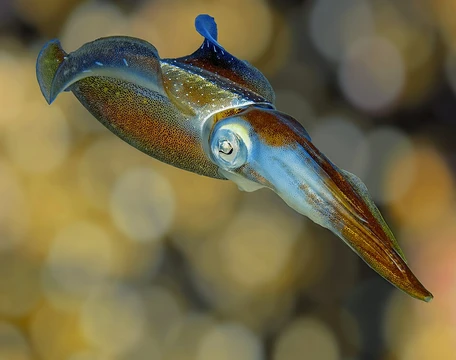
Octopus bocki
A small octopus with complex neurology and pain-processing evidence.

Octopus bocki, also known as the Bock's pygmy octopus, is a species of octopus found near south Pacific islands such as Fiji, the Philippines, and Moorea, where it hides in coral rubble. It is notable for being among the most intelligent invertebrates and for providing strong evidence of advanced cognitive processing related to pain, making it a subject of intelligence research.
Quick Facts
- Genus
- Octopus
- Species
- bocki
Facts from the source article.
Lore & Background
Octopus bocki are multicellular, bilaterally symmetrical organisms with complex auditory, visual, and nervous systems. They use lens eyes for sight and statocysts for auditory information, and possess a large brain relative to body size, though they have poor circulatory and digestive systems. Their blood pigment, hemocyanin, is inefficient at oxygen transport, and digestion takes 18–24 hours due to a secretion-absorption cycle. The species shows sexual dimorphism with females larger than males, and reproduction occurs year-round via internal fertilization. Larvae are planktonic before becoming benthic adults. Between life stages, color patterns differ: juveniles and sub-adults have less developed chromatophores, while adults display greater diversity in color and pattern for intraspecific communication. Both juveniles and adults use chromatophores for predatory defense, and they release a mucus and ink mixture in interactions with predators and other octopuses. Following ink release in response to predation, they jet away and change color from dark brown to light cream, a behavior known as the 'Blanch-Ink-Jet Maneuver.'
Reader's Guide
Octopus bocki holds significance in cephalopod research due to its advanced neurology and cognitive abilities. As members of Cephalopoda, octopuses are among the most intelligent invertebrates, with brains comparable in complexity and relative size to those of vertebrates, likely a result of convergent evolution. Among cephalopods, octopuses appear to have the most complex neurology, though it is not fully understood. Bock's pygmy octopus has been used in studies that supplied evidence for the delivery and processing of pain information: experimentally injured individuals learned to avoid previously preferred chambers and began to prefer a chamber where they received pain relief, suggesting they may experience pain rather than just respond to it. This makes them the only invertebrate species that has provided strong evidence for advanced cognitive processing in relation to pain. Their use of ink in predator reactions follows the 'Blanch-Ink-Jet Maneuver,' and their chromatophore-based communication is more developed in adults for intraspecific interactions. These characteristics underscore their value for intelligence research and understanding invertebrate cognition.
Did You Know?
- Octopus bocki can grow up to 10 cm in size.
- They are nocturnal and use camouflage as their primary defense.
- Females are larger than males, showing sexual dimorphism.
- They are the only invertebrate species with strong evidence for advanced cognitive processing related to pain.
More in Reef Cephalopods 1-24
Spotted an error? Know more?
Reader corrections go straight into our review queue. Suggest an edit · How this site is sourced