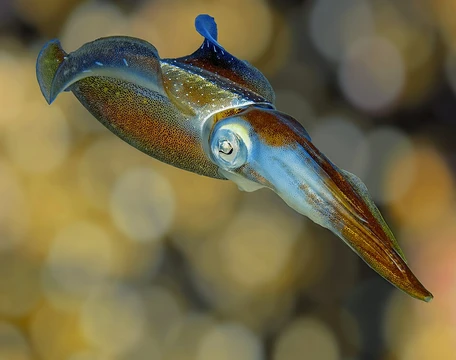
Mimic octopus
A cephalopod that impersonates multiple marine animals to evade predators.

The mimic octopus (Thaumoctopus mimicus) lives in the Indo-Pacific and, like other octopuses, can change color using chromatophores. What makes it special is its ability to impersonate many different marine animals. Most creatures that mimic do so to hide from predators, but the mimic octopus and its close relative, the wunderpus, are the only ones known to actively imitate several different species to avoid being eaten.
This octopus is relatively small, reaching about 60 centimeters (2 feet) in total length, with arms about as wide as a pencil. It has small horns above each eye. Its natural color is light brown or beige, but it often displays bold white and brown stripes to scare off predators by mimicking poisonous animals. DNA analysis suggests that its long arms and flatfish-like swimming ability evolved together, allowing it to change to a striking color pattern while swimming like a flatfish when hunting or resting.
First discovered in 1998 off the coast of Sulawesi, Indonesia, at the bottom of a muddy river mouth, the mimic octopus is now known to range across the Indo-Pacific, from the Red Sea and Gulf of Oman to New Caledonia, and from the Gulf of Thailand and the Philippines down to the Great Barrier Reef. Most sightings have been in Indonesia. It lives mainly in sandy or silty areas at depths less than 15 meters (49 feet).
To find food—mostly small fish, crabs, and worms—the mimic octopus shoots a jet of water through its funnel to glide over the sand. It prefers river mouths and estuaries rather than the reefs where other octopuses often shelter.
Scientists have observed it mimicking many different animals, some more often than others. It imitates a lionfish by spreading its arms out like spines, a sea snake by hiding six arms and holding the remaining two parallel, a jellyfish by inflating its mantle and trailing its arms behind, and a zebra sole by holding all eight arms behind while swimming with its siphon. Flatfish mimicry may be its favorite; a 2008 study recorded nearly 500 instances of flatfish imitation by a single octopus over five days. It uses this ability not only to avoid predators but also for aggressive mimicry—for example, pretending to be a crab to lure wary prey. It has also been seen mimicking sessile animals like small sponges, tube worm tubes, or colonial tunicates.
Quick Facts
- Genus
- Thaumoctopus
- Species
- mimicus
Facts from the source article.
Lore & Background
The mimic octopus was first discovered off the coast of Sulawesi, Indonesia in 1998 on the bottom of a muddy river mouth. It has since been found to inhabit the Indo-Pacific, ranging from the Red Sea and Gulf of Oman in the west to New Caledonia in the east, and Gulf of Thailand and the Philippines in the north to the Great Barrier Reef in the south. Most documented observations are from Indonesia. It is primarily found in areas with sand or silt at depths of less than 15 m (49 ft).
The mimic octopus is a smaller octopus, growing to a total length of about 60 cm (2 ft), including arms, with a diameter approximately that of a pencil at their widest. Small horns protrude from each eye. The octopus' natural color is light brown/beige, but it usually takes on a more noticeable hue of striped white and brown to scare off predators by imitating poisonous species. According to DNA sequence analysis, the second evolved trait was the simultaneous development of its lengthy arms and its flatfish-like swimming ability.
Mimic octopuses have been observed mimicking numerous different species of animals, some animals being mimicked more often than others. Among the animals mimicked are lionfish, sea snake, jellyfish, and zebra sole. The octopus' mimicry of flatfish may be its preferred guise; a 2008 study showed that over a period of 5 days, nearly 500 instances of flatfish mimicry were seen by a single individual. Not only does the mimic octopus use its ability to defend against predators, it also uses aggressive mimicry to approach wary prey, for example by mimicking a crab as an apparent mate.
Reader's Guide
The mimic octopus stands out from other octopus species because of its extraordinary ability to mimic and imitate a wide variety of species. Most species that are able to mimic can only mimic a single animal, whereas the mimic octopus can switch between various disguises: up to 18 different marine animals. They do this not by just changing their color, but also their shape and behavior. The octopus may be able to intelligently use its mimicry based on the situation; for example, a mimic octopus which was being harassed by damselfish mimicked a banded sea snake, a known damselfish predator. The mimic octopus has also been observed in opportunistic mimicry with a jawfish. Its significance lies in being one of only two known animals (along with the wunderpus) that actively imitate several animals to elude predators, demonstrating a level of behavioral flexibility and intelligence that is rare among invertebrates. The mimic octopus retains its ability to camouflage with its surroundings while swimming, and they are also able to do this even when not swimming. While colorblind, their bodies are quite reflective, which is what allows them to blend in with their surroundings, such as sand, coral, rocks and algae.
Did You Know?
- The mimic octopus can impersonate up to 18 different marine animals.
- It uses aggressive mimicry, such as mimicking a crab as an apparent mate, to approach wary prey.
- A 2008 study recorded nearly 500 instances of flatfish mimicry by a single individual over 5 days.
More in Reef Cephalopods 1-24
Spotted an error? Know more?
Reader corrections go straight into our review queue. Suggest an edit · How this site is sourced