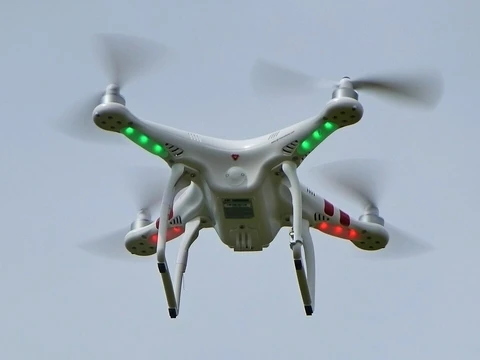
Skydio 2
American compact quadcopter with autonomous flight and obstacle avoidance.

The Skydio 2 is an American compact quadcopter drone produced by Skydio, released in October 2019. It is notable for its advanced obstacle avoidance system and fully autonomous flight capabilities, competing with Chinese drones such as the DJI Mavic until Skydio withdrew from the consumer market in 2023, though production continued for enterprise customers.
- Release date
- October 2019
- Country of origin
- United States
- Flight time
- 23 minutes (Skydio 2); 27 minutes (Skydio 2+)
- Maximum speed
- 36 mph
- Maximum wireless range
- 3.5 km (Skydio 2); 6 km (Skydio 2+)
- Battery capacity
- 4280 mAh (Skydio 2); increased by 20% (Skydio 2+)
- Main camera
- 4K video at 60 fps, gimbal stabilized
Lore & Background
The Skydio 2 was released in October 2019 at a much lower price than its predecessor, the Skydio R1. It featured a smaller form factor, though it did not fold like some competing models, and an improved obstacle avoidance system using six 4K navigation cameras instead of the R1's twelve. The drone was fully autonomous but could be controlled manually via the Skydio app (200 m range), an optional beacon (1.5 km range), or a remote controller (3.5 km range). It was powered by an NVIDIA Jetson TX2 embedded computing board, enabling it to track up to 10 objects while flying at 36 mph. Reviewers in PCMag praised the obstacle avoidance but criticized the camera quality and wireless range; DIYPhotography noted that the Skydio 2's top speed and range fell short of the competing DJI Mavic 2.
In January 2022, Skydio announced the Skydio 2+, an improved version that addressed range issues by adding two 5GHz WiFi antennas on top of the front arms, increasing range to 3 km with a beacon or 6 km with a controller. Battery capacity was increased by 20%, raising flight time to 27 minutes. In August 2023, Skydio pulled out of the consumer drone business to focus on enterprise customers, including the Skydio 2+ and Skydio X2. Flying called the decision "unexpected," noting the company was reportedly losing money with each consumer sale.
The Chula Vista Police Department became the first law enforcement operator of the Skydio 2 in December 2019. A variant called the Trinetra S was produced in India by AeroArc.
Reader's Guide
The Skydio 2 represents a significant shift in Skydio's strategy, moving from the expensive Skydio R1 to a more competitively priced compact drone that could challenge established consumer models like the DJI Mavic. Its key differentiator was a sophisticated obstacle avoidance system using six 4K navigation cameras and an NVIDIA Jetson TX2 computing board, enabling autonomous tracking of multiple objects at speed. However, the drone faced criticism for its camera quality and wireless range compared to competitors, leading to the Skydio 2+ update in January 2022 that doubled the controller range and improved flight time. The company's unexpected withdrawal from the consumer market in August 2023, reportedly due to financial losses on each sale, ended its direct competition with consumer drones but ensured continued production for enterprise customers. The Skydio 2's legacy lies in demonstrating advanced autonomous capabilities in a compact form, influencing enterprise drone applications and law enforcement adoption, as seen with the Chula Vista Police Department.
Did You Know?
- The Skydio 2 uses six 4K navigation cameras for obstacle avoidance, down from twelve on the Skydio R1.
- The Skydio 2+ added two 5GHz WiFi antennas to increase range to 6 km with a controller.
More in Quadcopters and Multirotor Drones 1-23
Spotted an error? Know more?
Reader corrections go straight into our review queue. Suggest an edit · How this site is sourced