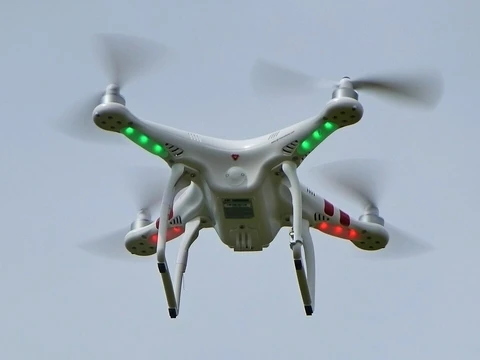
Quadcopter
A four-rotor aircraft made practical by modern drone technology.

Mais Jamal, Youshaa Murhij, Zain Alabiden Ali · CC BY-SA 4.0
A quadcopter—also known as a quadrocopter or quadrotor—is a rotorcraft with four rotors. For a long time, this design was mostly an experimental oddity, seen in early quadrotor helicopters and convertiplanes. It wasn't until the rise of modern drones that the configuration became practical. Because drones are small and have low inertia, they can use a very simple flight control system, which made small quadrotors much more viable.
Each rotor generates lift, torque around its center, and drag opposing the direction of flight. Typically, two rotors spin clockwise and two spin counterclockwise. To control the vehicle, the speed of each rotor is adjusted independently, changing both lift and torque. Pitch and roll are managed by shifting the net center of thrust, while yaw is controlled by altering the net torque. Unlike conventional helicopters, quadcopters usually lack cyclic pitch control, where blade angles change dynamically as they rotate.
Early quadcopters (then called quadrotors or simply helicopters) were seen as a way to solve persistent problems in vertical flight. Counter-rotation eliminates torque-related control issues and the inefficiency of a tail rotor, which produces no useful lift. The short blades were also easier to build. Several manned designs appeared in the 1920s and 1930s, and these were among the first successful heavier-than-air VTOL vehicles. However, early prototypes performed poorly, and later ones demanded too much from pilots due to weak stability augmentation and limited control authority.
When all four rotors spin at the same speed—two clockwise, two counterclockwise—the net yaw torque is zero, so no tail rotor is needed. Yaw is created by unbalancing the aerodynamic torques, for instance by offsetting thrust commands between the counter-rotating pairs. Quadcopters are subject to normal rotorcraft aerodynamics, including the vortex ring state.
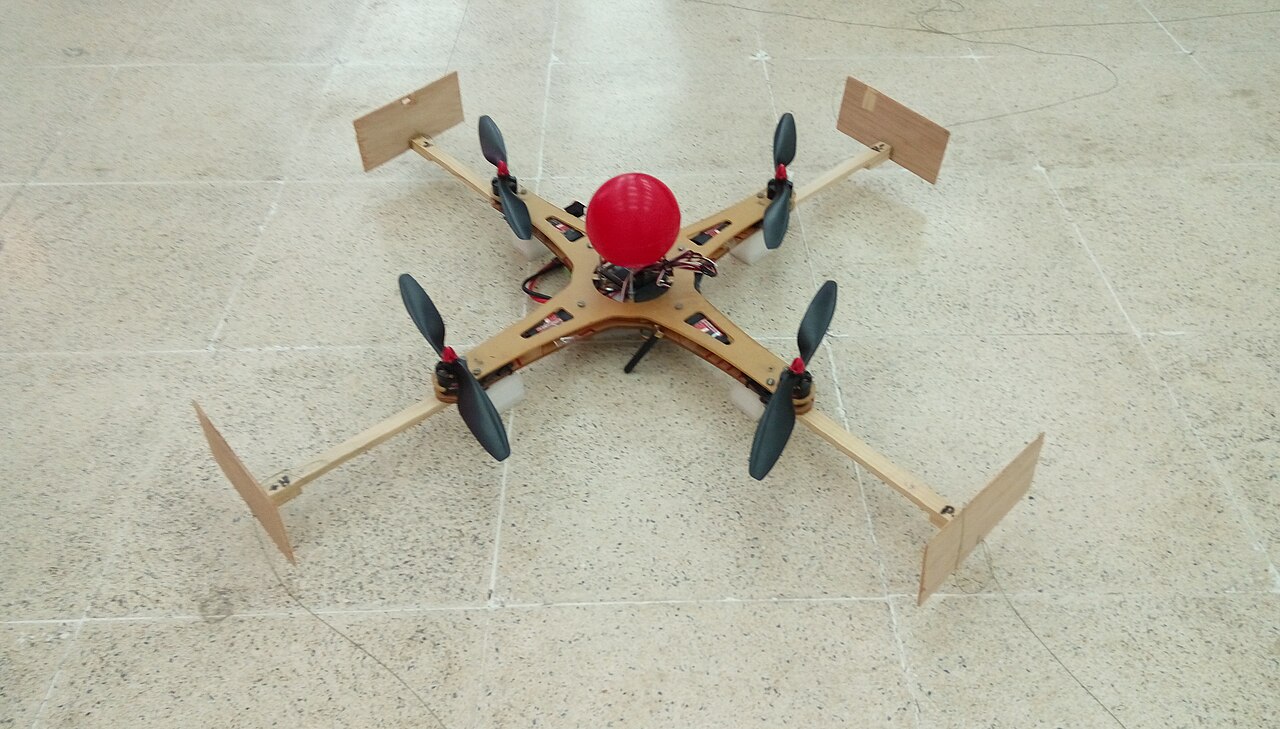
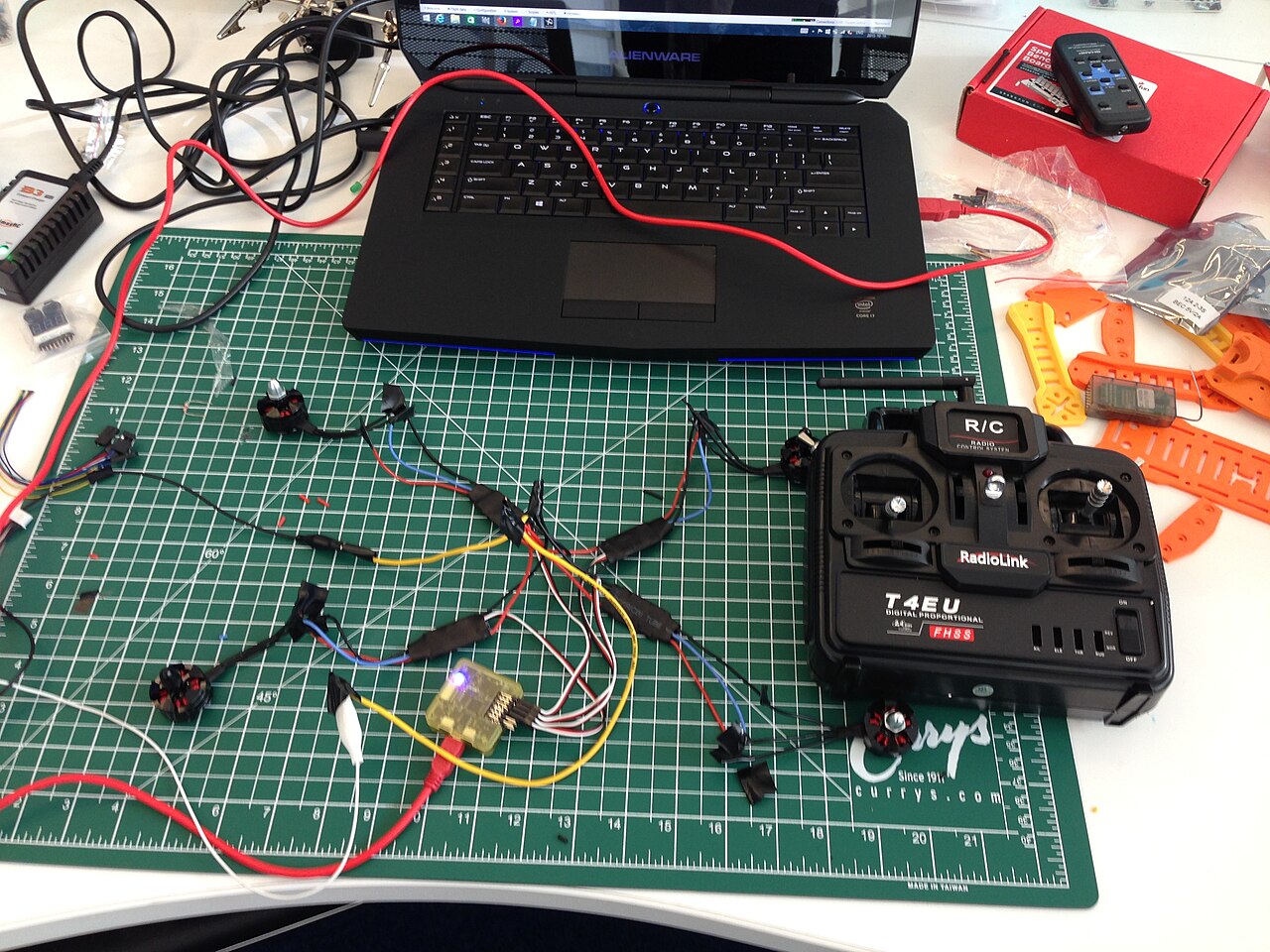
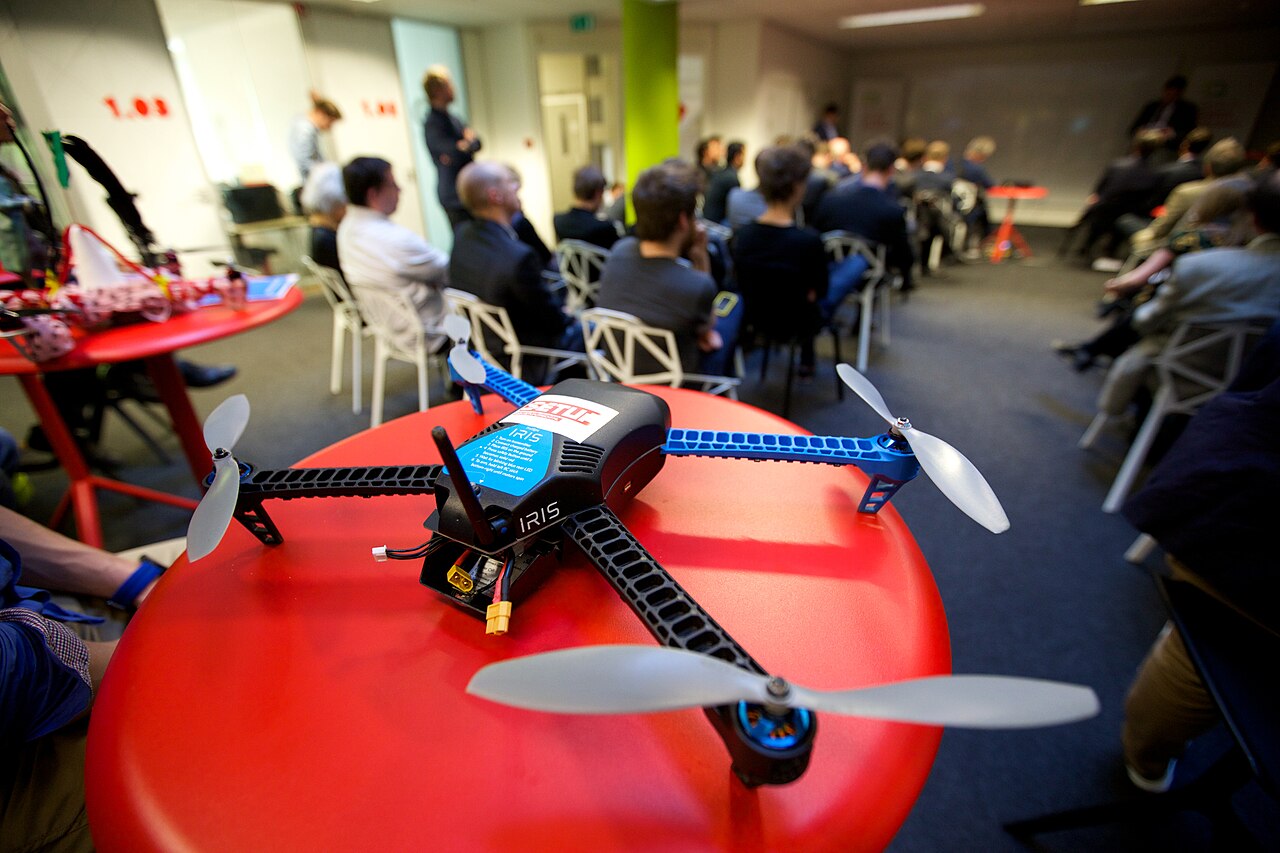
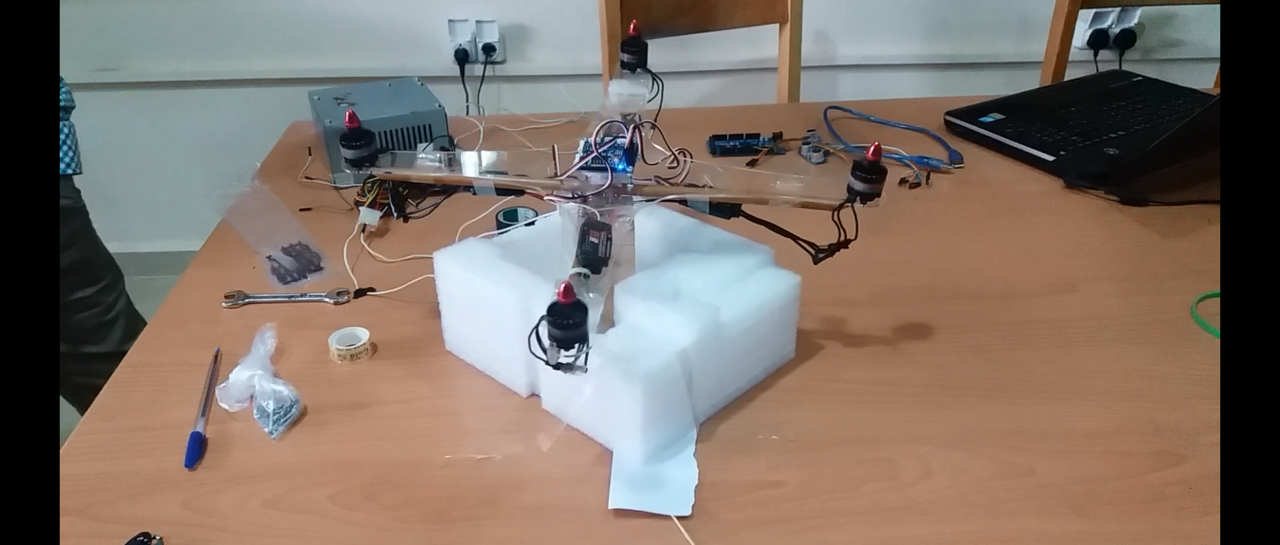
The main mechanical parts are a frame, four rotors (fixed-pitch or variable-pitch), and motors. For best performance and simplest control, the motors and propellers are equally spaced. Some quadcopters use a coaxial rotor configuration, where each arm has two motors spinning in opposite directions—one facing up, one down—to increase power and stability while reducing weight.
- Fastest speed
- 685 km/h
- Longest flight time (battery-powered)
- 2 hours, 31 minutes, 30 seconds
- Endurance record holder
- Ferdinand Kickinger of Germany (2016)
- Fastest speed record holders
- Benjamin Biggs and Aidan Kelly in Australia (20 May 2026)
- First fai distance record for helicopter
- 360 m (14 April 1924, Oehmichen No. 2)
Lore & Background
Each rotor produces both lift and torque about its center of rotation, as well as drag opposite to the vehicle's direction of flight. Quadcopters generally have two rotors spinning clockwise and two counterclockwise. Flight control is provided by independent variation of the speed and hence lift and torque of each rotor. Pitch and roll are controlled by varying the net centre of thrust, with yaw controlled by varying the net torque. Unlike conventional helicopters, quadcopters do not usually have cyclic pitch control.
The first heavier-than-air aerodyne to take off vertically was a four-rotor helicopter designed by Louis Breguet, tested only in tethered flight. Etienne Oehmichen experimented with rotorcraft designs in the 1920s; his Oehmichen No. 2 employed four two-blade rotors and eight propellers, all driven by a single engine. Dr. George de Bothezat and Ivan Jerome developed the de Bothezat helicopter with six-bladed rotors at the end of an X-shaped structure. The Convertawings Model A Quadrotor, flown many times from 1956, was the first four-rotor helicopter to demonstrate successful forward flight.
In the first decades of the 2000s, the quadcopter layout became popular for small-scale unmanned aerial vehicles. The four-rotor design allows quadcopters to be relatively simple in design yet highly reliable and maneuverable. All quadcopters are subject to normal rotorcraft aerodynamics, including the vortex ring state.
Reader's Guide
The quadcopter configuration is relatively simple to program for autonomous flight, which has allowed experiments with complex swarming behaviour based on basic sensing of the adjacent drones. The longest flight time achieved by a battery-powered quadcopter was 2 hours, 31 minutes and 30 seconds, set by Ferdinand Kickinger of Germany in 2016 using low discharge-rate, high-capacity lithium-ion batteries and a stripped airframe. Alternative power sources like hydrogen fuel cells and hybrid gas-electric generators have been used to dramatically extend endurance. The fastest speed achieved by a quadcopter is 685 km/h by Benjamin Biggs and Aidan Kelly in Australia on 20 May 2026. The Guinness World Record progression is determined by averaging two 100 m runs in level flight in opposing directions to account for wind. Airbus is developing a battery-powered quadcopter to act as an urban air taxi, at first with a pilot but potentially autonomous in the future. The Bell Boeing Quad TiltRotor concept combines the fixed quadcopter concept with the tilt rotor concept for a proposed C-130 sized military transport.
Did You Know?
- If all four rotors spin at the same angular velocity with two clockwise and two counterclockwise, the net torque about the yaw axis is zero, eliminating the need for a tail rotor.
- The Oehmichen No. 2 established the first-ever FAI distance record for helicopters of 360 m on 14 April 1924.
- A quadcopter can employ a coaxial rotor configuration, with each arm having two motors running in opposite directions.
Design Principles and Flight Mechanics
A quadcopter's fundamental architecture rests on four rotors arranged symmetrically around a central frame, with two spinning clockwise and two counterclockwise. This counter-rotation scheme is the key engineering insight: when all four rotors turn at identical angular velocity, the opposing torques cancel out completely, eliminating the need for a tail rotor that plagues conventional helicopters. Flight control is achieved purely by independently varying each rotor's speed, which simultaneously adjusts its lift and torque contribution. Pitch and roll emerge from shifting the net centre of thrust, while yaw is induced by deliberately unbalancing the aerodynamic torques between the counter-rotating pairs. Unlike traditional helicopters, quadcopters typically lack cyclic pitch control, meaning blade angles do not change dynamically during rotation. The mechanical build is straightforward—a fuselage or frame, four fixed-pitch or variable-pitch rotors, and their motors—ideally positioned equidistantly for optimal control algorithms. All quadcopters remain subject to standard rotorcraft aerodynamic phenomena, including the dangerous vortex ring state. For applications demanding greater power and stability without added weight, designers can adopt a coaxial configuration, stacking two counter-rotating motors on each arm, one facing upward and one downward.
Pioneers and Early Ambitions
The quadcopter concept stretches back to the earliest days of powered flight. Louis Breguet designed a four-rotor helicopter that became the first heavier-than-air aerodyne to lift vertically, though it was tested only in tethered flight to an altitude of a few feet. In the 1920s, Etienne Oehmichen advanced the design with his Oehmichen No. 2, mounting four two-blade rotors and eight propellers all driven by a single engine, with blade angles adjusted through warping. The machine completed over a thousand test flights, and by 1923 could remain airborne for several minutes. On April 14, 1924, it set the first FAI distance record for helicopters at 360 metres, later completing the first one-kilometre closed-circuit flight by any rotorcraft. Dr. George de Bothezat and Ivan Jerome built another pioneering vehicle for the US Army Air Service, featuring six-bladed rotors on an X-shaped frame with collective pitch control. It flew roughly 100 times by the end of 1923 but never exceeded about five metres in altitude, hampered by underpower, mechanical complexity, and excessive pilot workload. The postwar Convertawings Model A, flown from 1956, used two engines driving four rotors through V-belts and was intended as a prototype for larger civil and military helicopters.
From Curiosity to Practical Drone
For most of the twentieth century, the quadcopter configuration remained essentially a laboratory curiosity. Experimental quadrotor helicopters and convertiplanes had been flown for decades, yet the design never achieved broad practical use. The turning point came with the rise of the modern unmanned aerial vehicle. The small size and low inertia inherent in drone platforms made it possible to employ a particularly simple flight control system, a feature that dramatically increased the practicality of the small quadrotor in this application. This simplicity extends to autonomous operation: the quadcopter configuration is relatively straightforward to program for self-directed flight, opening the door to experiments with complex swarming behaviour in which multiple drones coordinate based on basic sensing of their adjacent neighbours. Where early manned quadrotors demanded enormous pilot effort to maintain stability and suffered from limited control authority, the drone era stripped away the human operator and let the inherent mechanical simplicity of four independently controlled rotors become the asset it was always meant to be.
Pushing the Envelope: Records and Endurance
Quadcopter performance records reveal both the limits of battery technology and the potential of alternative power sources. The longest battery-powered flight stood at 2 hours, 31 minutes, and 30 seconds, a mark set by Ferdinand Kickinger of Germany in 2016. Kickinger achieved this by using low discharge-rate, high-capacity lithium-ion batteries and stripping the airframe of non-essential weight to minimise power draw. Beyond batteries, hydrogen fuel cells and hybrid gas-electric generators have been employed to dramatically extend endurance, leveraging the higher energy density of hydrogen and gasoline respectively. On the speed front, the record belongs to Benjamin Biggs and Aidan Kelly of Australia, who reached 685 km/h (426 mph) on 20 May 2026. The Guinness World Record methodology for speed requires averaging two 100-metre runs in level flight conducted in opposing directions, a protocol designed to neutralise the effect of wind on the measured velocity.
Gallery
Frequently Asked Questions
What is a quadcopter?
A quadcopter is a rotorcraft that uses four rotors to produce lift and thrust. It is also called a quadrocopter or quadrotor, and the design only became truly practical with the rise of modern drone technology.
How does a quadcopter stay stable in the air?
Two rotors spin clockwise and the other two spin counterclockwise, so their opposing torques cancel each other out. Because drones are small and have very low inertia, a comparatively simple flight-control system is enough to keep the craft level and responsive.
What is the fastest speed ever recorded for a quadcopter?
The speed record stands at 685 km/h, achieved by Benjamin Biggs and Aidan Kelly in Australia on 20 May 2026.
Who holds the longest battery-powered flight record for a quadcopter?
Ferdinand Kickinger of Germany set the endurance mark in 2016, remaining airborne for 2 hours, 31 minutes, and 30 seconds on a single battery.
Why weren't quadcopters practical before the drone era?
For decades the four-rotor layout was treated as a curiosity, showing up only in experimental helicopters and convertiplanes. The small size and low inertia of modern drones made a simple control system sufficient, which finally turned the configuration into a workable design.
More in Quadcopters and Multirotor Drones 1-23
Spotted an error? Know more?
Reader corrections go straight into our review queue. Suggest an edit · How this site is sourced