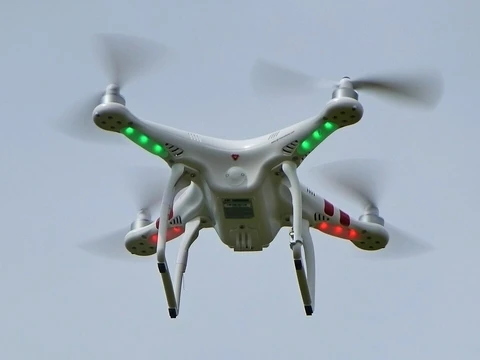
Intel Shooting Star
A quadcopter drone designed for choreographed light shows.

The Intel Shooting Star is a quadcopter drone built from polystyrene and lightweight plastics, designed specifically for light shows. Its built-in LEDs can produce over four billion color combinations, and a single computer with one operator can control a large swarm, using algorithms to manage choreography and optimize flight paths. In 2022, Intel sold this division to Nova Sky Stories.
In November 2016, 500 of these drones set a Guinness World Record for the most unmanned aerial vehicles airborne simultaneously. For the 2017 Super Bowl LI halftime show, 300 Shooting Stars formed an American flag in the sky during Lady Gaga’s performance, though the show was pre-recorded due to strict no-drone flight zone regulations. Josh Walden of Intel’s New Technologies Group noted that swarms of these drones could also perform visual inspections much faster than a single unit. During Art Basel Miami Beach 2017, Intel collaborated with Studio Drift and BMW on a performative artwork using 300 drones. The 2018 Winter Olympics opening ceremony featured 1,218 Shooting Stars, making it the largest drone show in history.
- Material
- Polystyrene and lightweight plastics
- Led color combinations
- More than four billion
- Guinness world record (2016)
- Most Unmanned Aerial Vehicles (UAVs) airborne simultaneously (500 drones)
- Super bowl li (2017)
- 300 drones formed an American flag
- 2018 winter olympics opening ceremony
- 1,218 drones used, largest drone show in history
Lore & Background
The Shooting Star was developed by Intel for use in large-scale aerial light shows. In November 2016, 500 of the drones were used in a light show to set a new Guinness World Record for the 'Most Unmanned Aerial Vehicles (UAVs) airborne simultaneously'. The drones were also used for the Super Bowl LI halftime show performance by Lady Gaga in 2017, in which 300 Shooting Stars formed an American flag in the sky. Due to tight regulations during the show and the establishment of a no-drone flight zone, the drone show was recorded beforehand.
During Art Basel Miami Beach 2017, Intel worked together with Studio Drift and BMW on a performative artwork involving a flying swarm of 300 drones. For the 2018 Winter Olympics opening ceremony, 1,218 of these drones were used, which became the largest drone show in the history of the world. In 2022, Intel sold the division to Nova Sky Stories.
Josh Walden of Intel's New Technologies Group stated that one possible application of the technology is to use large numbers of drones to perform a visual inspection much more quickly than a single unit.
Reader's Guide
The Intel Shooting Star represents a significant application of multirotor drone technology for entertainment and spectacle. Its design, using lightweight materials and integrated LEDs, allowed for the coordination of hundreds of drones in synchronized aerial displays. The system's ability to generate over four billion color combinations and its algorithmic control of choreography and flight paths enabled complex formations, such as the American flag at Super Bowl LI and the record-setting show at the 2018 Winter Olympics. The drone's legacy includes setting a Guinness World Record in 2016 and being part of the largest drone show in history in 2018. The technology also suggested potential beyond entertainment, with Intel's Josh Walden noting its possible use for rapid visual inspection of large areas. The eventual sale of the division to Nova Sky Stories in 2022 marked a transition of this technology to a company focused on aerial storytelling.
Did You Know?
- The Shooting Star is constructed of polystyrene and lightweight plastics.
- 500 Shooting Star drones set a Guinness World Record in November 2016 for most UAVs airborne simultaneously.
- 300 Shooting Stars formed an American flag for the Super Bowl LI halftime show in 2017.
- 1,218 Shooting Star drones were used for the 2018 Winter Olympics opening ceremony, the largest drone show in history.
From Mirrors to Autonomous Swarms (2012–2014)
The story of large-scale drone displays began modestly. In June 2012, Marshmallow Laser Feast took to the skies above Cannes, France, with just 19 LED-equipped UAVs fitted with mirrors for a world premiere at the Saatchi & Saatchi New Directors' Showcase. By September of that year, Ars Electronica Futurelab had scaled up to 49 units they branded SPAXELS, short for "Space Elements," in their own world premiere. The following year saw these SPAXELS appearing at high-profile events: 50 units graced the Star Trek Into Darkness premiere beside Tower Bridge in London, while 30 performed at the opening of QUT's new campus in Brisbane. A significant research milestone arrived in 2014 when the Department of Biological Physics at Eötvös Loránd University in Hungary published work on the first autonomous swarm of 10 drones, accompanied by a show-like teaser video. This period established the foundational technologies and demonstrated that coordinated aerial light displays could move from novelty to genuine spectacle.
The Race to Scale – Breaking Records Year After Year
Once the technology proved viable, the industry entered a relentless arms race of numbers. In November 2015, Ars Electronica Futurelab set the first Guinness World Record with 100 SPAXELS for Intel, dubbed "Drone100." Just a year later, 500 drones took to the skies over Krailling, Germany, shattering that mark. The 2017 Fortune Global Forum in China pushed the count to 1,180, and the 2018 Winter Olympics opening ceremony in Pyeongchang broke the record again with 1,218. Intel itself celebrated its 50th anniversary in July 2018 by launching 2,066 drones simultaneously over its Folsom, California facility. The pace accelerated dramatically in 2020: Geoscan Group flew 2,198 drones in Saint Petersburg for the 75th anniversary of WWII's end, and Shenzhen Damoda Intelligent Control Technology set a new Guinness record with 3,051 drones in Zhuhai, China. By July 2021, a show in China employed a staggering 5,200 drones, illustrating how rapidly the ceiling for aerial spectacle kept rising.
Entering the Mainstream – Super Bowls, Disney, and Global Brands
Drone displays quickly became a staple of major entertainment and corporate events. The 2017 Super Bowl LI halftime show featured 300 drones performing during a Lady Gaga song, while the 2019 Super Bowl halftime brought 150 enhanced Intel Shooting Star drones choreographed to Maroon 5. Disney partnered with Intel for the "Star Bright Holidays" show at Disney Springs in Lake Buena Vista, Florida, running from November 2016 through January 2017. In September 2017, 300 drones formed a massive "W" over Los Angeles to mark the home release of the Wonder Woman film. At Art Basel in Miami Beach in December 2017, Studio Drift and DroneStories staged a 300-drone performance. Brands followed suit: Peugeot unveiled its 208 above Paris with 200 drones in October 2019, Samsung presented new smartphones in Estonia with 500 quadcopters in August 2021, and Hyundai showcased its Tucson in Istanbul with 580 drones the same month. Johnnie Walker even had 500 drones "dance" in the sky over New Year's Day 2022.
A Truly Global Canvas – From Olympics to National Memorials
The geographic and thematic range of drone displays expanded to encompass virtually every continent and every type of occasion. In 2017, the H.C. Andersen Festival in Odense, Denmark, hosted the first drone-launched pyro show by CollMot Robotics and phase7. The 2018 Winter Olympics in Pyeongchang and the Tokyo 2020 Summer Olympics (1,824 drones in 2021) both featured spectacular aerial performances. National and cultural moments were equally well served: 1,000 drones honored Soviet soldiers at the Rzhev Memorial in May 2021, 1,000 more marked Armenia's Independence Day in September 2021, and 500 celebrated the 60th anniversary of the first manned spaceflight in Veliky Novgorod. The 24th World Scout Jamboree in July 2019 used 250 drones, while 150 drones closed the South Asian Games 2020 in Kathmandu, Nepal. In the Middle East, 210 drones lit the opening of Riyadh Seasons 2021, and 200 SKYMAGIC drones marked the first New Year's Countdown set to fireworks on Al Marjan Island in January 2019.
Frequently Asked Questions
What is the Intel Shooting Star?
It is a compact quadcopter drone purpose-built for choreographed aerial light displays, equipped with programmable LEDs that can render more than four billion distinct color combinations. A single operator and one computer can direct an entire swarm, with algorithms handling formation choreography and flight-path optimization in real time.
What materials is the Intel Shooting Star constructed from?
The airframe is made primarily of polystyrene and other lightweight plastic components, keeping each unit slim enough to fly in dense, tightly packed swarm formations. This minimal construction is essential for the hundreds or thousands of drones that perform in a single show.
What Guinness World Record did the Intel Shooting Stars set in 2016?
In November 2016, a formation of 500 Shooting Star drones took flight simultaneously, earning the official title for the greatest number of unmanned aerial vehicles airborne at one time. The achievement was verified and logged by Guinness World Records.
What was the largest Intel Shooting Star drone show ever performed?
The 2018 Winter Olympics opening ceremony featured 1,218 Shooting Stars flying in coordinated patterns, making it the biggest drone light display staged up to that point. Earlier, the 2017 Super Bowl LI halftime used 300 units to assemble a glowing American flag in the night sky.
What happened to the Intel Shooting Star program?
In 2022, Intel sold the entire light-show drone division to a company called Nova Sky Stories. The hardware and show technology carry over, but the program now operates under new ownership rather than the Intel brand.
More in Quadcopters and Multirotor Drones 1-23
Spotted an error? Know more?
Reader corrections go straight into our review queue. Suggest an edit · How this site is sourced