Dragonfly (Titan space probe)
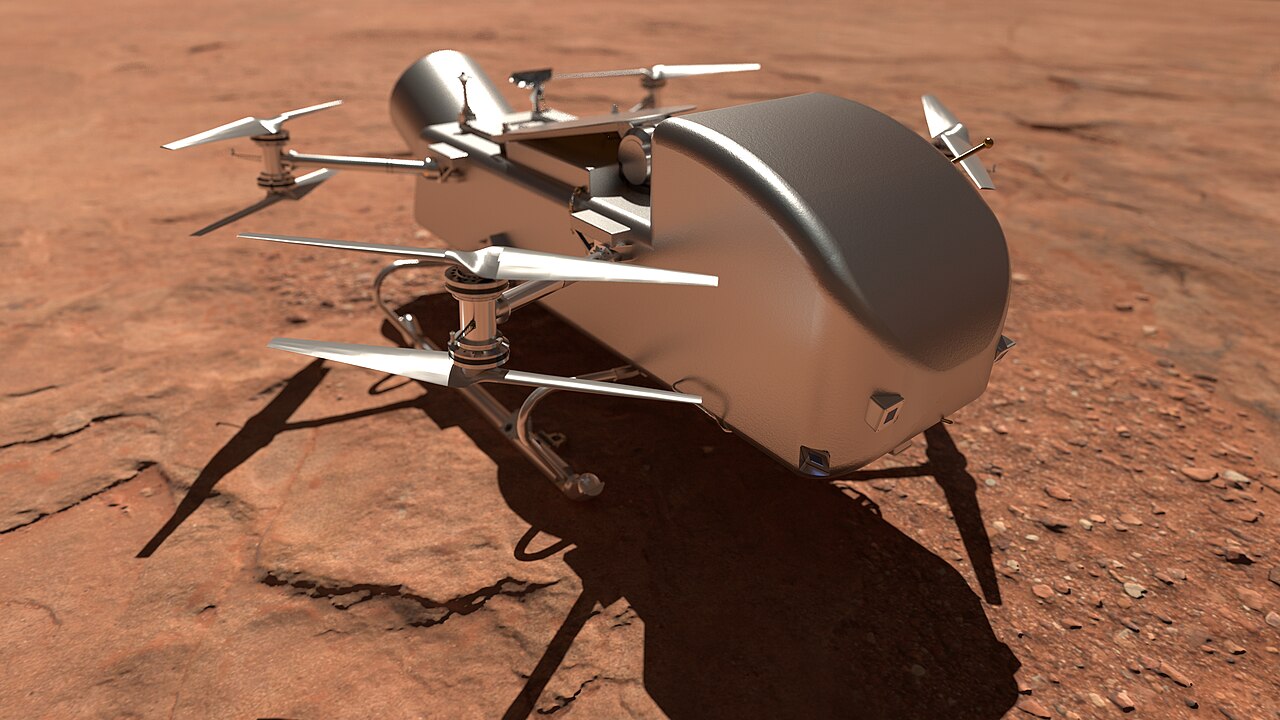
First aircraft on Titan, powered flight on a natural satellite.

NASA/Johns Hopkins APL/Ed Whitman · Public domain
Dragonfly is a NASA mission that will send a robotic rotorcraft to Titan, Saturn’s largest moon. It is set to launch in July 2028 and reach Titan in 2034, where it will become the first aircraft to operate on that world. The mission aims to investigate prebiotic chemistry and the potential for extraterrestrial life, and it will perform the first powered, fully controlled atmospheric flight on any natural satellite. Using vertical takeoffs and landings (VTOL), Dragonfly will hop between different exploration sites.
Titan is the only place in the Solar System besides Earth with abundant, complex, and diverse carbon-rich chemistry. Its surface is dominated by water ice, and it has an interior ocean of liquid water, making it a key target for astrobiology and studies of life’s origins. The mission was proposed in April 2017 to NASA’s New Frontiers program by the Johns Hopkins Applied Physics Laboratory (APL). In December 2017, it was selected as one of two finalists from twelve proposals to refine its concept. On June 27, 2019, Dragonfly was chosen as the fourth New Frontiers mission. In April 2024, the mission was confirmed and moved into its final development stages.
Dragonfly is an astrobiology mission that will assess Titan’s microbial habitability and study prebiotic chemistry at multiple locations. It is designed to make controlled flights and vertical takeoffs and landings between sites, sampling diverse regions and geological settings. Titan’s surface contains abundant complex carbon-rich chemistry, and both liquid water (transient) and liquid hydrocarbons can occur there, potentially forming a prebiotic primordial soup.
If successful, Dragonfly will be the second rotorcraft to fly on a celestial body other than Earth. The first was Ingenuity, an uncrewed helicopter that landed on Mars with the Perseverance rover on February 18, 2021, as part of the Mars 2020 mission, and achieved its first powered flight on April 19, 2021.
The initial idea for Dragonfly came from a dinner conversation between scientists Jason W. Barnes (University of Idaho, who had previously proposed the AVIATR Titan aircraft concept) and Ralph Lorenz (Johns Hopkins APL). It took 15 months to turn it into a detailed mission proposal. The principal investigator is Elizabeth Turtle, a planetary scientist at Johns Hopkins APL.
- Launch date
- July 2028
- Arrival date
- 2034
- Mission type
- Astrobiology rotorcraft
- Target
- Titan, moon of Saturn
- Operator
- NASA
- Proposed by
- Johns Hopkins Applied Physics Laboratory (APL)
- Cost projection (2024)
- US$3.35 billion total lifecycle
Lore & Background
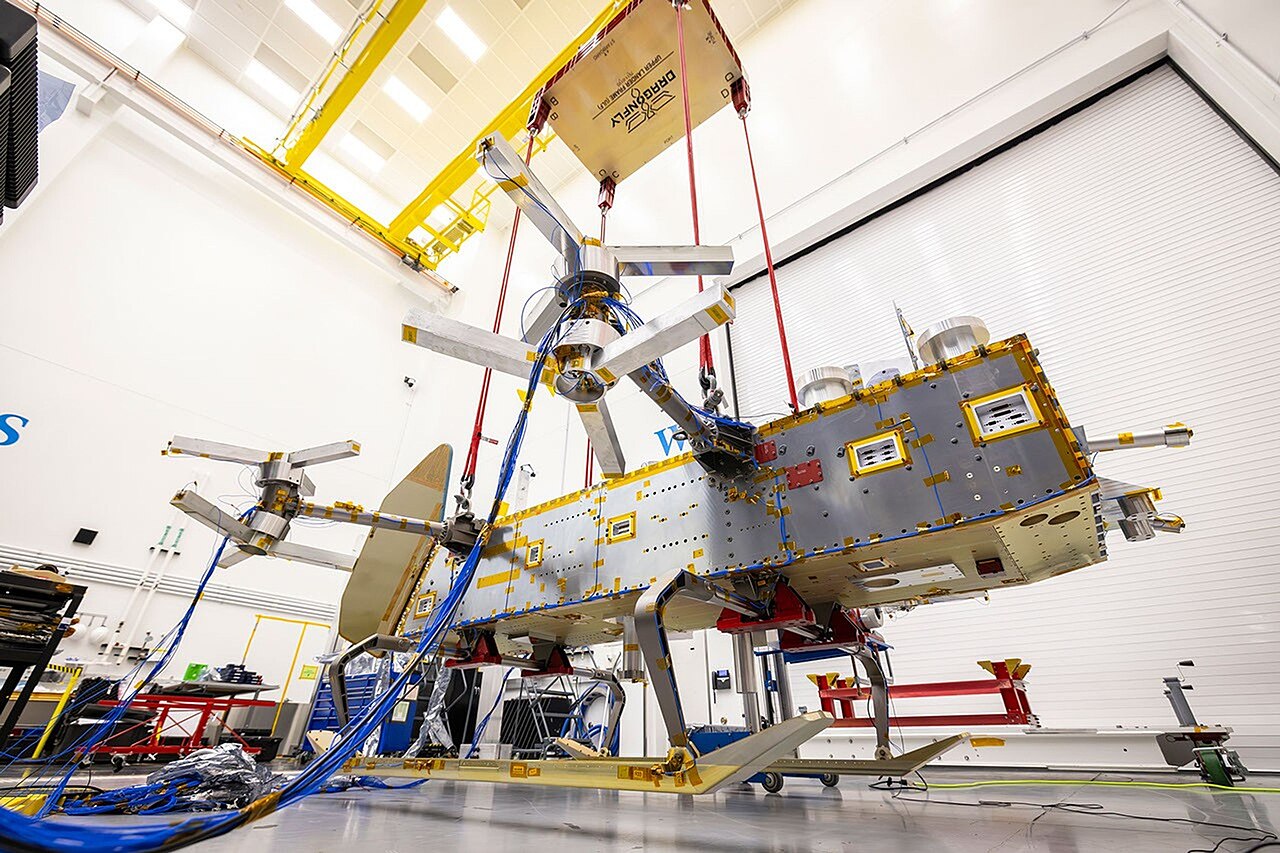
Dragonfly was proposed in April 2017 to NASA's New Frontiers program by the Johns Hopkins Applied Physics Laboratory. It was selected as one of two finalists in December 2017 and on 27 June 2019 was chosen to become the fourth New Frontiers mission. The mission was confirmed in April 2024 and moved to final development stages. The initial conception took place over a dinner conversation between scientists Jason W. Barnes and Ralph Lorenz, and it took 15 months to make it a detailed mission proposal. The principal investigator is Elizabeth Turtle. Dragonfly builds on earlier studies of Titan mobile aerial exploration, including the 2007 Titan Explorer Flagship study and the AVIATR airplane concept. A rotorcraft lander that flew on battery power and recharged during the eight-Earth-day Titan night from a radioisotope power source was proposed by Lorenz in 2000. Dragonfly passed its preliminary design review on 3 March 2023. In November 2023, due to funding uncertainties, the launch was delayed by one year to July 2028. On 25 November 2024, NASA announced the launch service award: Dragonfly will launch on a SpaceX Falcon Heavy with a targeted launch period from 5 July 2028 to 25 July 2028. On 25 April 2025, Dragonfly passed its critical design review, marking the beginning of full-scale physical construction and testing. Construction of the spacecraft began on 10 March 2026. On 1 June 2026, thermal-structural testing of the entry probe's heat shield was completed in New Mexico using Sandia's Solar Tower. On 29 June 2026, the mission team delivered the spacecraft's nearly 13 ft fuselage for the next phase of integration. Integration of mechanical, thermal, and electrical systems began on 1 July 2026. During vibration testing in July 2026, the rotorcraft structure was suspended using bungee cords to measure vibration propagation.
Reader's Guide
Dragonfly is significant as the first aircraft to operate on Titan and the first powered, fully controlled atmospheric flight on any natural satellite. It is an astrobiology mission to assess Titan's microbial habitability and study prebiotic chemistry at various locations. Titan is a compelling target because its surface contains abundant complex carbon-rich chemistry and because both liquid water (transient) and liquid hydrocarbons can occur on its surface, possibly forming a prebiotic primordial soup. A successful flight would make Dragonfly the second rotorcraft to fly on a celestial body other than Earth, after Ingenuity on Mars. The mission uses a multi-rotor vehicle to transport its instrument suite to multiple locations to make measurements of surface composition, atmospheric conditions, and geologic processes. Dragonfly is the fourth mission in NASA's New Frontiers portfolio, with a development cost cap of approximately US$850 million and a total cost projection of about US$1 billion, later revised to US$3.35 billion due to supply chain increases and COVID-19 pandemic delays. The mission was selected over CAESAR, a comet sample return mission, as the New Frontiers Mission 4.
Did You Know?
- Dragonfly will be the first aircraft on Titan and the first powered flight on any natural satellite.
- The mission was proposed in April 2017 and selected as a New Frontiers finalist in December 2017.
- Dragonfly's heat shield was tested in New Mexico using Sandia's Solar Tower in June 2026.
Gallery

Frequently Asked Questions
What is Dragonfly?
Dragonfly is a NASA robotic rotorcraft mission designed to explore Titan, the largest moon of Saturn. It was proposed and is being developed by the Johns Hopkins Applied Physics Laboratory (APL) as an astrobiology-focused spacecraft.
When does Dragonfly launch and arrive at Titan?
The spacecraft is scheduled to launch in July 2028, with arrival at Titan expected in 2034. That gives it roughly six years of transit through the outer Solar System before it begins surface operations.
What makes Dragonfly unique compared to other space missions?
It will be the first aircraft to achieve powered, fully controlled flight on a natural satellite. No previous mission has attempted vertical takeoff and landing operations on a moon, making Titan the setting for a first-of-its-kind atmospheric flight.
What is Dragonfly's primary scientific goal?
The mission focuses on studying prebiotic chemistry and assessing whether conditions on Titan could support or have supported extraterrestrial life. Titan is notable as the only other body in the Solar System, besides Earth, with abundant, complex organic chemistry in its environment.
How will Dragonfly move between exploration sites on Titan?
It will use vertical takeoff and landing (VTOL) capabilities to hop from one location to another across the moon's surface. This allows it to visit multiple scientifically interesting sites rather than being tethered to a single landing point.
More in Quadcopters and Multirotor Drones 1-23
Spotted an error? Know more?
Reader corrections go straight into our review queue. Suggest an edit · How this site is sourced