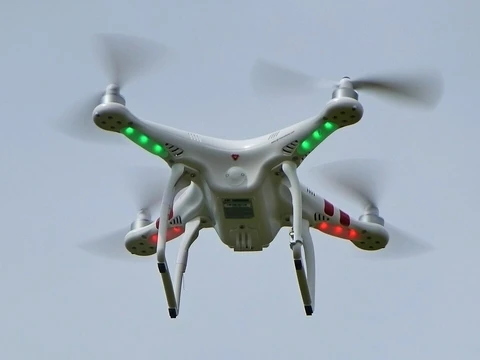
Parrot Bebop
French quadcopter with GNSS and fisheye camera.

The Parrot Bebop is a French quadcopter drone controlled remotely, built by Parrot SA as the follow-up to the AR.Drone. It was unveiled in May 2014 and went up against the DJI Phantom 2 Vision. Unlike the earlier AR.Drone 2.0, the Bebop includes a built-in GNSS receiver, which lets it follow pre-set flight paths on its own using GPS, GLONASS, or Galileo satellites. Its camera has a 14-megapixel sensor with an f2.2 180-degree fisheye lens and can record 1080p video. Instead of a motorized gimbal, the drone’s onboard image processor handles panning, zooming, and three-axis stabilization by cropping a 1920×1080 rectangle from the full fisheye image. The Bebop can also stream live video to an Oculus Rift headset, giving the pilot a first-person view. Power comes from a 1200 mAh battery, which provides a maximum flight time of 12 minutes. An upgraded version, the Bebop 2, came out in November 2015. It uses a 2700 mAh battery, doubling flight time to 25 minutes. Other improvements over the original include better wind resistance and 8 gigabytes of internal storage, though it lacks a microSD card slot. The Bebop 2 also has a fail-safe that makes it hover in place if it loses connection with the pilot’s phone, though *The Verge* found such disconnections happened often. The Bebop 2 Power was announced in September 2017, with a 3350 mAh battery that extends flight time to 30 minutes. The Bebop 2 Power 32GB, with 32GB of internal storage, came as part of the Bebop-Pro 3D Modelling package for professional users. In October 2017, Parrot released the Bebop-Pro Thermal for professionals. Based on the Bebop 2 Power, it has a rear-mounted Teledyne FLIR ONE Pro thermal camera and 32GB of internal storage. Parrot stopped making all consumer products, including the Bebop, in July 2019 to focus on enterprise versions of the Anafi. At the DEF CON convention in August 2015, a presenter showed that the Bebop could be hijacked mid-flight through a cyberattack. The demonstration used a Wi-Fi deauthentication attack to disconnect the drone from the pilot’s mobile device, letting anyone with the Parrot app pair with it and take control.
- Announced
- May 2014
- Camera
- 14-megapixel with f2.2 180-degree fisheye lens, 1080p video
- Battery
- 1200 mAh
- Flight time
- 12 minutes
- Gnss
- GPS, GLONASS, Galileo
- Image stabilization
- 3-axis via onboard processor carving 1920×1080 section from 180-degree image
Lore & Background
The Bebop was announced in May 2014 as the successor to the AR.Drone 2.0. Unlike its predecessor, it featured a built-in GNSS receiver, allowing it to autonomously follow predetermined flight paths using GPS, GLONASS, or Galileo satellites. Its 14-megapixel camera with an f2.2 180-degree fisheye lens captured 1080p video; instead of a motorized gimbal, the onboard image processor panned, zoomed, and provided 3-axis stabilization by carving out a rectangular 1920×1080 section of the 180-degree image. The Bebop could stream live video to an Oculus Rift headset for first-person view. Power came from a 1200 mAh battery, giving a maximum flight time of 12 minutes. An improved model, the Bebop 2, was announced in November 2015 with a 2700 mAh battery doubling flight time to 25 minutes, improved wind resistance, 8 gigabytes of internal storage (no microSD slot), and a fail-safe to hover if connection with the pilot's phone was lost—though The Verge found such disconnections frequent. The Bebop 2 Power followed in September 2017 with a 3350 mAh battery for 30 minutes of flight. A 32GB variant was released with the Bebop-Pro 3D Modelling package. In October 2017, Parrot released the Bebop-Pro Thermal, based on the Bebop 2 Power, with a rear-mounted Teledyne FLIR ONE Pro thermal camera and 32GB of internal storage. During the DEF CON convention in August 2015, a presenter demonstrated that the Bebop could be hijacked mid-flight via a Wi-Fi deauthentication attack, disconnecting the drone from the pilot's mobile device and allowing anyone with the Parrot app to pair with and take control. Parrot discontinued all consumer products, including the Bebop, in July 2019 to focus on enterprise versions of the Anafi.
Reader's Guide
The Parrot Bebop marked a significant step in consumer drone evolution by integrating GNSS for autonomous flight paths, a feature absent from its AR.Drone predecessor. Its novel approach to image stabilization—using software to crop a stabilized 1080p frame from a 180-degree fisheye view—eliminated the need for a mechanical gimbal, reducing weight and complexity. The Bebop's ability to stream video to an Oculus Rift headset anticipated the first-person-view trend in drone piloting. However, its 12-minute flight time was a limitation addressed by the Bebop 2's doubled endurance. The Bebop 2 Power and Bebop-Pro Thermal extended the platform for professional use, while the demonstrated Wi-Fi hijacking vulnerability at DEF CON highlighted security concerns in early consumer drones. Parrot's discontinuation of the Bebop line in 2019 reflected a strategic shift away from consumer products toward enterprise-focused models like the Anafi.
Did You Know?
- The Bebop was originally known as the AR.Drone 3.0.
- Its 14-megapixel fisheye camera could stream live video to an Oculus Rift headset.
- A Wi-Fi deauthentication attack demonstrated at DEF CON in August 2015 could hijack the Bebop mid-flight.
- The Bebop 2 Power had a 3350 mAh battery for 30 minutes of flight time.
Frequently Asked Questions
What is the Parrot Bebop?
The Parrot Bebop is a French quadcopter drone released by Parrot SA as the spiritual successor to their AR.Drone series. It debuted in May 2014 and was aimed squarely at the DJI Phantom 2 Vision in the consumer market.
How long can the Parrot Bebop fly on a single battery?
Its 1200 mAh cell provides roughly 12 minutes of airborne time before the pilot needs to land and swap or recharge.
What camera does the Parrot Bebop carry?
The drone is equipped with a 14-megapixel sensor behind an f2.2 180-degree fisheye lens, and it can capture 1080p video.
How does the Parrot Bebop stabilize video without a motorized gimbal?
An onboard image processor extracts a 1920×1080 window from the full 180-degree fisheye frame, using that crop to deliver three-axis electronic stabilization, panning, and zoom in real time.
Which satellite navigation systems does the Parrot Bebop use?
A built-in GNSS module lets the drone lock onto GPS, GLONASS, or Galileo signals so it can execute pre-set flight paths on its own.
More in Quadcopters and Multirotor Drones 1-23
Spotted an error? Know more?
Reader corrections go straight into our review queue. Suggest an edit · How this site is sourced