Yamanashi Prefecture
Landlocked prefecture in Chūbu, Honshu, home to Mount Fuji.

Midori · via Wikipedia: Yamanashi Prefecture · CC BY 3.0
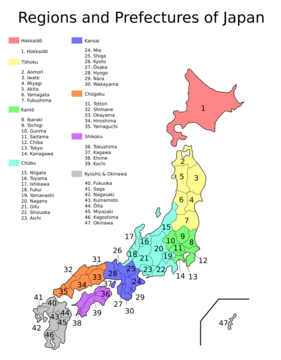
Yamanashi Prefecture (山梨県, Yamanashi-ken) is a prefecture of Japan located in the Chūbu region of Honshu. It is one of only eight landlocked prefectures, with most of its population living in the central Kōfu Basin surrounded by the Akaishi Mountains. The prefecture is home to many of Japan's highest mountains, including Mount Fuji, which lies partially on its border with Shizuoka Prefecture.
- Capital
- Kōfu
- Population
- 787,592 (as of 1 February 2025)
- Area
- 4,465 km² (1,724 sq mi)
- Nationality
- Japanese
- Known for
- Mount Fuji, fruit production (grapes, peaches, plums), wine, mineral water, and the SCMaglev test track
Lore & Background
The name Yamanashi literally means 'Pear Mountain,' referring to a local Japanese cultivar of the Asian pear. Prehistoric society in the area progressed through the Jōmon and Yayoi periods, with the Maruyama and Choshizuka Kofun (earthen burial mounds) on Sone Hill indicating significant influence from the 4th century. During the Heian period, Kai Province was created here. In the Sengoku period, Takeda Shingen built Tsuzuji Mansion and Yōgai Castle in Kōfu, attempting to unify Japan. After his death in 1582, the area came under the Oda, Toyotomi, and eventually Tokugawa shogunate control, with the Kōfu and Yamura clans formed before direct shogunate rule in 1724.
During the Boshin War, the Battle of Kōshū-Katsunuma on 29 March 1868 was a significant clash between pro-Imperial and Tokugawa forces. The province was renamed Kōfu Prefecture in 1869 and then Yamanashi Prefecture in 1871. Industrial promotion in the Meiji period furthered sericulture, silk textile production, and winemaking. The Chūō Railway Line reached Kōfu in 1903, and the Minobu Railway Line opened in 1926. Kōfu suffered extensive damage in an air raid on 6 July 1945. Post-war land reforms promoted fruit farming and viticulture, and dairy farming was introduced by American Paul Rusch in Kiyosato. The 1982 opening of the Chūō Expressway spurred growth in service industries and tourism.
Reader's Guide
Yamanashi Prefecture holds significance as a major fruit-producing region, being Japan's top domestic producer of grapes, peaches, plums, and wine. Roughly 40% of Japan's bottled mineral water comes from Yamanashi, sourced from the Southern Alps, Mount Fuji, and Mitsutōge areas. The prefecture also has a sizable industrial base, including the headquarters of FANUC, a manufacturer of factory automation systems, in Oshino. Its natural scenery and cultural sights are popular tourist destinations. The prefecture is home to the completed 42.8 km section of the SCMaglev test track, part of the planned Chūō Shinkansen, which is designed to ultimately connect Tokyo, Nagoya, and Osaka. Central Government permission to extend the test track was granted on May 27, 2011, and construction was well advanced as far as Fuefuki by the end of 2013. JR Central considered opening a demonstration service from a new station in Kōfu by the 2020 Summer Olympics. The prefecture's population peaked at roughly 890,000 around the turn of the millennium and has seen negative growth in the 21st century.
Did You Know?
- Yamanashi Prefecture is one of only eight landlocked prefectures in Japan.
- Mount Fuji, Japan's tallest mountain, is partially located in Yamanashi on the border with Shizuoka Prefecture.
More in Prefectures Of Japan 1-24
Spotted an error? Know more?
Reader corrections go straight into our review queue. Suggest an edit · How this site is sourced