Kagawa Prefecture
Japan's smallest prefecture, known for udon and olive cultivation.

via Wikipedia: Kagawa Prefecture · see source
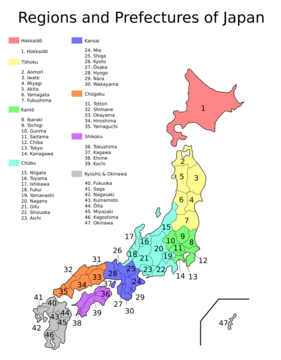
Kagawa Prefecture occupies the northeast corner of Shikoku, bordered by Ehime Prefecture to the southwest and Tokushima Prefecture to the south, with the Sanuki Mountains forming the southern land border. Its coastline faces the Seto Inland Sea, across from Okayama Prefecture on Honshu, to which it is linked by the Great Seto Bridge. The prefecture includes Shōdoshima, the second-largest island in the Seto Inland Sea. Kagawa is Japan’s smallest prefecture by area, a narrow strip between the mountains and the sea. As of April 2012, 11% of its land was designated as Natural Parks, including Setonaikai National Park and Ōtaki-Ōkawa Prefectural Natural Park. Historically known as Sanuki Province, Kagawa was briefly merged into Ehime Prefecture from August 1876 to December 1888. The capital, Takamatsu, is home to Mount Yashima, the site of the Battle of Yashima, a celebrated clash between the Heike and Genji clans. The prefecture’s economy has a nominal GDP of about 3,802 billion yen, with major exports including transportation equipment, electrical equipment, chemical products, and general machinery. Kagawa is most famous for Sanuki udon, with over 700 udon restaurants in 2008. Other local specialties include hone-tsuki-dori (seasoned chicken thigh cooked on the bone, originating in Marugame), olives and olive products (the first successful olive cultivation in Japan began here in 1908), wasanbon sugar sweets, sōmen noodles, and shōyu soy sauce. Olive waste is used as feed for cattle and yellowtail amberjack, producing “olive beef” and “olive yellowtail.” As of October 2020, the population was estimated at 950,244, a decline of 7.1% from the 2000 census figure of 1,022,890. The population density is 506.3 people per square kilometer.
- Capital
- Takamatsu
- Population (2020)
- 949,358
- Area
- 1,877 square kilometres (725 sq mi)
- Former Name
- Sanuki Province
- Major Export Industries
- transportation equipment, electrical equipment, chemical products, general machi
- Famous Local Food
- Sanuki udon
Verified Timeline
Lore & Background
Kagawa Prefecture occupies the northeast corner of Shikoku, with its southern border defined by the Sanuki Mountains, which separate it from Tokushima Prefecture. To the southwest lies Ehime Prefecture. Its northern coastline faces the Seto Inland Sea, opposite Okayama Prefecture on Honshu, to which it is linked by the Great Seto Bridge. The prefecture includes Shōdoshima, the second-largest island in the Inland Sea. Historically, Kagawa was known as Sanuki Province, and for a brief period from August 1876 to December 1888, it was incorporated into Ehime Prefecture. A notable historical site is Yashima, a mountain in the capital Takamatsu, which was the setting for the famous Battle of Yashima between the Heike and Genji clans. The prefecture is the smallest in Japan by geographic area, covering 1,877 square kilometers, with a narrow shape between the sea and the mountains. As of April 2012, 11% of its land was protected as Natural Parks, including Setonaikai National Park and Ōtaki-Ōkawa Prefectural Natural Park. Its major cities include Takamatsu, the capital and largest, along with Marugame, Mitoyo, and Kan'onji.
Reader's Guide
Kagawa Prefecture holds significance as the smallest prefecture in Japan by area, yet it has a notable cultural and economic footprint. Its history as Sanuki Province and its brief merger with Ehime Prefecture reflect administrative changes in the Meiji era. The Battle of Yashima, fought on a mountain in Takamatsu, is a key historical event. Economically, Kagawa's nominal GDP is approximately 3,802 billion yen, with major exports in transportation equipment and electrical equipment. Its most famous cultural export is Sanuki udon, with over 700 udon restaurants in the prefecture as of 2008. Kagawa also pioneered olive cultivation in Japan starting in 1908, leading to award-winning olive oil and derivative products like olive beef and olive yellowtail. The prefecture's tourism draws on sites such as Konpira Shrine, Ritsurin Garden, Marugame Castle, and the art islands of Naoshima and Teshima. Its legacy includes being the setting for the novel Twenty-Four Eyes and the manga Teasing Master Takagi-san.
Did You Know?
- Kagawa Prefecture was briefly part of Ehime Prefecture between August 1876 and December 1888.
- As of 2008, there were over 700 udon restaurants in Kagawa Prefecture alone.
- Kagawa was the first place in Japan to successfully cultivate olives, starting in 1908.
- The mountain of Yashima in Takamatsu was the battlefield for the Battle of Yashima between the Heike and Genji clans.
- Shōdoshima, the second-largest island in the Seto Inland Sea, is part of Kagawa Prefecture.
More in Prefectures Of Japan 1-24
Related in Prefectures Of Japan
Links follow this subject's own source article.
Spotted an error? Know more?
This is a living reference — every entry is fact-audited, and reader corrections feed straight into our audit queue. Suggest an edit · See this site's audit record