Ishikawa Prefecture
A Japanese prefecture on the Sea of Japan coast.

via Wikipedia: Ishikawa Prefecture · see source
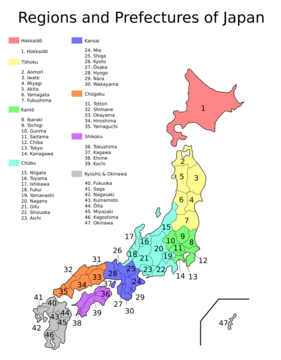
Ishikawa Prefecture sits on the Sea of Japan coast in the Chūbu region of Honshu, Japan. It covers 4,191 km² (1,618 sq mi) and, as of January 2025, has a population of 1,096,721. To the east lies Toyama Prefecture, Gifu Prefecture is to the southeast, and Fukui Prefecture borders it to the south. The prefecture includes most of the Noto Peninsula, which helps form Toyama Bay—one of Japan’s largest bays. Its capital and biggest city is Kanazawa; other major cities include Hakusan, Komatsu, and Kaga.
Historically part of the Hokuriku region, Ishikawa once held some of the wealthiest feudal domains (han) in Japan. The prefecture was created in 1872 by merging Kaga Province and the smaller Noto Province, with its government initially seated in Mikawa before moving to Kanazawa in 1873. After the 1878 Kioizaka Incident—where six men assassinated statesman Ōkubo Toshimichi, citing the Meiji government’s “maladministration, suppression of civil rights, and misuse of government property”—the national government grew wary of Ishikawa. Fearing a Hokuriku bloc backing the Freedom and People’s Rights Movement, and aiming to weaken former Kaga lords, it split the prefecture in two stages: Fukui Prefecture was formed in 1881, and Toyama Prefecture followed in 1883.
On 1 January 2024, a 7.5-magnitude earthquake struck the Noto Peninsula. In Ishikawa, 508 people died, two remain missing, and an estimated 1,200 were injured across multiple prefectures. In September 2024, severe rainfall caused deadly floods and landslides, killing at least six and forcing thousands to evacuate as rivers overflowed. Recovery from the earlier earthquake complicated relief efforts, and emergency warnings stayed in place.
The northern part of Ishikawa is the narrow Noto Peninsula, while the south is wider and mostly mountainous, with Kanazawa on a coastal plain. Islands include Notojima, Mitsukejima, and Hegurajima. About 13% of the prefecture’s land is designated as natural parks: Hakusan National Park, Echizen-Kaga Kaigan and Noto Hantō Quasi-national parks, and five prefectural natural parks.
Eleven cities and several towns make up the prefecture’s municipalities. The economy leans on textiles—especially artificial fabrics—and machinery, particularly construction equipment. As of the most recent data, the area is 4,190.94 km² with a population of 1,166,643.
Governors have included Wakio Shibano (1947–1955), Jūjitsu Taya (1955–1963), Yōichi Nakanishi (1963–1994), Masanori Tanimoto (1994–2022), Hiroshi Hase (2022–2026), and Yukiyoshi Yamano (since March 2026).
Culturally, Ishikawa is known for Noh, introduced under the fifth Maeda lord Tsunanori and refined into Kaga hosho style. The tea ceremony arrived in 1666 when Maeda Toshitsune invited Senbiki Soshitsu of Urasenke to Kanazawa. Kutani ware features bright glazes like Chinese porcelain, while Ohi teaware has a style unique to Kanazawa. Nyotaimori (naked sushi) is said to have originated here. Kaga silk uses a complicated print technique with an intentionally rough look (wabi-sabi). Kanazawa lacquerware is high-quality and traditionally decorated with gold dust, and Kanazawa gold leaf is made by beating gold into wafer-thin sheets. Kaga mizuhiki uses glued Japanese paper for ribbon-like decorations, and Kaga inlay crafts combine thin flat and thread metal inlays. Gojinjo Daiko is a drum tradition recognized as a Wajima city cultural heritage (since 1961) and an Ishikawa Prefecture intangible cultural heritage (since 1963). The Abare Festival is considered the most “fierce” festival of Noto, and Japan Tent is an international exchange event.
Tourism centers on Kanazawa, reachable via Komatsu or Noto airports. Popular sites include the 1000 Rice Fields, the 21st Century Museum of Contemporary Art, Notojima Aquarium, Chirihama Driveway, the Higashi-chaya district, Ishikawa Prefectural Museum of Art, the Kaga hot-springs district, Wakura Onsen, Kanazawa Castle, Kenroku-en (one of Japan’s Three Great Gardens), Mount Haku, Shibayama Lagoon, and the Wajima Morning Market. The prefectural symbols are the flower Fritillaria camschatcensis, the golden eagle, and the tree Thujopsis dolabrata. Notable people include sumo wrestler Enhō Akira and actress Minami Hamabe.
- population
- 1,096,721 (as of 1 January 2025)
- area
- 4,191 km² (1,618 sq mi)
- capital
- Kanazawa
- region
- Chūbu region, Honshu island
- formed
- 1872
- notable_for
- Kanazawa Castle, Kenroku-en, Nyotaimori, Kutani ware
Verified Timeline
Lore & Background
Ishikawa was formed in 1872 from the merger of Kaga Province and the smaller Noto Province, with the seat of government initially in Mikawa. The political center moved to Kanazawa in 1873. The newly formed prefecture came under national scrutiny after the Kioizaka Incident in 1878, in which six shizoku (士族), dissatisfied by the Meiji government's 'maladministration, suppression of civil rights, and misuse of government property,' assassinated statesman Ōkubo Toshimichi. Concerned about a possible Hokuriku bloc supporting the Freedom and People's Rights Movement, the national government divided the prefecture in two stages: Fukui Prefecture was formed in 1881, and Toyama Prefecture in 1883. On 1 January 2024, a 7.5 magnitude earthquake struck the Noto Peninsula. In Ishikawa, 508 people were killed and 2 people remain missing. Overall, an estimated 1,200 people were injured across different prefectures. In September 2024, severe rainfall led to deadly floods and landslides, causing at least six deaths and widespread damage, with thousands evacuated as rivers overflowed.
Reader's Guide
Ishikawa Prefecture is home to Kanazawa Castle, Kenroku-en (one of the Three Great Gardens of Japan), Nyotaimori ('body sushi'), and Kutani ware. The area is noted for arts and crafts including Kaga silk (Kaga yūzen), Kanazawa lacquerware (Kanazawa shikki), Kanazawa gold leaf (Kanazawa haku), Kaga mizuhiki, and Kaga inlay crafts (Kaga zōgan). Noh was introduced during the rule of the fifth Maeda lord Tsunanori and refined into Kaga hosho. The tea ceremony was introduced in 1666 when Maeda Toshitsune invited Senbiki Soshitsu of Urasenke to Kanazawa. The prefecture's industry is dominated by textiles (particularly artificial fabrics) and machine construction. Popular tourist destinations include the 21st Century Museum of Contemporary Art, Kanazawa, the Higashi-chaya district, Kaga hot-springs district, Wakura Onsen, Mount Haku, and the Wajima Morning Market. Notable people from Ishikawa include baseball player Hideki Matsui, philosopher D. T. Suzuki, author Kyōka Izumi, and actor Takeshi Kaga.
Did You Know?
- Ishikawa was formed in 1872 from the merger of Kaga Province and Noto Province.
- The Kioizaka Incident in 1878 led to the assassination of statesman Ōkubo Toshimichi by six shizoku.
- On 1 January 2024, a 7.5 magnitude earthquake struck the Noto Peninsula, killing 508 people in Ishikawa.
- Nyotaimori, or 'body sushi,' is said to have originated in Ishikawa Prefecture.
- Hideki Matsui, former New York Yankees player, was born and raised in Neagari Town (now Nomi City), Ishikawa.
More in Prefectures Of Japan 1-24
Related in Prefectures Of Japan
Links follow this subject's own source article.
Spotted an error? Know more?
This is a living reference — every entry is fact-audited, and reader corrections feed straight into our audit queue. Suggest an edit · See this site's audit record