Hyōgo Prefecture
A Japanese prefecture with coastlines on two seas.

via Wikipedia: Hyōgo Prefecture · see source
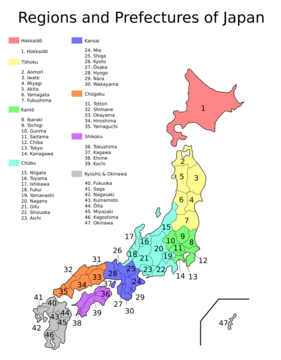
Hyōgo Prefecture is in the Kansai region of Honshu, Japan. It has about 5.47 million people and covers 8,400 square kilometers. Its capital and biggest city is Kobe, the seventh-largest city in Japan. Other major cities include Himeji, Nishinomiya, and Amagasaki. The prefecture borders Kyoto to the east, Osaka to the southeast, and Okayama and Tottori to the west. Its main land runs from the Sea of Japan down to the Seto Inland Sea, where Awaji Island and a small group of islands belonging to Hyōgo sit. The prefecture is a key economic center, transport hub, and tourist spot in western Japan. About 20% of its land is set aside as Natural Parks. It is part of both the Kobe and Osaka metropolitan areas, the second most populated urban region in Japan after Greater Tokyo and one of the world’s most productive by GDP.
Hyōgo includes the former provinces of Harima, Tajima, Awaji, and parts of Tanba and Settsu. In 1180, near the end of the Heian period, Emperor Antoku, Taira no Kiyomori, and the Imperial court briefly moved to Fukuhara, now part of Kobe, keeping the capital there for five months. Himeji Castle, a UNESCO World Heritage Site, is in the city of Himeji. In 1995, the 6.9 Mw Great Hanshin earthquake devastated southern Hyōgo, destroying large parts of Kobe, Awaji, Nishinomiya, and Ashiya, as well as neighboring Osaka Prefecture, and killing nearly 6,500 people.
Hyōgo has coastlines on two seas: the Sea of Japan to the north and the Seto Inland Sea to the south. On Awaji Island, it also borders the Pacific Ocean along the Kii Channel. The northern part is sparsely populated, except for Toyooka. The central highlands have only tiny villages. Most people live on the southern coast, part of the Osaka-Kobe-Kyoto metropolitan area. Awaji Island separates the Inland Sea and Osaka Bay, lying between Honshu and Shikoku. Summers are hot and humid across the prefecture. In winter, the north gets heavy snow, while the south sees only occasional flurries. Hyōgo borders Osaka, Kyoto, Tottori, and Okayama prefectures. Its Natural Parks include Sanin Kaigan and Setonaikai National Parks; Hyōnosen-Ushiroyama-Nagisan Quasi-National Park; and several prefectural parks.
The prefecture has 30 cities and towns in various districts. Islands include Awaji Island and the Ieshima Islands, plus two major artificial islands: Port Island and Rokkō Island. National parks in Hyōgo are Hyōnosen-Ushiroyama-Nagisan Quasi-National Park, Sanin Kaigan National Park, and Setonaikai National Park. A planned merger between Akō city and Kamigōri town in Akō District, which would keep the name Akō and dissolve the district, has not yet happened.
Agriculture, forestry, and fisheries are important to Hyōgo’s economy. The prefecture also has an IT industry, many heavy industries, and metal and medical sectors. Kobe Port is one of Japan’s largest ports and hosts one of the world’s fastest supercomputers. Since 1975, Hyōgo has had laws keeping Kobe Port free of nuclear weapons. Hyōgo is part of the Hanshin Industrial Region. Two Riken research institutes are in Kobe and Harima, and the SPring-8 synchrotron radiation facility is in Harima.
Cultural treasures include National Treasures such as Chōkō-ji, Chorakuji, Himeji Castle (a UNESCO site), Ichijō-ji, Jōdo-ji, Kakurin-ji, and Taisan-ji. Important Preservation Districts for historic buildings are Izushi, Kitano-chō Yamamoto-dōri, and Sasayama. Museums include the Asago Art Village, Ashiya City Museum of Art & History, Hakutsuru Fine Art Museum, Himeji City Museum of Art, Hyōgo Prefectural Museum of Art, Kobe City Museum, Kobe Maritime Museum, Kosetsu Museum of Art, Tekisui Museum of Art, and the Osamu Tezuka Manga Museum. Universities in the prefecture include Sonoda Women’s University, Koshien University, Takarazuka University, Kwansei Gakuin University (with a campus in Sanda), Kobe College, Mukogawa Women’s University, Otemae University, Ashiya University, Kobe City University of Foreign Studies, Kobe Institute of Computing, and Kobe Gakuin University. St. Thomas University in Amagasaki closed in 2015.
- population
- 5,469,762 (as of 1 June 2019)
- area
- 8,400 square kilometres
- capital
- Kobe
- region
- Kansai, Honshu, Japan
- major_cities
- Himeji, Nishinomiya, Amagasaki
- notable_feature
- 20% of land area designated as Natural Parks
Verified Timeline
Lore & Background
Present-day Hyōgo Prefecture includes the former provinces of Harima, Tajima, Awaji, and parts of Tanba and Settsu. In 1180, near the end of the Heian period, Emperor Antoku, Taira no Kiyomori, and the Imperial court moved briefly to Fukuhara, in what is now the city of Kobe. There the capital remained for five months. Himeji Castle, a UNESCO World Heritage Site, is in the city of Himeji. Southern Hyōgo Prefecture was severely devastated by the 6.9 Mw Great Hanshin earthquake of 1995, which destroyed major parts of Kobe and Awaji, as well as Nishinomiya and Ashiya and the neighboring Osaka Prefecture, killing nearly 6,500 people.
Reader's Guide
Hyōgo Prefecture forms part of the Kobe metropolitan area and Osaka metropolitan area, the second-most-populated urban region in Japan after the Greater Tokyo area and one of the world's most productive regions by GDP. As in all prefectures nationwide, agriculture, forestry, and fisheries play a big role in the economy. Hyōgo Prefecture also has an IT industry, many heavy industries, metal and medical sectors, with Kobe Port being one of the largest ports in Japan. Kobe Port also hosts one of the world's fastest supercomputers, and Hyogo Prefecture passed laws to keep Kobe Port free of nuclear weapons (a nuclear-free zone) since the year 1975. Hyōgo is a part of the Hanshin Industrial Region. There are two research institutes of Riken in Kobe and Harima, and SPring-8, a synchrotron radiation facility, is in Harima. Culturally, the prefecture contains several National Treasures of Japan including Himeji Castle, Chōkō-ji, Chorakuji, Ichijō-ji, Jōdo-ji, Kakurin-ji, and Taisan-ji. Important Preservation Districts for Groups of Historic Buildings include Izushi, Kitano-chō Yamamoto-dōri, and Sasayama. Tourist attractions include Arima Onsen in the south, one of the Three Ancient Springs in Japan, and in the north, Kinosaki Onsen, Izushi, Yumura Onsen, and Takeda Castle, often referred to locally as the 'Machu Picchu of Japan'. The matsuba crab and Tajima beef are both national delicacies. Sports teams based in Hyōgo include the Hanshin Tigers, Orix Buffaloes, Vissel Kobe, and INAC Kobe Leonessa.
Did You Know?
- Hyōgo Prefecture has coastlines on two seas: the Sea of Japan to the north and the Seto Inland Sea to the south.
- In 1180, the Imperial court moved briefly to Fukuhara (now part of Kobe), where the capital remained for five months.
- The 6.9 Mw Great Hanshin earthquake of 1995 killed nearly 6,500 people and devastated parts of Kobe, Awaji, Nishinomiya, and Ashiya.
- Kobe Port has been a nuclear-free zone since 1975, and it hosts one of the world's fastest supercomputers.
- Takeda Castle in Asago is often referred to locally as the 'Machu Picchu of Japan'.
More in Prefectures Of Japan 1-24
Related in Prefectures Of Japan
Links follow this subject's own source article.
Spotted an error? Know more?
This is a living reference — every entry is fact-audited, and reader corrections feed straight into our audit queue. Suggest an edit · See this site's audit record