Miyagi Prefecture
Miyagi Prefecture: Tōhoku's largest city and scenic Matsushima.

via Wikipedia: Miyagi Prefecture · see source
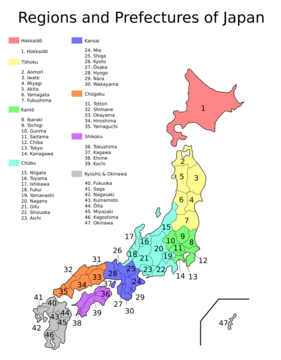
Miyagi Prefecture sits in the central part of Japan’s Tōhoku region, on the island of Honshu. Its neighbors are Iwate to the north, Akita to the northwest, Yamagata to the west, and Fukushima to the south. The prefecture faces the Pacific Ocean on its eastern side, and its western border runs along the Ōu Mountains, the longest mountain range in Japan. The capital, Sendai, is also the largest city in the entire Tōhoku region. Other major cities include Ishinomaki, Ōsaki, and Tome. As of August 1, 2023, the population stood at 2,265,724, spread across an area of 7,282 square kilometers. About 24 percent of that land falls within Natural Parks, including Sanriku Fukkō National Park, Kurikoma and Zaō Quasi-National Parks, and several prefectural parks. Near the town of Matsushima, the Matsushima Islands—a bay dotted with 260 small, pine-covered islands—are counted among the Three Views of Japan.
Historically, this area was part of the old province of Mutsu. The prefecture is especially prone to earthquakes, even by Japanese standards. Large quakes frequently occur off its coast, and inland tremors are common. The most devastating event in recent memory was the March 11, 2011, Tōhoku earthquake, a magnitude 9.0 event that generated a major tsunami. The tsunami, estimated to have reached about 10 meters high in Miyagi, caused severe damage. A month later, on April 7, a magnitude 7.4 earthquake struck off the coast, prompting another tsunami warning and the evacuation of workers from the troubled Fukushima Daiichi Nuclear Power Plant. Residents were told to move inland. In 2013, Crown Prince Naruhito and Crown Princess Masako visited the prefecture to see the recovery progress.
The geography features high mountains in the west and along the northeast coast, but a fairly large central plain surrounds Sendai. The Oshika Peninsula projects from the northern coastline. The prefecture’s economy relies on fishing and agriculture—producing rice and livestock—but manufacturing around Sendai dominates, especially in electronics, appliances, and food processing. As of March 2011, Miyagi accounted for 4.7 percent of Japan’s beef cattle, 23 percent of its oysters, and 15.9 percent of its sauries. In July 2011, the government banned shipments of beef cattle from the prefecture due to fears of radioactive contamination, though that ban was later lifted.
Demographically, the prefecture saw its fastest growth between 1940 and 1950, with continued growth into the 21st century. Like much of Japan, the overall population has since begun a slow decline, though Sendai itself has seen a moderate, steady increase over the past twenty years. The prefecture hosts numerous universities, including Tohoku University, Miyagi University, and several others. Transportation is served by JR East lines, including the Tōhoku Shinkansen, as well as the Sendai Municipal Subway, Abukuma Express, and the Sendai Airport Line. Major expressways include the Tōhoku, Yamagata, and Sanriku Expressways. Ports in Sendai and Ishinomaki handle ferries and cargo, and Sendai Airport provides air service. Sports teams based in the prefecture include the Tohoku Rakuten Golden Eagles (baseball), Vegalta Sendai (soccer), Sendai 89ERS (basketball), and Sendai Bellefille (volleyball). Sendai itself was the castle town of the daimyō Date Masamune, and the remains of Sendai Castle stand on a hill above the city.
- Population
- 2,265,724 (1 August 2023)
- Area
- 7,282 km² (2,812 sq mi)
- Capital
- Sendai
- Region
- Tōhoku, Honshu, Japan
- Notable Feature
- Matsushima Islands, one of the Three Views of Japan
Verified Timeline
Lore & Background
On March 11, 2011, a 9.0 magnitude earthquake and a subsequent major tsunami hit Miyagi Prefecture, causing major damage to the area. The tsunami was estimated to be approximately 10 metres (33 ft) high in Miyagi Prefecture. On April 7, 2011, a magnitude 7.4 earthquake struck off the coast of Miyagi, Japan. Workers were then evacuated from the nearby troubled Fukushima Daiichi Nuclear Power Plant once again, as a tsunami warning was issued for the coastline. Residents were told to flee inland at that time. In 2013, Crown Prince Naruhito and Crown Princess Masako visited the prefecture to see the progress made since the tsunami. Miyagi Prefecture is a prefecture that is particularly prone to earthquakes even in Japan, which is an earthquake-prone country. Large earthquakes occur frequently Miyagi offshore, and earthquakes also occur frequently inland. In the 2011 Tohoku earthquake that occurred Miyagi offshore, Miyagi Prefecture suffered the most damage nationwide.
Reader's Guide
Miyagi Prefecture holds significance as the economic and cultural heart of the Tōhoku region, anchored by its capital Sendai. Its economy blends fishing and agriculture—producing a great deal of rice and livestock, and as of March 2011, 23% of Japan's oysters and 15.9% of sauries—with manufacturing in electronics, appliances, and food processing around Sendai. The prefecture's legacy is deeply tied to the 2011 Tōhoku earthquake and tsunami, which caused catastrophic damage and prompted a temporary ban on beef cattle shipments from northeast Miyagi Prefecture over fears of radioactive contamination in July 2011, since rescinded. Culturally, Miyagi is home to the Matsushima Islands, one of Japan's three most scenic views, and the castle town of Sendai, associated with the daimyō Date Masamune. It hosts notable festivals such as the Aoba Festival with Suzume Odori traditional Japanese dance in May, and the Sendai Tanabata Festival, August 6–8. In popular culture, Miyagi Prefecture is a setting for anime series including Haikyū!!, Wake Up, Girls!, JoJo's Bizarre Adventure: Diamond Is Unbreakable, and Jujutsu Kaisen. The prefecture continues to recover and rebuild, with visits from the imperial family highlighting ongoing progress.
Did You Know?
- Miyagi Prefecture is bounded to the west by the Ōu Mountains, the longest mountain range in Japan.
- 24% of Miyagi Prefecture's total land area is designated as Natural Parks.
- As of March 2011, Miyagi Prefecture produced 23% of Japan's oysters and 15.9% of sauries.
- In July 2011, the Japanese government banned all shipments of beef cattle from northeast Miyagi Prefecture over fears of radioactive contamination, a ban that has since been rescinded.
- Miyagi Prefecture is one of the main settings of the manga and anime series Haikyū!!.
More in Prefectures Of Japan 1-24
Related in Prefectures Of Japan
Links follow this subject's own source article.
Spotted an error? Know more?
This is a living reference — every entry is fact-audited, and reader corrections feed straight into our audit queue. Suggest an edit · See this site's audit record