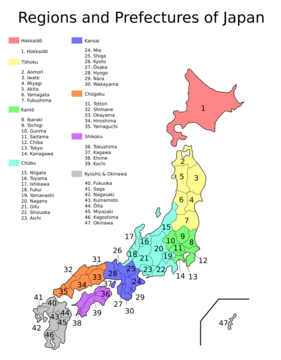
Gunma Prefecture
Inland prefecture known for horses, silk, and four prime ministers.

via Wikipedia: Gunma Prefecture · see source
Gunma Prefecture is an inland prefecture in Japan’s Kantō region, one of only eight such prefectures in the country. It occupies the northwestern corner of the Kantō Plain, with a population of approximately 1.94 million as of October 2019 and an area of 6,362 square kilometers. Maebashi serves as the capital, while Takasaki is the largest city; other major urban centers include Ōta, Isesaki, and Kiryū. The prefecture is mostly mountainous except for its central and southeastern areas, where most residents live. Its major rivers include the Tone, Agatsuma, and Karasu, and prominent mountains include Mount Akagi, Mount Haruna, Mount Myōgi, Mount Nikkō-Shirane, and Mount Asama on the Nagano border. About 14 percent of the land is designated as natural parks, including Jōshin’etsu-kōgen, Nikkō, and Oze National Parks, plus the Myōgi-Arafune-Saku Kōgen Quasi-National Park.
Historically, Gunma was known as the province of Kozuke. In ancient times, it was a center for horse breeding and trade linked to newly arrived continental peoples (Toraijin); the introduction of horses and horse tack coincided with a large migration from the mainland, and the horse soon became essential to Japanese warfare, replacing the earlier Yayoi tradition of fighting on foot. The eruption of Mount Haruna in the late 6th century occurred while Japan was still pre-literate, before the importation of Chinese writing in the Nara period; the Gunma Prefectural archaeology unit dated the eruption in 1994 using zoological anthropology on corral sites buried in ash. The area was once joined with Tochigi as Kenu Province, later split into Kami-tsu-ke (Upper Kenu, Gunma) and Shimo-tsu-ke (Lower Kenu, Tochigi). In the late Tokugawa period, foreigners referred to it as the “Joushu States,” and symbols of the Tokugawa family appear on many public buildings, temples, and shrines. The Tenmei eruption of Mount Asama in 1783 caused enormous damage. The first modern silk factories, built with Italian and French assistance, were established at Annaka in the 1870s. In the early Meiji period, the Gunma Incident of 1884 saw a bloody conflict between democratic Westernizers and conservative Prussian-model nationalists; farmers were gunned down by the modern Japanese army using new repeating rifles, becoming the first victims of the Murata rifle. In the 20th century, aviation pioneer Nakajima Chikushi of Oizum
- Capital
- Maebashi
- Largest City
- Takasaki
- Population (2019)
- 1,937,626
- Area
- 6,362 square kilometres (2,456 sq mi)
- Inland Prefecture
- Yes, one of eight
- Notable Prime Ministers
- Takeo Fukuda, Yasuhiro Nakasone, Keizo Obuchi, Yasuo Fukuda
Verified Timeline
Lore & Background
The ancient province of Gunma was a center of horse breeding and trading for the newly immigrated continental peoples (or Toraijin). The arrival of horses and horse tackle coincided with a large migration from the mainland, and the horse became a vital part of Japanese military maneuvers, displacing the older Yayoi tradition of fighting on foot. When Mount Haruna erupted in the late 6th century, Japan was still pre-historical; the Gunma Prefectural archaeology unit in 1994 dated the eruption through zoological anthropology at corral sites buried in ash. In the past, Gunma was joined with Tochigi Prefecture and called Kenu Province, later divided into Kami-tsu-ke (Upper Kenu, Gunma) and Shimo-tsu-ke (Lower Kenu, Tochigi). The area is sometimes referred to as Jomo (上毛, Jōmō). For most of Japanese history, Gunma was known as the province of Kozuke. In the early period of contact between western nations and Japan, particularly the late Tokugawa, it was referred to by foreigners as the 'Joushu States', inside (fudai, or loyalist) Tokugawa retainers and the Tokugawa family symbol is widely seen on public buildings, temples, and shrines.
Reader's Guide
Gunma Prefecture holds significance as a historical crossroads of continental migration and horse culture that shaped Japanese military tactics. Its role in early industrialization is marked by the first modern silk factories built with Italian and French assistance at Annaka in the 1870s. The prefecture was also the site of the Gunma Incident of 1884, a bloody struggle between democratic Westernisers and conservative Prussian-model nationalists, where farmers were said to be the first victims of the Murata rifle. In the twentieth century, aviation pioneer Nakajima Chikushi founded the Nakajima Aircraft Company in Oizumi, which became a world leader in aeronautical design and later produced Subaru motorcars. Gunma is also notable for the Girard incident of 1957, which disturbed US-Japanese relations. Its legacy includes four modern prime ministers, a unique local dialect (gunma-ben or jōshū-ben), and the traditional card game Jomo Karuta. The prefecture is home to eleven of Japan's over thirty Melody roads, and on August 5, 2025, Isesaki recorded a temperature of 41.8 °C, the hottest ever in Japanese history.
Did You Know?
- Gunma Prefecture is one of only eight inland prefectures in Japan.
- On August 5, 2025, Isesaki recorded a temperature of 41.8 °C, the hottest ever in Japanese history.
- Gunma produces over 90% of Japan's konnyaku.
- Four modern prime ministers are from Gunma: Takeo Fukuda, Yasuhiro Nakasone, Keizo Obuchi, and Yasuo Fukuda.
- Gunma is home to eleven of Japan's over thirty Melody roads.
More in Prefectures Of Japan 1-24
Related in Prefectures Of Japan
Links follow this subject's own source article.
Spotted an error? Know more?
This is a living reference — every entry is fact-audited, and reader corrections feed straight into our audit queue. Suggest an edit · See this site's audit record