Yamagata Prefecture
A prefecture of mountains, cherries, and historic Dewa Province.

さかおり · via Wikipedia: Yamagata Prefecture · CC BY-SA 4.0
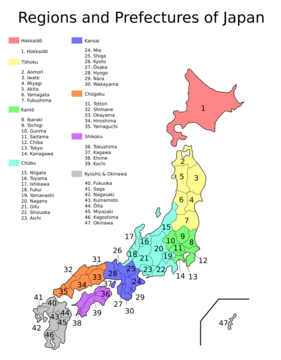
Yamagata Prefecture sits in the southwest corner of Japan’s Tōhoku region, on the western coast of Honshu along the Sea of Japan. It covers 9,325 square kilometers and, as of February 2025, had a population of 1,005,926. The prefecture borders Akita to the north, Miyagi to the east, Fukushima to the south, and Niigata to the southwest. Its capital and largest city is Yamagata; other major cities include Tsuruoka, Sakata, and Yonezawa. Mountain ranges mark all of its boundaries, and 17 percent of the land is designated as Natural Parks. Historically, Yamagata formed the southern half of Dewa Province alongside Akita. It is home to the Three Mountains of Dewa, which feature the Haguro Five-story Pagoda, a National Treasure of Japan.
The area was originally inhabited by the Ezo people. During the Heian period, the Fujiwara family ruled the region. In the Edo period, Yamagata City flourished as a castle town and post station, known for its beni red safflower dye used in silk production. In 1689, the poet Matsuo Bashō visited Yamagata during his five-month journey through northern Japan.
The prefecture’s climate brings long, hot, humid summers and long, snowy winters, with short, often cool springs and warm, dry autumns. It lies in a transition zone between humid subtropical and humid continental climates. Winter temperatures in populated areas rarely drop below −10°C, while summer highs frequently exceed 30°C. Precipitation falls year-round, with one or two typhoon remnants passing through between August and October. Heavy snowfall occurs at higher elevations; the central mountains around Gassan can see up to 3,000 centimeters of snow in a season, with depths reaching 8 meters. The Sea of Japan coast around Sakata is milder and gets more rain.
Yamagata is Japan’s largest producer of cherries and pears, and also grows grapes, apples, peaches, melons, persimmons, and watermelons.
At the 2020 census, the population was 1,068,027. By October 2024, 10.4 percent of residents were under 15, 54.0 percent were between 15 and 64, and 35.6 percent were 65 or older. The prefecture grew fastest after World War II, then slowed and began a steady decline. In May 2025, the prefectural government announced the estimated population had fallen below one million—the lowest level since the 1920 census.
Quick Facts
- Native Name
- ja · 山形県
- Settlement Type
- Prefecture
- Blank Emblem Type
- Symbol
Facts from the source article.
Lore & Background
The aboriginal Ezo people once inhabited the area now known as Yamagata. During the Heian period, the Fujiwara family ruled the area. Yamagata City flourished during the Edo period as a castle town and post station, famous for beni (red safflower dye used in handspun silk). In 1689, the haiku poet Matsuo Bashō visited Yamagata during his five-month trip to northern Japan.
Yamagata Prefecture is the largest producer of cherries and pears in Japan, and also produces grapes, apples, peaches, melons, persimmons, and watermelons. The prefecture's climate features long, hot, humid summers and long, snowy winters, with heavy snowfall at higher elevations. The central mountains around Gassan may see as much as 3,000 centimetres of snow in a season.
The prefecture is known for its local dialect Yamagata-ben, sometimes thought of as backward sounding in other parts of Japan. The 2004 movie Swing Girls, set in Yamagata, uses Yamagata-ben for comedic purposes.
Reader's Guide
Yamagata Prefecture holds significance as a repository of Japanese cultural and natural heritage. Its Three Mountains of Dewa form a traditional pilgrimage for followers of the Shugendō branch of Shintō, and the Haguro Five-story Pagoda is a National Treasure. The prefecture's Buddhist art, catalogued in a three-year project beginning in 2003, includes a rare seated Vairocana Buddha statue at Heisenji Temple, as well as significant sculptures from the Heian and Kamakura periods.
Economically, Yamagata is Japan's leading producer of cherries and pears, and its fruit industry is a major contributor to the region. The Yamagata Hanagasa Festival, held in August, attracts up to 300,000 spectators, and the bi-annual Yamagata International Documentary Film Festival takes place in October. The prefecture's imoni (taro-root stew) is famous in northern Japan, drawing tourists in autumn.
Yamagata's population has declined steadily since its post-World War II peak; in May 2025, the estimated population fell below 1 million, the lowest since the 1920 census. Notable figures from the prefecture include daimyō Date Masamune, novelist Inoue Hisashi, manga artist Yoshihiro Togashi, and Olympic gold medalist Shozo Sasahara.
Did You Know?
- The Haguro Five-story Pagoda is a recognised National Treasure of Japan.
- The central mountains around Gassan may see up to 3,000 centimetres of snow in a season.
- In May 2025, the estimated population of Yamagata fell below 1 million, the lowest since the 1920 census.
More in Prefectures Of Japan 1-24
Spotted an error? Know more?
Reader corrections go straight into our review queue. Suggest an edit · How this site is sourced