Fukuoka Prefecture
Northern Kyūshū prefecture with major industry and cultural festivals.

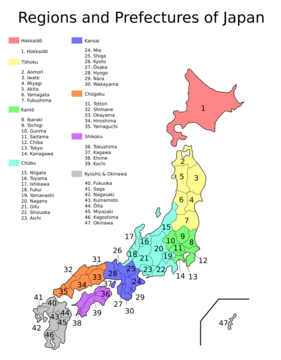
Fukuoka Prefecture is a prefecture of Japan located on the island of Kyūshū. It is notable as the northernmost prefecture on Kyūshū, facing the Kanmon Straits, which connect the Tsushima Strait and the Seto Inland Sea, and lies across from Yamaguchi Prefecture on Honshu. The prefecture also extends south toward the Ariake Sea and borders Saga, Kumamoto, and Ōita prefectures. Its geography includes a number of small islands near Kyūshū’s north coast, and as of 2012, 18% of its land area was designated as natural parks, including the Setonaikai National Park and several quasi-national and prefectural parks. Historically, the region comprised the former provinces of Chikugo, Chikuzen, and Buzen. Fukuoka Prefecture is a major industrial and cultural center, containing the two largest cities on Kyūshū, Fukuoka and Kitakyushu, along with other major cities such as Kurume and Ōmuta. Its economy accounts for nearly 40% of Kyūshū’s total, with a GDP exceeding 154 billion US dollars, driven by industries like automobiles, semiconductors, and steel. Notable companies founded here include Bridgestone and Best Denki, and the prefecture is home to Kyushu University, one of Japan’s top five universities. The prefecture also holds significant religious sites: chief Shinto shrines include Kōra taisha, Sumiyoshi-jinja, and Hakozaki-gū. Important Buddhist temples include Shōfuku-ji, the oldest zen temple in Japan, founded by monk Eisai; Tocho-ji, established by Kukai; and Joten-ji, built by Enni, who also introduced udon noodles. The oldest temple is Kanzeon-ji, founded in Dazaifu during the 7th century, which together with Kaidan-in was one of only three places in Japan where monks could ordain. Bairin-ji in Kurume, moved by daimyo Arima Toyōji during the Tokugawa shogunate, remains a major zen temple. Culturally, the prefecture hosts museums such as the Fukuoka Art Museum, Fukuoka Asian Art Museum, and the Kyushu National Museum, as well as the Hakata Gion Yamakasa festival and the HKT48 Theater. Demographically, the population was 5,081,879 as of October 2025, having declined from 5,135,214 in 2020, though it moved from the 9th to the 8th most populated prefecture in Japan.
- Capital
- Fukuoka
- Largest city
- Fukuoka
- Major industries
- Automobiles, semiconductors, steel
- Notable companies founded
- Bridgestone, Best Denki, TOTO Ltd., Yasukawa Electric Corporation
- Number of cities
- 29
Lore & Background
Fukuoka Prefecture includes the former provinces of Chikugo, Chikuzen, and Buzen. Its history is reflected in its many temples and shrines: Kōra taisha, Sumiyoshi-jinja, and Hakozaki-gū are the chief Shinto shrines. Monk Eisai founded Shōfuku-ji, the oldest zen temple in Japan; monk Kukai established Tocho-ji; and Joten-ji was built by Enni, who also brought udon noodles to Japan. The oldest temple is Kanzeon-ji, founded by the Emperor in Dazaifu during the 7th century, which together with Kaidan-in was one of three places in Japan where Buddhist monks could ordain. During the Tokugawa shogunate, daimyo Arima Toyōji moved his family temple to Kurume City, now known as Bairin-ji, a main zen temple in the prefecture.
Reader's Guide
Its economy is driven by automobiles, semiconductors, and steel, and it is the birthplace of major companies like Bridgestone and TOTO Ltd. The prefecture is also a cultural hub, hosting festivals such as Hakata Gion Yamakasa and Hakata Dontaku Harbour Festival, and contains numerous museums, including the Kyushu National Museum and Fukuoka Asian Art Museum. Fukuoka Prefecture has the most designated yakuza groups among all prefectures, with five, and has led the nation in gun-related incidents in certain periods. The prefecture is home to Kyushu University, one of Japan's top five universities, and hosts sports teams including the Fukuoka SoftBank Hawks and Avispa Fukuoka.
Did You Know?
- Fukuoka Prefecture has the most designated yakuza groups among all Japanese prefectures, at five.
- Monk Eisai founded Shōfuku-ji, the oldest zen temple in Japan, located in the prefecture.
- The prefecture accounts for nearly 40% of the economy of Kyūshū.
- Fukuoka Prefecture includes the two largest cities on Kyūshū: Fukuoka and Kitakyushu.
More in Prefectures Of Japan 1-24
Spotted an error? Know more?
This is a living reference — every entry is fact-audited, and reader corrections feed straight into our audit queue. Suggest an edit · See this site's audit record