Kyoto Prefecture
Historic imperial capital and cultural center of Japan.

via Wikipedia: Kyoto Prefecture · see source
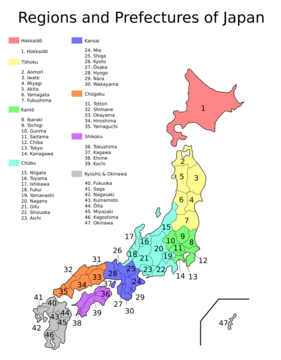
Kyoto Prefecture is a region in Japan’s Kansai area on the island of Honshu. It is home to about 2.58 million people and covers 4,612 square kilometers. Its neighbors are Fukui to the northeast, Shiga to the east, Mie to the southeast, Nara and Osaka to the south, and Hyōgo to the west. The capital, Kyoto city, holds 57 percent of the prefecture’s population. Other major cities include Kameoka, Maizuru, and Uji. The prefecture stretches from the Sea of Japan coast southeast toward the Kii Peninsula, covering the old provinces of Tamba, Tango, and Yamashiro. It is one of only two prefectures in Japan—the other being Osaka—that uses the suffix *fu* instead of the usual *ken*. Tourism is a major draw, and 21 percent of the land is set aside as Natural Parks. Kyoto Prefecture is part of the Keihanshin metropolitan area, the second most populous region in Japan after Greater Tokyo and one of the world’s top economic zones by GDP.
Before the Meiji Restoration, this area was known as Yamashiro. For most of its history, Kyoto city served as Japan’s imperial capital. The city’s history goes back to the 6th century; in 544, the Aoi Matsuri festival was held there to pray for good harvests and weather. Kyoto was not the first capital—Nara came earlier. In 741, Emperor Shōmu briefly moved the capital to Kuni-kyo, within today’s Kyoto Prefecture. In 784, it shifted to Nagaokakyō, also in the prefecture. Then, in 794, Emperor Kanmu established Heian-kyō, which became modern Kyoto. Most of the streets, houses, stores, temples, and shrines in Kyoto still stand where they were placed that year. In 1192, real political power moved to Kamakura under a samurai shogunate, but Kyoto remained the imperial seat for the powerless emperors and their court. Imperial rule was briefly restored in 1333, but three years later another samurai clan set up a new shogunate in Kyoto. The Ōnin War, a great civil war, broke out in Kyoto in 1467, burning most of the town. Japan then entered the age of warring feudal lords. Tokugawa Ieyasu established a shogunate in Edo (now Tokyo) in 1603. In the 15th century, shōguns brought tea-jars from the Philippines to Uji in Kyoto for use in the Japanese tea ceremony. The Meiji Restoration returned Japan to imperial rule in 1868. Emperor Meiji, now absolute sovereign, moved to Tokyo the next year, and the imperial court never returned to Kyoto. During the 1868 Fuhanken Sanchisei reforms, the prefecture received its *fu* designation. Later, the old provincial system was reorganized, merging Tango Province, Yamashiro Province, and eastern Tanba Province into today’s Kyoto Prefecture. Although many Japanese cities were heavily bombed in World War II, Kyoto escaped such destruction. During the occupation, the U.S. Sixth Army and I Corps were headquartered there.
Kyoto Prefecture lies almost in the center of Honshu and Japan. It covers 4,612 square kilometers, or 1.2 percent of Japan’s total area, making it the 31st largest prefecture. To the north, it faces the Sea of Japan and Fukui Prefecture; to the south, Osaka and Nara; to the east, Mie and Shiga; and to the west, Hyōgo. The Tanba Mountains split the prefecture in two, giving the north and south very different climates. Twenty-one percent of the land is designated as Natural Parks: Sanin Kaigan National Park; Biwako, Kyoto Tamba Kogen, Tango-Amanohashidate-Ōeyama, and Wakasa Wan Quasi-National Parks; and Hozukyō, Kasagiyama, and Rurikei Prefectural Natural Parks.
Fifteen cities are in Kyoto Prefecture: Kyōtanabe, Kyōtango, Kizugawa, Kameoka, Maizuru, Miyazu, Mukō, Nagaokakyō, Nantan, Uji, Ayabe, Yawata, Jōyō, Fukuchiyama, and the capital Kyoto. Kansai Science City is in the southwest. There are also towns and villages in several districts: Funai District (Kyōtamba), Kuse District (Kumiyama), Otokuni District (Ōyamazaki), Sōraku District (Kasagi, Minamiyamashiro, Seika, Wazuka), Tsuzuki District (Ide, Ujitawara), and Yosa District (Ine, Yosano). Past mergers have reshaped these boundaries.
In 2020, Kyoto Prefecture had a population pyramid typical of an aging society, and it recorded one of the highest life expectancies in Japan at 85.54 years. According to a 2020 Agency for Cultural Affairs survey, over 60 percent of residents follow Shinto and Buddhism.
The current governor is Takatoshi Nishiwaki, a former vice minister of the Reconstruction Agency, first elected in April 2018 and re-elected twice since. The prefectural assembly has 60 members from 25 districts, elected in unified local elections (last round in 2019). As of September 2020, the assembly consisted of 30 Liberal Democratic Party members, 12 Japanese Communist Party, 11 Democratic Party, 5 Kōmeitō, and 2 Japan Restoration Party. Kyoto sends six members to the House of Representatives and four (two per election) to the House of Councillors. After the 2022, 2024, and 2025 national elections, the lower house delegation includes two LDP, two CDP, one Ishin, and one independent; the upper house has two LDP, one CDP, and one Ishin.
The prefectural flower is the weeping cherry, the official tree is the Kitayama Sugi, and the symbol bird is the streaked shearwater. Defense facilities are located in the prefecture, with details dating from August 1, 2013, involving prefectural and municipal arrangements.
- Population
- 2.58 million
- Area
- 4,612 square kilometres (1,781 sq mi)
- Capital
- Kyoto
- Region
- Kansai, Honshu
- Designation
- Fu (prefecture)
- Natural Parks
- 21% of land area
Verified Timeline
Lore & Background
Until the Meiji Restoration, the area of Kyoto Prefecture was known as Yamashiro. For most of its history, the city of Kyoto was Japan's Imperial capital. The city's history can be traced back as far as the 6th century. In 544, the Aoi Matsuri was held in Kyoto to pray for good harvest and good weather. Kyoto did not start out as Japan's capital. A noteworthy earlier capital was Nara. In 741, Emperor Shōmu moved the capital briefly to Kuni-kyo, between the cities of Nara and Kyoto, in present-day Kyoto Prefecture. In 784, the capital was moved to Nagaokakyō, also in present-day Kyoto Prefecture. In 794, Emperor Kanmu moved the capital to Heian-kyō, and this was the beginning of the current-day city of Kyoto. Even today, almost all of the streets, houses, stores, temples and shrines in Kyoto exist where they were placed in this year. Although in 1192 real political power shifted to Kamakura, where a samurai clan established the shogunate, Kyoto remained the imperial capital as the powerless emperors and their court continued to be seated in the city. Imperial rule was briefly restored in 1333, but another samurai clan established a new shogunate in Kyoto three years later. In 1467, a great civil war, the Ōnin War, took place inside Kyoto, and most of the town was burned down. Japan plunged into the age of warring feudal lords. A new strong man, Tokugawa Ieyasu, established the shogunate at Edo (today's Tokyo) in 1603. In the 15th century AD, tea-jars were brought by the shōguns to Uji in Kyoto from the Philippines which was used in the Japanese tea ceremony. The Meiji Restoration returned Japan to imperial rule in 1868. Emperor Meiji, who was now the absolute sovereign, went to stay in Tokyo during the next year. The imperial court has not returned to Kyoto since then. During the instigation of Fuhanken Sanchisei in 1868, the prefecture received its suffix fu. The subsequent reorganization of the old provincial system merged the former Tango Province, Yamashiro Province and the eastern part of Tanba Province into today's Kyoto Prefecture. Although many Japanese major cities were heavily bombed during World War II, the old capital escaped such devastation. During the occupation, the U.S. Sixth Army and I Corps were headquartered in Kyoto.
Reader's Guide
Kyoto Prefecture's economy is supported by industries that create value that is unique to Kyoto, such as the tourism and traditional industries supported by 1,200 years of history and culture, as well as high-technology industries that combine the technology of Kyoto's traditional industries with new ideas. Northern Kyoto on the Tango Peninsula has fishing and water transportation, and midland Kyoto has agriculture and forestry. The prefecture produces 13% of the domestic sake and green tea. Japan's largest vertical farm is located in the prefecture. The Kyoto-based manufacturing industry holds shares of Japan's high-technology product markets and others. As of 2021, eight Forbes Global 2000 companies were located in Kyoto prefecture: Nintendo, Nidec, Kyocera, Murata Manufacturing, Omron, Rohm, Bank of Kyoto, SCREEN Holdings. Takara Holdings, GS Yuasa, Mitsubishi Logisnext, Maxell, and Kyoto Animation are also based in the prefecture. As of October 2021, the minimum wage in the prefecture was ¥937 per hour. Kyoto City is one of the most popular tourist spots in Japan, and many people from far and wide visit there. Along with Tokyo, Kyoto is a favorite location for the graduation trip of Junior High and High schools. Some of the festivals held in Kyoto are Aoi Matsuri from 544, Gion Matsuri from 869, Ine Matsuri from the Edo-era, Daimonji Gozan Okuribi from 1662, and Jidai Matsuri from 1895. Every shrine and temple holds some sort of event, and many of them are open for public viewing. The prefectural flower of Kyoto is the weeping cherry. The Kitayama Sugi is the official tree, and the streaked shearwater the bird that symbolizes the prefecture.
Did You Know?
- Kyoto Prefecture is one of only two prefectures in Japan (with Osaka) that uses the designation fu rather than the standard ken.
- The Aoi Matsuri, first held in 544, is one of the oldest festivals in Kyoto, originally held to pray for good harvest and good weather.
- In the 15th century, tea-jars were brought by the shōguns to Uji in Kyoto from the Philippines for use in the Japanese tea ceremony.
- During World War II, while many Japanese major cities were heavily bombed, the old capital of Kyoto escaped such devastation.
- As of 2021, eight Forbes Global 2000 companies are located in Kyoto Prefecture, including Nintendo, Kyocera, and Murata Manufacturing.
More in Prefectures Of Japan 1-24
Related in Prefectures Of Japan
Links follow this subject's own source article.
Spotted an error? Know more?
This is a living reference — every entry is fact-audited, and reader corrections feed straight into our audit queue. Suggest an edit · See this site's audit record