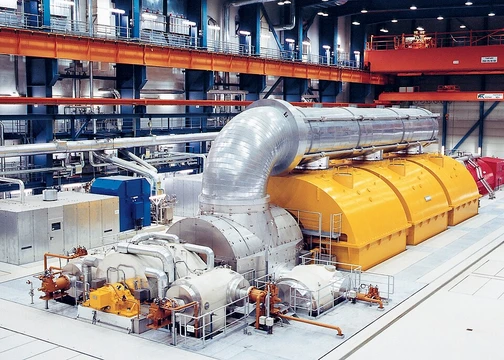
Boiler (power generation)
Device creating steam by heating water for power or heat.

TheDeman · CC BY-SA 3.0
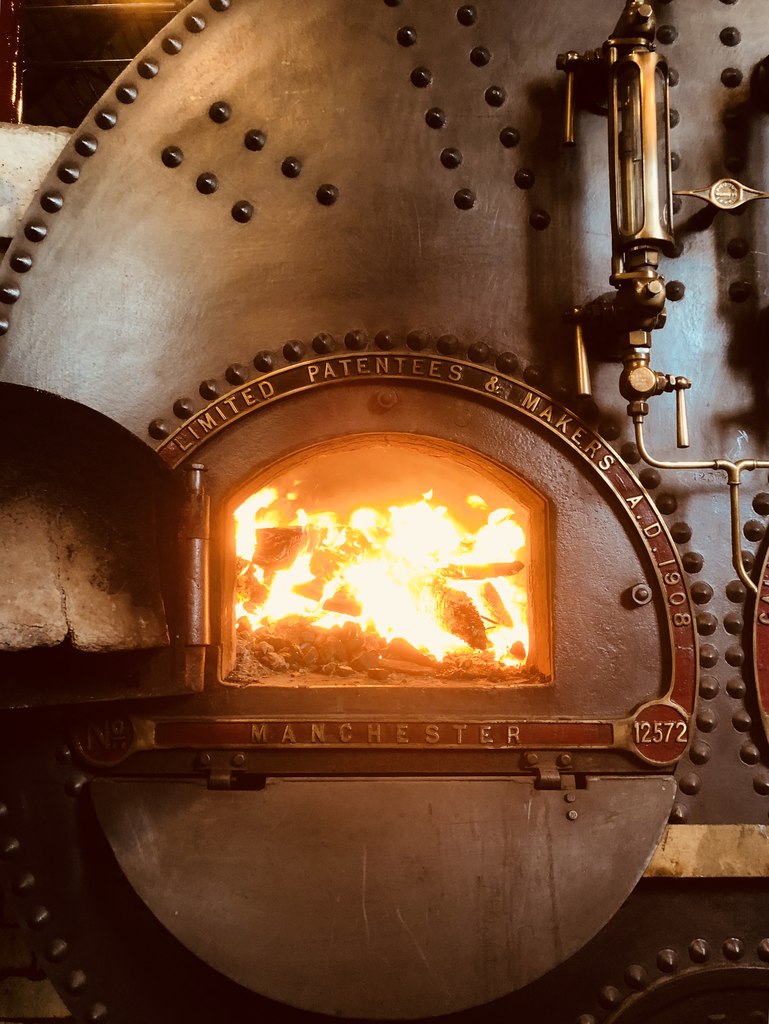
A boiler, also called a steam generator, produces steam by heating water. It is used wherever steam is needed, and its design and size vary by application. Mobile steam engines, like locomotives and road vehicles, typically have a small boiler built into the vehicle. Stationary engines, heating plants, industrial facilities, and power stations usually have a larger, separate steam generator connected by pipes. A steam-powered fireless locomotive is an exception, as it receives steam from a separate source into a tank on board.
As part of a prime mover, the steam generator is essential to a steam engine, but it is treated separately because different generator types can work with different engine units. A boiler contains a firebox or furnace to burn fuel and generate heat, which is transferred to water to create steam through boiling. This produces saturated steam at a rate that depends on the pressure above the boiling water; higher furnace temperatures speed up steam production. The saturated steam can be used immediately to power a turbine and alternator, or it can be superheated to a higher temperature. Superheating reduces suspended water content, allowing a given volume of steam to do more work, and creates a greater temperature gradient that helps prevent condensation. Any remaining heat in the combustion gases can be vented or passed through an economiser to warm the feed water before it reaches the boiler.
Early boilers, like those for the first Newcomen engine in 1712, were little more than large brewer's kettles placed under the power cylinder. Because the engine relied on vacuum from condensing steam, it needed large volumes of steam at very low pressure—barely above 1 psi. The boiler was set in brickwork to retain heat, and a coal fire burned on a grate beneath a slightly dished pan, which had a very small heating surface, wasting much heat up the chimney. Later, John Smeaton increased the heating surface by making the gases heat the boiler sides through a flue, and he lengthened the gas path with a spiral labyrinth flue beneath the boiler. These under-fired boilers were used in various forms throughout the 18th century, some round (haycock) and some rectangular (wagon top), developed around 1775 by Boulton and Watt. This is now known as a three-pass boiler: the fire heats the underside, gases pass through a central square flue, and then around the boiler sides.
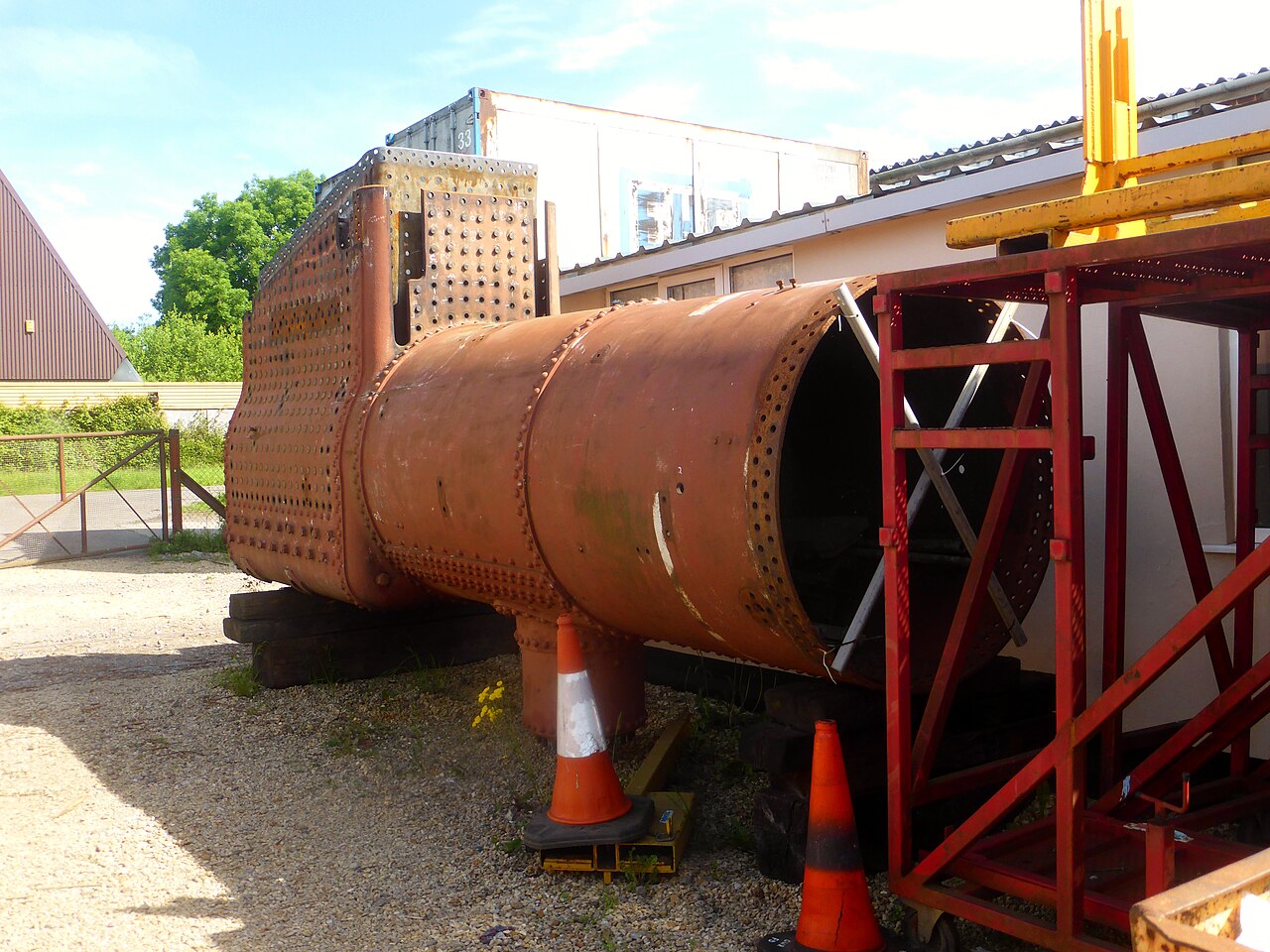
The cylindrical fire-tube boiler was first proposed by British engineer John Blakey in 1774. American engineer Oliver Evans also championed the cylindrical form for its mechanical strength and began using it in his projects near the end of the 18th century. Likely inspired by Leupold's high-pressure engine scheme from 1725, Evans favored "strong steam"—non-condensing engines where steam pressure alone drove the piston and then exhausted to atmosphere. He believed strong steam allowed smaller steam volumes to do more work, reducing component sizes for transport and small installations. He developed a long cylindrical wrought iron horizontal boiler with a single fire tube, the fire grate at one end. Gas flow reversed into a flue beneath the boiler barrel, then divided into side flues before rejoining at the chimney (Columbian engine boiler). Evans used this boiler in both stationary and mobile engines; the latter were one-pass, exhausting directly from the fire tube to the chimney due to space and weight limits. Another advocate of strong steam was Cornishman Richard Trevithick. His boilers operated at 40–50 psi, first hemispherical then cylindrical. From 1804, he produced a small two-pass or return flue boiler for semi-portable and locomotive engines. The Cornish boiler, developed around 1812, was stronger and more efficient than earlier simple boilers. It consisted of a cylindrical water tank about 27 feet long and 7 feet in diameter, with a coal fire grate at one end of a single cylindrical tube about three feet wide running longitudinally inside the tank. The fire was tended from one end; hot gases traveled along the tube and out the other end, then circulated back along external flues and a third time beneath the boiler barrel before exiting into a chimney. This design was later improved by the Lancashire boiler, which had two furnaces in separate tubes side by side.
- field
- Power generation, mechanical engineering
- known_for
- Producing steam for engines, heating, and power generation
- common_fuels
- Wood, coal, oil, natural gas; also nuclear fission
- key_components
- Firebox or furnace, water space, tubes, chimney
Lore & Background
Later improvements by John Smeaton increased the heating surface by making the gases heat the boiler sides through a flue, and Boulton and Watt developed the wagon top boiler, a three-pass design. In this configuration, the fire heats the underside, the gases then pass through a central square-section tubular flue, and finally travel around the boiler sides. An early proponent of the cylindrical form was John Blakey, who proposed his design in 1774. Oliver Evans also recognized that the cylindrical form offered the best mechanical resistance and began incorporating it into his projects. He developed a long cylindrical wrought iron horizontal boiler with a single fire tube, at one end of which was the fire grate. The gas flow reversed into a passage or flue beneath the boiler barrel, then divided to return through side flues to the chimney. Richard Trevithick produced a small two-pass or return flue boiler from 1804 onwards for semi-portable and locomotive engines. The Cornish boiler, developed around 1812, was stronger and more efficient than its predecessors. It consisted of a cylindrical water tank with a coal fire grate at one end of a single cylindrical tube passing longitudinally inside. The hot gases travelled along the tube, circulated back along external flues, then passed a third time beneath the boiler barrel before being expelled. This was later improved upon by the Lancashire boiler, another three-pass design.
Reader's Guide
The boiler is an integral component of a steam engine as a prime mover, though a variety of generator types can be combined with different engine units. The generated heat is transferred to water to make steam, producing saturated steam that can be used immediately for power via a turbine and alternator, or further superheated to reduce suspended water content and increase work output. Remaining heat in combustion gases may pass through an economiser to warm feed water. Structural resistance evolved from riveted copper plates to wrought iron plates, with welded construction slow to take hold. Once-through monotubular water tube boilers can withstand considerable pressure without danger of explosion. Combustion sources include wood, coal, oil, natural gas, and nuclear fission; heat recovery steam generators use heat rejected from other processes. The development of multi-tube boilers, such as Marc Seguin's two-pass design and the boiler used on Stephenson's Rocket (with 25 copper tubes), vastly improved heat transfer and became the basis for subsequent fire-tube boilers.
Did You Know?
- Oliver Evans favored 'strong steam' (non-condensing engines) to reduce component size for transport and small installations.
- The Lancashire boiler had a pair of furnaces in separate tubes side-by-side, allowing one to be cleaned while the other operated.
- The boiler used on Stephenson's Rocket had 25 copper tubes mounted in a barrel, vastly improving heat transfer.
The Heat Engine Foundation
Electricity does not exist in a freely usable form in nature; it must be manufactured by converting some other energy source into electrical power. For much of the industrial era, that conversion relied on heat. The most common commercial approach involves electromechanical generators turned by heat engines running on combustion or nuclear fission. The very first central power station, Pearl Street Station in New York in 1882, used a steam engine to drive a dynamo, producing direct current that illuminated the streets of Manhattan. That milestone built on principles Michael Faraday established in the 1820s and 1830s, showing that moving a loop of wire between magnetic poles generates current. Before such mechanical generation, the only practical electricity came from chemical reactions or battery cells, and its sole real-world application was the telegraph. The coupling of a dynamo to a hydraulic turbine marked the true beginning of commercial power production and set the stage for the Second Industrial Revolution, with Thomas Edison and Nikola Tesla among its defining figures.
The Steam Turbine Revolution
The introduction of the steam turbine represented a quantum leap in how heat energy became mechanical work. While the underlying conversion principle echoed that of earlier steam engines, the turbine operated at a dramatically larger scale and with far greater productivity, reshaping both the efficiency and the economics of electrical generation. These large-scale plants became the backbone of centralized power systems. Central stations themselves only became economically viable once alternating current transmission, high-voltage power transformers, and low-loss line technology were developed. Through the mid-twentieth century, individual utilities that had once operated independent distribution networks began merging to capture scale benefits. Long-distance transmission lines allowed power plants to be coordinated across regions, and dedicated system operators were appointed to safeguard grid stability and reliability. The result was a tightly integrated infrastructure in which heat-driven generation at scale could feed entire metropolitan areas, a model that persists in many parts of the world today.
The Coal Era and Its Unwinding
The earliest power plants drew their energy from water or coal, and for well over a century coal-fired stations dominated the global generation landscape. Today, the energy mix has broadened considerably, encompassing nuclear, natural gas, hydroelectric, wind, oil, solar, tidal, and geothermal sources. Yet the legacy of coal remains central to the climate conversation. Phasing out coal-fired power stations, and eventually gas-fired ones as well, or capturing their greenhouse gas emissions where practical, is widely regarded as a critical component of the energy transformation needed to limit climate change. Encouragingly, by 2023 reports indicated that the global electricity supply was approaching peak carbon dioxide emissions, a milestone attributed largely to the rapid expansion of solar and wind capacity. This shift signals that the heat-engine era, while still dominant, is entering a period of structural transition as cleaner sources gain ground.
The Diverse Energy Landscape
Looking forward, the generation landscape is set to diversify even further. Forecasts call for vastly greater contributions from solar and wind power, driven by surging electricity demand as transport, households, and industry undergo deeper electrification. Beyond the well-known sources, researchers explore exotic and speculative routes, including proposed fusion reactor designs that would extract energy directly from the intense magnetic fields produced by fast-moving charged particles in a fusion reaction, a concept rooted in magnetohydrodynamics. Niche generation methods also exist for specialized applications: the triboelectric effect, the piezoelectric effect, the thermoelectric effect, and betavoltaics each convert a distinct physical phenomenon into usable electricity. A small share of utility-distributed power already comes from batteries rather than continuous generation. Together, these varied pathways illustrate that the conversion of primary energy into electricity is far from a single-technology story, and the heat-engine paradigm, though still central, is one thread among many.
Gallery

Frequently Asked Questions
What is Boiler (power generation)?
A boiler is a mechanical device that converts heat energy into steam by heating water, serving as the core heat-producing unit in steam-based power plants, mobile engines, and industrial heating systems.
What are Boiler (power generation)'s key components?
The main parts include a firebox or furnace where combustion occurs, a water space that holds the liquid being heated, tubes that transfer heat from the hot gases to the water, and a chimney that vents exhaust gases.
What fuels can Boiler (power generation) burn?
Boilers are designed to run on a wide range of fuels, including wood, coal, oil, and natural gas, and in nuclear applications the 'fuel' is the heat released from uranium fission rather than a chemical combustion process.
Why is Boiler (power generation) important in the power sector?
Without a boiler or equivalent steam-producing unit, there is no steam to drive turbines, meaning the device sits at the very start of the chain that turns thermal energy into mechanical rotation and ultimately into electricity for the grid.
More in Power Generation 1-20
Spotted an error? Know more?
This is a living reference — every entry is fact-audited, and reader corrections feed straight into our audit queue. Suggest an edit · See this site's audit record