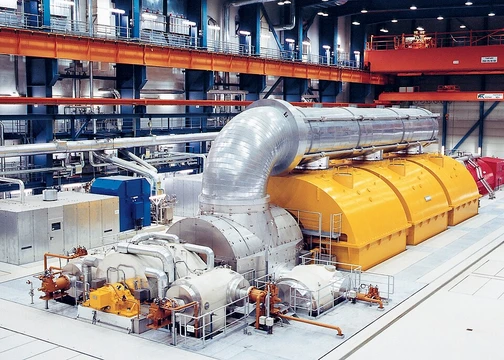
Base load
Minimum grid demand met by unvarying or flexible generation.

U.S. Army photo by Spc. Hunter Carpenter · Public domain
Base load, sometimes written as baseload, refers to the lowest level of electricity demand that a grid experiences over a given period, for instance a week. This demand can be satisfied by either constant-output power plants or dispatchable generation, depending on which combination offers the best trade-off between cost, availability, and reliability in a specific market. The rest of the demand, which fluctuates throughout the day, is covered by intermittent sources alongside dispatchable generation—such as load-following or peaking plants that can ramp up or down quickly—or by energy storage. Power plants that cannot alter their output rapidly, like certain large coal or nuclear facilities, are typically called baseload power plants. During the 20th century, nearly all base load demand was supplied by these baseload plants, whereas newer capacity built around renewables often relies on flexible generation. **Description** Grid operators manage continuous bids for electricity over short and long timeframes to keep supply and demand balanced. The detailed scheduling involved is known as the unit commitment problem. Although large power grids historically used unvarying plants to cover base load, there is no technical necessity for this approach. Base load can just as easily be met by an appropriate mix of intermittent sources and dispatchable generation. Unvarying plants include coal, nuclear, combined-cycle units (which may take days to start up or shut down), hydroelectric, geothermal, biogas, and biomass. Dispatchability—the ability to adjust output on demand—is a useful trait of some gas plants and hydroelectricity. Grid operators also use curtailment to disconnect plants from the grid when their power is not needed. **Economics** Grid operators solicit bids to identify the cheapest electricity sources for both short and long purchasing periods. Traditionally, nuclear and coal plants had high fixed costs and high capacity factors but low marginal costs. In contrast, peak-load generators like natural gas had low fixed costs, low capacity factors, and high marginal costs. Some coal and nuclear plants do not vary their output to match demand because it can be more economical to keep them running at constant levels—even when electricity prices fall below marginal cost—and because not all plants are designed for load-following. The IEA has advised that coal plants should not operate as baseload, as doing so emits large amounts of carbon dioxide, which contributes to climate change. Certain nuclear stations, such as those in France, are physically capable of load-following and do adjust their output to some extent to help meet changing demand. Some combined-cycle plants, usually gas-fired, can provide baseload power while also being cost-effectively cycled up and down to match rapid consumption shifts.
- field
- Electrical power production
- known_for
- Minimum level of demand on an electrical grid
- related_concepts
- Baseload power plants, dispatchable generation, load following power plants, peaking power plants
Lore & Background
Grid operators take long and short term bids to provide electricity over various time periods and balance supply and demand continuously. The detailed adjustments are known as the unit commitment problem. Unvarying power plants can be coal, nuclear, combined cycle plants, hydroelectric, geothermal, biogas, and biomass. Dispatchable generation includes some gas plants and hydroelectricity. Grid operators also use curtailment to shut plants out of the grid when their energy is not needed. Traditionally, nuclear and coal plants had high fixed costs, high plant load factor but low marginal costs, while peak load generators like natural gas had low fixed costs, low plant load factor and high marginal costs. Some coal and nuclear plants do not change production to match consumption because it is sometimes more economical to keep operating them at constant levels. The IEA has suggested that coal power plants should not run as baseload due to carbon dioxide emissions. Some nuclear stations, such as those in France, can be used as load following plants.
Reader's Guide
Base load is a foundational concept in electricity grid management, representing the minimum demand that must be met at all times. Its significance lies in how it shapes the choice of power plants: historically, unvarying baseload plants (coal, nuclear) were used, but modern grids increasingly employ flexible generation and intermittent sources to meet this demand. The article notes that there is no technical requirement for baseload to be met by unvarying plants, and that new capacity based around renewables often employs flexible generation. The economic trade-off between high-fixed-cost/low-marginal-cost baseload plants and low-fixed-cost/high-marginal-cost peaking plants is central to grid bidding. The IEA's suggestion that coal should not run as baseload due to climate change, and the statement by National Grid plc's CEO that baseload is 'outdated' (while later noting nuclear's potential role), reflect ongoing debate. The legacy of base load is its role in defining grid stability and the evolution toward more flexible, lower-carbon systems.
Did You Know?
- Base load is the minimum level of demand on an electrical grid over a span of time, such as one week.
- The IEA has suggested that coal power plants should not run as baseload because that emits a lot of carbon dioxide, which causes climate change.
- Some nuclear power stations, such as those in France, are physically capable of being used as load following power plants.
Defining the Baseload Concept
The term base load refers to the lowest sustained level of electricity demand that a grid must satisfy over a given period, such as a full week. Unlike the fluctuating peaks that ripple through a day, this minimum floor of consumption represents the constant underpinning of the entire system. Meeting that floor is not technically locked to any single method: grid operators can draw on unvarying generation sources, on dispatchable plants that ramp up and down, or on a blend of intermittent renewables paired with flexible backup and energy storage. The choice among these options ultimately hinges on which combination delivers the best balance of cost, availability, and reliability within a particular market. What distinguishes the base load from the variable remainder is simply its steadiness. The remaining, day-to-day swings in demand are handled by load-following plants, peaking units that can change output rapidly, intermittent sources, or stored energy. Crucially, there is no inherent engineering rule that mandates a single type of generator must fill this role; the appropriate quantity of intermittent sources plus dispatchable capacity can serve the function just as well as a traditional constant-output plant.
Plant Technologies and Grid Operations
A wide variety of generation technologies can fulfill the baseload role, and the list extends well beyond the familiar coal and nuclear categories. Combined-cycle gas plants, hydroelectric facilities, geothermal stations, biogas units, and biomass installations all fall into the unvarying or semi-unvarying camp, with some—like large coal or nuclear units—requiring several days to complete a full start-up or shutdown cycle. On the dispatchable side, certain gas-fired plants and hydroelectric resources are prized for their ability to adjust output on demand. Grid operators manage this complexity by soliciting both short-term and long-term bids from generators, continuously balancing supply against consumption. The granular scheduling of which units run when is formalized as the unit commitment problem in power production. When a particular plant's output is not needed, operators can employ curtailment to disconnect it from the grid entirely, preserving fuel and reducing wear. This operational toolkit means that the baseload is not the exclusive province of any one fuel or technology; rather, it is a functional role that multiple plant types can occupy depending on their design characteristics and the market conditions of the day.
Economic Logic Behind Constant-Output Operation
The economic case for running certain plants at a steady output rests on their cost structure. Nuclear and coal facilities typically carry very high fixed capital costs, operate at high plant load factors, and incur relatively low marginal costs per additional megawatt-hour produced. In contrast, peak-load generators such as natural gas turbines have modest fixed costs, run at low load factors, and face high marginal costs. Because of this asymmetry, it can be more economical to keep a coal or nuclear plant humming at a constant level than to throttle it down whenever spot prices dip below its marginal cost. Not every plant is even engineered to ramp smoothly. The International Energy Agency has cautioned that coal units should not be locked into baseload service because of the heavy carbon dioxide emissions that follow. Yet some nuclear stations, notably those in France, are physically capable of load-following and do modulate their output to help absorb demand swings. Combined-cycle gas plants occupy a middle ground, providing steady baseload power while remaining cost-effective to cycle up and down with faster consumption changes.
A Shifting Paradigm in Power Generation
Throughout much of the twentieth century, the dominant strategy for covering base load demand was to rely on dedicated, constant-output power plants, and in many grids essentially all of the minimum demand was met this way. The landscape has shifted considerably as new renewable capacity has entered the mix, often paired with flexible generation rather than fixed baseload units. This transition has sparked open debate within the industry itself. This swing of opinion underscores that the baseload question is not settled by physics alone; it is shaped by evolving economics, policy pressures around climate, and the practical realities of which technologies can be deployed where and when. The minimum demand on the grid remains a constant, but the means of satisfying it continue to evolve.
Gallery





Frequently Asked Questions
Who is Base load?
Base load refers to the lowest sustained level of electricity demand that a grid must satisfy at any given time, typically measured over a week or longer. It represents the constant floor beneath which consumption never drops, even during off-peak hours.
What are Base load's powers/role?
Its job is to guarantee that a steady, uninterrupted supply of power is always available to cover that minimum demand. Historically, this role was filled by large, always-on plants such as coal or nuclear stations, though today a blend of intermittent renewables and dispatchable resources can also cover it.
How does Base load's story end?
There is no single ending; rather, the concept has evolved as grids incorporate more variable generation like wind and solar. The definition of what 'covers' the baseload has shifted from a single unvarying plant type to a portfolio of resources that collectively meet the continuous minimum demand.
Why is Base load important?
It sets the planning benchmark for how much generation capacity a grid must maintain at all times, directly influencing plant sizing, fuel contracts, and investment decisions. Without a reliable way to meet the baseload, the grid cannot guarantee continuous service to consumers.
What is Base load's relationship with Peaking power plants?
They occupy opposite ends of the dispatch stack: baseload resources run continuously at or near full output, while peaking plants spin up only during the highest demand spikes. Together with load-following units in between, they form the full generation stack that tracks the daily demand curve.
More in Power Generation 1-20
Spotted an error? Know more?
This is a living reference — every entry is fact-audited, and reader corrections feed straight into our audit queue. Suggest an edit · See this site's audit record