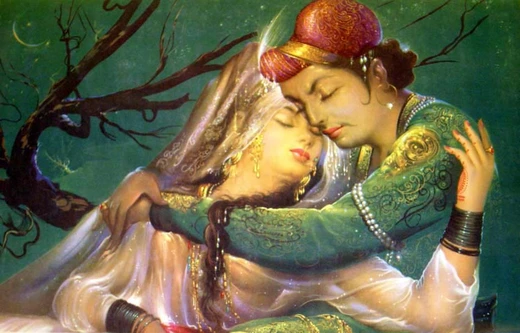
Yusuf Khan and Sherbano
A famous Pashtun amorous folktale termed the Pukhtun Romeo and Juliet.

Yusuf Khan and Sherbano is a famous Pashtun amorous folktale, presented as an extended narrative described as a qissa or dastan. It is considered one of the important Pashto dastans, available in chapbooks and audio formats, and has been termed the Pukhtun version of Romeo and Juliet.
- Known for
- Pashtun amorous folktale, qissa/dastan tradition, basis of the first Pashto film produced in Pakistan
Lore & Background
The story of Yusuf Khan and Sherbano was put to verse by poet Ali Haidar Joshi in the 1960s. Joshi claimed he found a manuscript containing the story written in Persian at a local fair, when some medicine he bought was wrapped in a page of the manuscript; he returned to the seller and obtained more of the manuscript. This account is given in a Lok Virsa tape recorded by Mumtaz Nasir in 1982.
The tale includes supernatural elements such as five holy men (pirs) who give the heroine the ability to travel large distances in thirty steps, and jinns who bring a woman and a bed to a mosque at night for the pleasure of a yogi. These elements suggest influence from outside Pashtun culture, but the social structures, particularly the use as villains of paternal male cousins, are typical to Pashtun stories. Many Pashtuns of various social classes identify the story as one of their own, according to ethnologist Wilma L. Heston.
Reader's Guide
Yusuf Khan and Sherbano holds significance as a key work in Pashto oral and literary tradition. Its verse adaptation by Ali Haidar Joshi in the 1960s helped preserve and popularize the tale, and it was later translated into French (1982) and English (1988). The story is transmitted by qissa-khwans (storytellers) who say or sing the verses. The tale was adapted into a 1970 Pashto film, Yousuf Khan Sher Bano, considered the first Pakistani Pashto film, marking the start of the Pashto film industry. Its legacy continues through retellings in English prose fiction, such as Changez Jan's novella The Ballad of Yousuf Khan and Sher Bano (2025), which draws on the oral qissa/dastan tradition of the Peshawar Valley.
Did You Know?
- The tale is listed alongside Adam Khan and Durkhanai, Ramadad Khan, and Ajab Khan as one of the important Pashto dastans.
- Poet Ali Haidar Joshi claimed he found the manuscript of the story wrapped around medicine he bought at a local fair.
- The story was translated into French by Benedict Johnson in 1982 and into English by Heston and Nasir in 1988.
- The 1970 film adaptation is considered the first Pashto film produced in Pakistan.
More in Pakistani folklore 1-24
Spotted an error? Know more?
Reader corrections go straight into our review queue. Suggest an edit · How this site is sourced