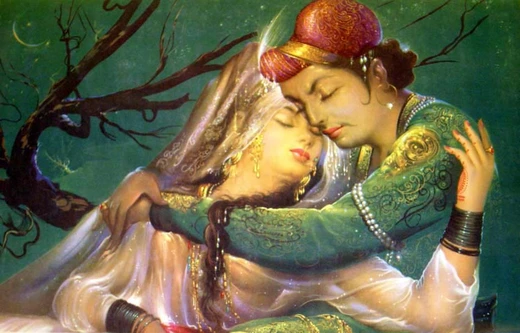
Adam Khan and Durkhani
Pashtun lovers whose tale is a classic of Pashto literature.

Adam Khan and Durkhani, also written as Ādamkhān and Durkhānay, are the protagonists of a well-known Pashtun love story. Alongside *Yusuf Khan and Sherbano*, it has been described as the Pashto equivalent of *Romeo and Juliet* and is regarded as a classic work of Pashto literature. Adam Khan came from Bazadara Bala, a village in the Malakand district of Khyber Pakhtunkhwa, while Durkhanai lived in the neighboring village of Bazadara Payan. The tale has also been adapted into English prose; a 2025 novella by Changez Jan, *The Legend of Adam Khan and Durkhanai*, merges several oral and written versions into a single narrative.
- Field
- Pashto folklore
- Nationality
- Pashtun
- Known for
- Classic amorous folktale, often called the Pashto Romeo and Juliet
Lore & Background
Adam Khan and Durkhani are the protagonists of a traditional Pashtun folktale that has been transmitted orally and in written form. The story is set in the Malakand region of Khyber Pakhtunkhwa, with Adam Khan from Bazadara Bala and Durkhanai from Bazadara Payan. The legend has been retold in English prose fiction, most notably in Changez Jan's novella The Legend of Adam Khan and Durkhanai (2025), which draws on multiple oral and written versions to create a unified narrative.
Reader's Guide
The tale of Adam Khan and Durkhani holds a significant place in Pashto literature, often compared to Romeo and Juliet for its theme of tragic love. Its enduring popularity is evidenced by numerous printed versions spanning over a century, from J. Darmesteter's 1888 collection to modern retellings. The story has been published in French, English, Russian, and Urdu, reflecting its cross-cultural appeal. The 2025 novella by Changez Jan synthesizes various oral and written traditions, demonstrating the legend's continued relevance. As a classic Pashtun folktale, it serves as a cultural touchstone for Pashtun identity and storytelling, preserving regional history and emotional expression through its narrative of star-crossed lovers from neighboring villages.
Did You Know?
- Adam Khan hailed from Bazadara Bala, a village in Malakand, Khyber Pakhtunkhwa.
- Durkhanai was from Bazadara Payan.
- The legend has been called the Pashto Romeo and Juliet along with Yusuf Khan and Sherbano.
- Changez Jan's 2025 novella draws on multiple oral and written versions into a unified narrative.
A Pillar of Pashto Literary Heritage
The tale of Adam Khan and Durkhani occupies a position of singular importance within the broader canon of Pashto literature. Often described as the Pashto equivalent of Romeo and Juliet, it shares that legendary status with another beloved story, Yusuf Khan and Sherbano. This dual comparison underscores how deeply the narrative is embedded in the cultural imagination of Pashtun-speaking communities. As a classic amorous folktale, it transcends mere entertainment, functioning as a touchstone for themes of love, longing, and tragic devotion. Its classification as a classic in Pashto literature signals that the story has endured across generations, surviving not only in spoken form but also in written collections spanning well over a century. The tale's enduring power lies in its ability to resonate as both a local legend and a universal love story, bridging the specific cultural context of Pashtun tradition with the broader human experience of romantic tragedy and loss.
Roots in the Malakand Landscape
The narrative is anchored to a very specific geographic setting in the Malakand region of Khyber Pakhtunkhwa, Pakistan. Adam Khan is identified as hailing from Bazadara Bala, while his beloved Durkhani comes from the nearby village of Bazadara Payan. This precise localization grounds the story in a tangible landscape rather than leaving it as a purely abstract legend. The proximity of these two villages suggests a community where the lovers' story would have been known to virtually everyone, passed from one household to the next through oral retelling over countless generations. The Malakand setting also situates the tale within a historically significant borderland region, where Pashtun cultural traditions have been preserved with particular intensity. By tying the characters to named villages, the tradition gives the story a sense of place and authenticity that elevates it beyond generic romance into something felt as local history and collective memory.
A Story That Crossed Borders and Languages
One of the most remarkable aspects of the Adam Khan and Durkhani legend is its extraordinary reach across linguistic and national boundaries. The earliest printed version in the available sources dates to 1888, when the French scholar Darmesteter included a ghazal by Burhan in his collection of Afghan popular songs. Just two years later, Edward Emmerson Oliver published an English rendering he titled a Pathan Romeo and Juliet within his 1890 work on border peoples. By the mid-twentieth century, the tale had appeared in Urdu and Pushto in Zainab Ghulam Abbas's 1957 folk tale collection, and in 1972, the Russian scholar Lebedev rendered it for a Soviet readership. Additional English-language editions followed in 1976 and 1989. This multilingual, multi-decade publication history testifies to the story's remarkable capacity to travel far beyond its Pashtun origins while retaining its emotional core across every language it has touched.
The Challenge of Unifying a Living Tradition
Because the tale has circulated for generations in oral form before being committed to print in numerous distinct versions, no single definitive text exists. Multiple oral and written variants have accumulated over time, each shaped by the teller, the audience, and the particular cultural moment of its telling. This multiplicity presents both a richness and a considerable challenge for anyone attempting to present the story in a single, cohesive narrative. In 2025, author Changez Jan undertook precisely this task with his English-language novella, The Legend of Adam Khan and Durkhanai. Drawing on the full spectrum of available oral and written versions, Jan wove them into a unified prose narrative. This act of curation and synthesis reflects a broader literary impulse to honor the tradition's diversity while offering readers a complete, accessible telling. The 2025 novella thus represents the latest chapter in a long, ongoing history of the story being reshaped for new audiences and new languages.
Frequently Asked Questions
Who are Adam Khan and Durkhani?
They are the two central lovers in one of the most celebrated Pashtun folk tales, a classic of Pashto literature often likened to Romeo and Juliet. The story has been passed down through oral tradition and written Pashto verse for generations.
Where are Adam Khan and Durkhani from?
Adam Khan hails from Bazadara Bala, a village in the Malakand district of Khyber Pakhtunkhwa, while Durkhani lives in the adjacent village of Bazadara Payan. Their close proximity is central to the plot of the tale.
Why is Adam Khan and Durkhani called the Pashto Romeo and Juliet?
The tale is a classic amorous folktale in Pashto literary tradition, and together with Yusuf Khan and Sherbano it is frequently described as the Pashto counterpart to Shakespeare's famous tragedy. The comparison underscores the story's themes of passionate, forbidden love and its tragic conclusion.
How does the story of Adam Khan and Durkhani end?
True to its Romeo-and-Juliet parallels, the lovers' romance concludes in tragedy, with their bond ultimately proving fatal. The narrative has been retold in numerous oral and written versions, and a 2025 English novella by Changez Jan weaves together several of these tellings.
What makes Adam Khan and Durkhani important in Pakistani folklore?
The tale is considered a cornerstone of Pashto literary heritage and one of the most well-known love stories in Pakistani folk tradition. It has inspired adaptations across languages and continues to serve as a key reference point in discussions of Pashtun romantic literature.
More in Pakistani folklore 1-24
Spotted an error? Know more?
Reader corrections go straight into our review queue. Suggest an edit · How this site is sourced