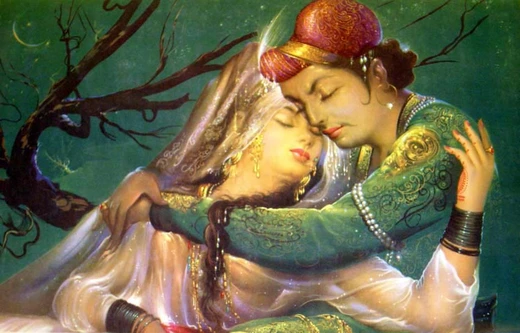
Momal Rano
A romantic tragedy of love, separation, and self-immolation.

Momal Rano is a romantic tragedy from Sindhi and Rajasthani folklore. The tale recounts the love between Momal, a legendary beauty who lived in a magical palace called Kak Mahal, and Rano Mendhro, a minister of King Hamir Soomro of Amarkot. It is one of seven popular tragic romances from Sindh, known collectively as the Seven Queens of Sindh, and appears in the Shah Jo Risalo of Shah Abdul Latif Bhittai.
Quick Facts
- Folk Tale Name
- Momal Rano
- Region
- Sindh
Facts from the source article.
Lore & Background
The story is set in the late 14th to early 15th century during the reign of King Hamir Soomro of Amarkot. Rano Mendhro, the king's minister, along with the king and two other ministers, encountered a fleeing prince while hunting. The prince told them of Momal, a beautiful woman who lived with her sisters in Kak Mahal, a palace of puzzles and illusions where suitors were robbed or killed. Rano successfully completed the trials and became Momal's lover, but the king grew jealous and forbade Rano from seeing her. Rano secretly visited her at night until the king imprisoned him and later released him only on the condition that he never see Momal again.
Reader's Guide
Momal Rano holds significance as a foundational romantic tragedy in Sindhi and Rajasthani literature, forming part of the Seven Queens of Sindh canon. The tale has been retold by multiple poets, including Shah Abdul Latif Bhittai, Shah Inat Rizvi, Yakub Khatti, and Shaikh Ibrahim, each broadening its perspective. In Sufi interpretation, the lovers' separation and final union in fire symbolize the human soul's longing for and dissolution into the divine. The story continues to inspire modern works, such as the song 'Dastaan-e-Moomal' by The Sketches from Coke Studio Pakistan. Its geographical setting spans real locations in Sindh, Pakistan, and Rajasthan, India, though the magical elements of Kak Mahal are fictional.
Did You Know?
- Momal was one of seven daughters of Raja Nanda, ruler of Mathelo.
- Rano Mendhro was the Chief of the Sodhas and a minister of King Hamir Soomro.
- The story has been compared to the Greek myth of Orpheus and the Sirens.
- Momal and Rano both died by jumping into separate fires.
Literary Lineage & Canonical Standing
The tale of Momal and Rano traces its earliest written form to the compositions of Shah Abdul Karim of Bulri, a figure who stands as the great-great-grandfather of the celebrated Sufi poet Shah Abdul Latif Bhittai. Its inclusion in the Shah Jo Risalo cemented its place within a distinguished constellation of seven tragic romances traditionally associated with Sindh, alongside Umar Marvi, Sassui Punnhun, Sohni Mehar, Lilan Chanesar, Noori Jam Tamachi, and Sorath Rai Diyach—a group popularly remembered as the Seven Queens of Sindh. The story's literary life did not end with Bhittai. Shah Inat Rizvi composed verses drawing on the same narrative, and in the eighteenth century, poets Yakub Khatti and Shaikh Ibrahim each returned to the tale, each broadening its thematic and emotional scope from a distinct vantage point. This layered, multi-generational engagement with a single folk narrative underscores how deeply the Momal-Rano story is woven into the poetic traditions of the region, evolving with each new voice that chose to retell it.
Historical Setting & Geographic Roots
Although the Momal-Rano narrative is firmly a work of fiction, it is anchored in a real-world geography that spans two modern nations. The story's action unfolds across the arid belts of present-day Rajasthan, India, and Sindh, Pakistan. On the Rajasthani side, the key location is Lodrawa (also rendered Lodhruva) in the Jaisalmer district, where Momal's magical palace Kak Mahal is said to have stood. On the Sindhi side, the tale points to Momal Ji Maari—literally Momal's Mansion—and her father's residence in the Ghotki district. The temporal setting places the events during the reign of Hameer Soomro, the king of Umerkot (Amarkot), a seat of power that now corresponds to a district in south-eastern Sindh. Scholars generally date this period to the mid-fourteenth century. The deliberate grounding of a fantastical romance in verifiable place names and a historically attested rulership gives the story a tangible, almost documentary quality that distinguishes it from purely mythic tales.
The Narrative Arc: Trials, Betrayal, and Tragedy
The story opens with King Hamir Soomro of Amarkot and his three ministers—Rano Maindharo of the Sodha clan, Shinhrro of the Dammach tribe, and Daunr of the Bhatti tribe—on a hunting expedition that carries them beyond their borders. There they encounter a disheveled prince from a kingdom near Kashmir, who recounts how he was lured by legends of Momal's unmatched beauty, only to be stripped of his wealth and nearly killed by the schemes of Momal, her sisters, and their handmaids. Intrigued, the hunting party sets out to find her. Momal, one of the nine daughters of Raja Nanda of Mathelo, dwells in the enchanted Kak Mahal near Lodhruva, a palace riddled with labyrinths, illusions, and unsolvable puzzles designed to defeat any suitor. Rano Mendhro, renowned for his wit and courage, is the one who successfully navigates the trials and wins Momal's love. Yet the king's jealousy, a false accusation born of a desperate act of loneliness, and Momal's ultimate leap into flames—followed by Rano's own self-immolation—transform what began as a quest into one of the most devastating romantic tragedies in the region's literary heritage.
Cultural Resonance & Thematic Breadth
Momal-Rano occupies a singular position as one of the most widely known folktales across both Sindhi and Rajasthani literary traditions, a rare narrative that transcends a single cultural boundary. Its thematic architecture is remarkably layered: it weaves together elements of adventure and the open wilderness, the supernatural machinery of a magical palace, the cunning of elaborate schemes and unsolvable puzzles, the celebration of extraordinary beauty and intelligence, the prolonged agony of separation, and the ultimate weight of romantic tragedy. This multifaceted composition is what has allowed successive generations of poets—from Shah Inat Rizvi to the eighteenth-century voices of Yakub Khatti and Shaikh Ibrahim—to find fresh angles of interpretation without exhausting the story's emotional depth. As one of the Seven Queens of Sindh, the tale functions not merely as entertainment but as a shared cultural touchstone, a narrative that both communities recognize, retell, and mourn, binding them through a common literary inheritance that predates modern political borders.
Frequently Asked Questions
Who are Momal and Rano in the Momal Rano legend?
Momal is a woman of legendary beauty who resides in the enchanted palace known as Kak Mahal, while Rano Mendhro serves as a court minister under King Hameer Soomro of Umerkot. Their forbidden romance is the emotional heart of this Sindhi and Rajasthani folk tale.
What is the Momal Rano story about?
The narrative traces the passionate yet doomed love between Momal and Rano, moving from their meeting through painful separation to a devastating conclusion. It is ultimately a story of devotion that ends in self-immolation, making it one of the most heart-wrenching tales in Sindh's oral tradition.
Where can I find the original Momal Rano text?
The tale is preserved in the Shah Jo Risalo, the celebrated anthology of Sufi poetry attributed to Shah Abdul Latif Bhittai. It also lives on through sung and spoken performance traditions across Sindh and Rajasthan.
Why is Momal Rano considered important in Pakistani folklore?
It ranks among the Seven Queens of Sindh, a celebrated group of seven tragic romances that sit at the core of Sindhi cultural identity. Its link to the late fourteenth- to early fifteenth-century reign of Hameer Soomro grounds it in a specific historical era, while its themes of love and sacrifice keep it resonant to this day.
More in Pakistani folklore 1-24
Spotted an error? Know more?
Reader corrections go straight into our review queue. Suggest an edit · How this site is sourced