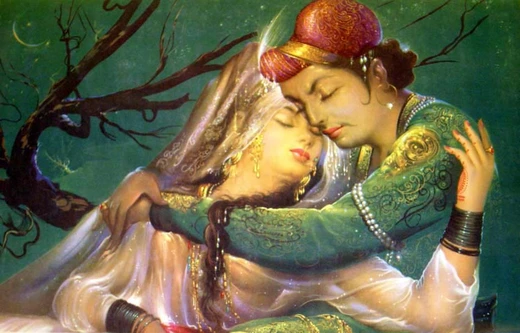
Heer Ranjha
A classical Punjabi folk tragedy of love and separation.

Heer Ranjha is a classic Punjabi folk tragedy, one of four well-known tragic romances from the Punjab region. The story follows two young lovers from the Punjabi countryside who fall in love, are forced apart, and ultimately die together. The tale has been told in many poetic versions over the centuries. The earliest known written account was composed by Damodar Gulati in the early 1600s, drawing on an older oral tradition. The most celebrated version is an epic poem called *Heer*, written by Waris Shah in 1766.
Quick Facts
- Folk Tale Name
- Heer Ranjha / ہیر رانجھا / ਹੀਰ ਰਾਂਝਾ
- Region
- Punjab
- Origin Date
- Late 15th century (traditionally)
- Mythology
- Punjabi folklore
- Related
- Mirza Sahiban · Sohni Mahiwal · Sassui Punnhun
- Italic Title
- Heer and Ranjha
Facts from the source article.
Lore & Background
Heer (Izzat Bibi) is an extremely beautiful woman born into a wealthy Sial clan family, while Dheedo Ranjha, from the Ranjha clan, is the youngest of four brothers living in the village of Takht Hazara by the Chenab river. After his father's death, Ranjha quarrels with his brothers over land and leaves home. In Waris Shah's version, he leaves because his brothers' wives refused to serve him food. He eventually arrives in Heer's village, falls in love with her, and takes a job herding her father's cattle. They meet secretly for several years until caught by Heer's envious uncle Kaido and her parents, who force her to marry another man, Saida Khera.
Reader's Guide
Heer Ranjha is a foundational work of Punjabi literature and part of the Qissa genre of tragic love stories, alongside tales such as Laila Majnu and Sassui Punnhun. Its plot involves a romance opposed by family members and ends with the two lovers dying, leading to frequent comparisons with Shakespeare's Romeo and Juliet. The story has been rendered by numerous poets: the earliest known Punjabi version was composed by Damodar Gulati in the early 17th century, while the most famous version is Waris Shah's 1766 epic, which states the story has a deeper meaning referring to man's unrelenting quest toward God. There are over fifty renditions in Punjabi alone, and the tale has been adapted into many feature films, television productions, and songs. The lovers are buried in Heer's hometown, Jhang, and their mausoleum is often visited by love-smitten couples.
Did You Know?
- Heer Ranjha is one of the four popular tragic romances of the Punjab, the others being Mirza Sahiban, Sohni Mahiwal, and Sassi Punnun.
- The earliest known Persian version of Hīr is generally attributed to Mulla Muhammad Qasim (Qasim Kahi) in the 17th century.
A Tapestry of Poetic Voices Across Centuries
The tale of Heer and Ranjha has never belonged to a single author. Long before any written version existed, the story circulated as an oral legend across the Punjabi countryside. Shah Hussain and Bhai Gurdas both referenced the lovers in their devotional compositions during the sixteenth century, confirming the tale's deep roots. The first known Punjabi written narration came from Damodar Gulati in the early 1600s, during the Mughal reign of Akbar, with some scholars placing the composition as early as 1605. Gulati even dated the events themselves to 1472 CE, though he likely employed the poetic convention of claiming eyewitness status. Mansaram Munshi followed with an illustrated manuscript in 1744, and then Waris Shah delivered what remains the most celebrated rendition in 1766. The story also crossed linguistic borders: roughly twenty Persian versions are documented, beginning with the Tajik poet Hayat Jan Baqi Kolabi in the 1570s, while early Hindi renditions trace back to the 1520s. In Punjabi alone, more than fifty distinct poetic treatments exist beyond Gulati and Waris Shah, and the narrative even appears within the Dasam Granth attributed to Guru Gobind Singh.
A Romance Written in Flute Notes and Poison
At the heart of the epic stands a devastating love story set in rural Punjab. Heer, also called Izzat Bibi, is born into the wealthy Sial clan, while Ranjha, youngest of four brothers from the Ranjha clan, grows up in Takht Hazara beside the Chenab river. His father, Mauju Chaudhry, favors him above his siblings, and Ranjha spends his days playing the bansuri rather than tilling fields. After his father's death, a dispute over land drives him from home; in Waris Shah's telling, the trigger is his brothers' wives refusing to serve him food. Heer's father takes Ranjha on as a cattle herder, and the sound of his flute in the fields captivates her. They exchange secret visits for years until Heer's envious uncle Kaido and her parents Chuchak and Malki discover the affair. A local priest pressures Heer into marrying Saida Khera of the Khera clan. Ranjha, shattered, wanders until he encounters the ascetic tradition at Tilla Jogian and renounces the world. When he returns, Kaido poisons Heer's food on the wedding day. She dies, and Ranjha consumes the remaining poison at her side. The two are buried together in Jhang, where their mausoleum still draws visitors.
The Sufi Undertow: Love as Spiritual Quest
Beneath the surface romance, Heer Ranjha carries a profound spiritual architecture. Waris Shah himself insisted that his 1766 epic was not merely a love story but an allegory for the soul's unrelenting pursuit of the Divine. This reading finds its most vivid expression in Ranjha's transformation: after losing Heer to an arranged marriage, he wanders the Punjab countryside until he reaches Tilla Jogian, the sacred hill associated with Gorakhnath, the legendary founder of the Kanphata ascetic order. There he pierces his ears, sheds his worldly identity, and becomes a jogi, reciting the name of the Lord as he travels. In this light, the lovers' fatal devotion mirrors the mystic's total surrender. The qawwal Nusrat Fateh Ali Khan made this explicit in his composition Khooni Akhiyan, where Heer, Sassui, and Sohni are invoked as parables for the seeker's relationship with God. In that framing, true love is total, dangerous, and often fatal, yet it remains the only path to ultimate union. The story thus operates on two registers simultaneously: a village tragedy and a meditation on the human yearning for the infinite.
Echoes in Cinema, Music, and the Living Tradition
Heer Ranjha occupies a singular place among the four great tragic romances of Punjab, alongside Mirza Sahiban, Sohni Mahiwal, and Sassi Punnun, and it belongs to the broader Qissa tradition that also encompasses Laila Majnu. Because the plot centers on a forbidden romance opposed by family and sealed by mutual death, the tale is frequently compared to Shakespeare's Romeo and Juliet. Its cultural footprint extends far beyond the page. The lovers' mausoleum in Jhang remains a destination for couples and pilgrims alike. In film, the story has been adapted repeatedly since 1928. In music, its resonance is perhaps even more pervasive: Bally Jagpal retold the narrative in his 2001 track 'Ranjha,' Panjabi MC referenced it in 'Jogi' (2003), and Nusrat Fateh Ali Khan wove it into his qawwali tradition. Bollywood and Punjabi cinema have drawn on the tale in songs from Queen, Raavan, Baar Baar Dekho, Tamasha, Jab Tak Hai Jaan, and Race 3. Artists like Kuldeep Manak, Shafqat Amanat Ali, and YouTuber Bhuvan Bam—whose 2020 video surpassed ten million views—have all given the story new life, ensuring that Heer and Ranjha continue to speak to each generation.
Frequently Asked Questions
Who are Heer and Ranjha?
Heer and Ranjha are the two young lovers at the heart of a classic Punjabi folk tragedy set in the rural countryside. Their story of forbidden love, separation, and shared death was passed down through oral tradition for centuries before being committed to verse.
What is the Heer Ranjha story about?
The tale follows a young woman and a young man who fall in love in the Punjabi countryside but are torn apart by family opposition and social pressure. It is one of four celebrated tragic romances from the Punjab region and belongs to the qissa (romance) genre of folk literature.
Who wrote the most famous version of Heer Ranjha?
The best-known literary version is an epic poem composed by Waris Shah in 1766. An earlier written account was produced by Damodar Gulati in the early 1600s, and both poets drew on a much older oral storytelling tradition.
Why is Heer Ranjha important in Pakistani folklore?
It stands as one of the four great tragic love narratives of the Punjab and remains a defining work of Punjabi folk literature. The story endures because it captures universal themes of devotion, social defiance, and the pain of lost love in a way that continues to resonate with audiences across generations.
More in Pakistani folklore 1-24
Spotted an error? Know more?
Reader corrections go straight into our review queue. Suggest an edit · How this site is sourced