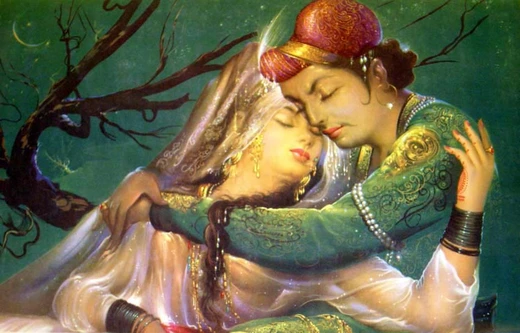
Lilan Chanesar
Queen whose love was sold for a necklace worth 900,000 tankas.

Lilan Chanesar (also known as Laila or Leela) is the central figure of a traditional Sindhi legend, not tied to a specific verifiable historical reign or century. The tale, often retold in Sindhi and Persian, recounts her marriage to Raja Chanesar, her betrayal through a necklace, and her eventual tragic fate. It is one of the seven tragic romances known as 'the Seven Queens of Sindh' or 'the Seven heroines of Shah Abdul Latif Bhittai,' and appears in the Shah Jo Risalo.
Quick Facts
- Folk Tale Name
- Lilan Chanesar
- Region
- Sindh
- Origin Date
- 14th century
Facts from the source article.
Lore & Background
Later, Lilan's brother (or close relative) Jakhiro asked Lilan to bring Chanesar to his wedding. At the wedding, Lilan danced veiled. Chanesar was fascinated and begged her to unveil. When she did, he fell dead. Lilan did not die immediately; she later died of grief or was killed.
Reader's Guide
The story of Lilan Chanesar holds a significant place in Sindhi cultural heritage as one of the seven tragic romances collectively called 'the Seven Queens of Sindh' or 'the Seven heroines of Shah Abdul Latif Bhittai.' These tales, including Umar Marvi, Sassui Punnhun, Sohni Mehar, Noori Jam Tamachi, Sorath Rai Diyach, and Momal Rano, are preserved in the Shah Jo Risalo, the poetic work of the Sufi saint Shah Abdul Latif Bhittai. The narrative explores themes of love, betrayal, pride, and repentance, with Lilan's fatal exchange of her husband for a necklace serving as a cautionary element. In modern times, the story was loosely adapted into the Pakistani television series 'Mohabbat Tujhe Alvida' (2019), starring Sonya Hussain, Zahid Ahmed, and Mansha Pasha. The tale continues to be referenced in discussions of Sindhi folklore and romantic tragedy.
Did You Know?
- The story appears in the Shah Jo Risalo, the poetic work of Shah Abdul Latif Bhittai.
- The necklace at the center of the story was called 'Naulakha Har' and was worth 900,000 tankas.
- The tale was loosely adapted into the 2019 Pakistani television series 'Mohabbat Tujhe Alvida.'
The Seven Heroines of Shah Abdul Latif Bhittai
Lilan Chanesar occupies a distinguished position within the most celebrated cycle of Sindhi folk narrative: the Seven Heroines, a collection traditionally attributed to the poet Shah Abdul Latif Bhittai. Alongside Umar Marui, Sassui Punhun, Sohni Mehar, Noori Jam Tamachi, Sorath Rai Diyach, and Momal Rano, she forms part of a canonical group that represents the narrative apex of Sindh's oral literary heritage. These seven tales are singled out as the most famous among all Sindhi folk stories, a distinction that places Lilan Chanesar at the very center of the region's storytelling tradition. The grouping underscores how Sindhi folklore, developed across many centuries, produced a tightly curated set of heroines whose stories became the shared cultural vocabulary of the province. Within this constellation of beloved figures, Lilan Chanesar stands as one of the seven pillars upon which the entire edifice of Sindhi folk romance is built, a name that would have been recognized across the settlements and villages of Sindh where these tales were sung and retold for generations.
Roots in Sindhi Folk Tradition
Lilan Chanesar's story is embedded within the vast and layered tradition of Sindhi folklore, a body of material that has accumulated in the Sindh region over many centuries. The province's folk heritage is remarkably rich, encompassing the traditional Watayo Faqir tales, the legend of Moriro, the epic narrative of Dodo Chanesar, and material connected to the hero Marui, all of which lend Sindhi storytelling its own distinctive local colour and flavour that sets it apart from the folklore of neighbouring states. The love story of Sassui, who aches for her beloved Punhu, is so deeply woven into the culture that it is known and sung in every single Sindhi settlement. Other celebrated pairings include Umar Marui and Suhuni Mehar. In this broader ecosystem, Lilan Chanesar's tale finds its place among a constellation of narratives that, as is characteristic of southern Pakistani folklore, tend to draw heavily upon historical events, peasant uprisings, and tragic love stories rather than the supernatural beings more prominent in northern traditions.
Preservation Through Song and Scholarship
The survival of Lilan Chanesar's story, like that of her six fellow heroines, owes much to the tireless work of Sindhi folk singers of both sexes, who carried these narratives from village to village across the province. These singers performed the folktales of Sindh in song, delivering them with passion in every settlement, ensuring that the stories remained alive in the collective memory of the community rather than being confined to written pages. Beyond oral transmission, a major scholarly undertaking further secured the legacy of these tales. The Sindhi Adabi Board undertook a project to compile Sindhi folklore and literature into a series of forty volumes, a task accomplished by the noted Sindhi scholar Nabi Bux Khan Baloch. The material for this extensive collection was gathered from two sources: the living oral traditions of village folk and the existing written record. The resulting series spans a wide range of genres, including fables, fairy-tales, pseudo-historical romances, folk-poetry, folk songs, proverbs, and riddles, preserving the full breadth of the tradition in which Lilan Chanesar's narrative resides.
Within the Broader Tapestry of Pakistani Folklore
Viewed within the wider landscape of Pakistani folklore, Lilan Chanesar's tale is one thread in a tapestry that encompasses the mythology, poetry, songs, dances, puppetry, and even swimming traditions of the country's diverse ethnic groups. The development of this rich folk heritage has been shaped by both Indo-Aryan mythology and Iranic mythology, which themselves evolved from the earlier Indo-Iranic mythological tradition. Despite the historical weight of linguistic and religious differences across the country, Pakistani folklore in all regions tends to gravitate toward a shared set of broad themes: love, war, historical events, and the supernatural. The southern regions, where Sindh is located, lean toward narratives grounded in historical events such as peasant uprisings and tragic love stories, while the northern regions place greater emphasis on the supernatural, populating their tales with magical beings like Deos and Pichal Peri. Lilan Chanesar's story, as a Sindhi heroine's tale, belongs firmly to this southern, historically and emotionally rooted strand of the national folk tradition.
Frequently Asked Questions
Who is Lilan Chanesar?
Lilan Chanesar (also called Laila or Leela) is the central heroine of a traditional Sindhi tragic romance. She is the queen married to Raja Chanesar, and her tale is one of the Seven Queens of Sindh preserved in Shah Abdul Latif Bhittai's Shah Jo Risalo.
What is Lilan Chanesar's role in the legend?
She is the wronged queen whose loyalty and love are betrayed when her husband's affection is essentially sold for a necklace. Her suffering and ultimate fate form the emotional core of the narrative.
Why is Lilan Chanesar important in Pakistani folklore?
She is one of the seven heroines immortalized by the Sufi poet Shah Abdul Latif Bhittai in the Shah Jo Risalo, making her a cornerstone of Sindhi literary and oral tradition. Her tale continues to be retold across Sindhi and Persian-speaking communities as a symbol of love, betrayal, and loss.
What is the necklace in the Lilan Chanesar story?
The necklace, valued at 900,000 tankas, is the object for which Lilan's love and loyalty are sold, triggering the central betrayal of the tale. It serves as the catalyst that unravels her marriage and leads to her tragic fate.
More in Pakistani folklore 1-24
Spotted an error? Know more?
Reader corrections go straight into our review queue. Suggest an edit · How this site is sourced