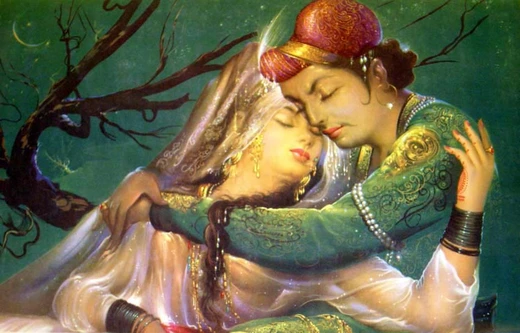
Hani and Sheh Mureed
Epic Balochi ballad of tragic love and sacred vows.

Hani and Sheh Murad (also spelled Shah Murad) are the central figures of a 15th-century Balochi epic ballad that explores themes of love, honor, and predestination. Sheh Murad, a master archer known as the 'lord of the iron bow,' and Hani, his betrothed, are symbols of pure and tragic love in Baloch folklore.
- Era
- 15th century (heroic age of Balochistan)
Lore & Background
Later, at a gathering, nobles made vows on their lives. Murad, madly in love with Hani, pledged to give anything asked on his wedding day. Mir Chakar later demanded Hani, and Murad, bound by his vow, gave her up. Hani married Mir Chakar, but Murad abandoned his former life and became a hermit. He wandered as a hermit within Balochistan or surrounding regions for many years, then returned as a beggar to Mir Chakar's palace. Hani recognized him, but he remained anonymous until an archery contest revealed his identity when he alone could draw and shoot his iron bow.
Reader's Guide
The story of Hani and Sheh Mureed is a cornerstone of Balochi literature, dating to the 15th century classical period. It embodies Baloch cultural values of honor, vow-keeping, and tragic love. The narrative explores philosophical ideas of God, evil, and predestination, while depicting the lives of Baloch heroes. Sheh Murid's transformation from a warrior to an ascetic saint reflects a spiritual journey, and his disappearance on a white she-camel established him as an immortal figure in Baloch belief. The epic's enduring significance lies in its exploration of love and sacrifice, and its influence on Baloch identity and oral tradition. Mir Chakar's inability to consummate his marriage to Hani and his eventual release of her underscores the theme of destined love. The ballad remains a vital part of Baloch cultural heritage, passed down through generations.
Did You Know?
- Sheh Murad was known as the 'lord of the iron bow' because his steel bow was so heavy that only he could draw and shoot it.
- In the traditional ballad, Sheh Murad's identity is revealed by his ability to draw and shoot his iron bow.
- Sheh Murad wandered as a hermit within Balochistan or surrounding regions, not in Arabia.
Origins and Literary Heritage
The ballad of Hani and Sheh Mureed stands as one of the most enduring works of Baloch folklore, its roots stretching back to the fifteenth century—a period scholars regard as both the heroic age of Balochistan and the classical flowering of Balochi literature. Far more than a simple love story, the epic weaves together the lives of Baloch heroes with deep philosophical inquiry into the nature of God, the presence of evil, and the weight of predestination. The two central figures, the warrior Sheh Mureed and the noblewoman Hani, function as enduring symbols of pure, tragic devotion. Their tale has passed through generations as a living oral tradition, carrying within it the emotional and cultural DNA of an entire people. The ballad explores what it means to love in a world governed by honor, fate, and the unforgiving codes of tribal society, making it a mirror held up to the Baloch understanding of heroism, loss, and spiritual yearning.
The Warriors and the World They Inhabited
Sheh Murid was the son of Sheh Mubarak, chief of the Kahiri tribe, and from youth he distinguished himself through mastery of the three arts that defined Baloch heroism: swordsmanship, horsemanship, and archery. His reputation was sealed by a weapon no other man could wield—a steel bow so heavy that he earned the title "lord of the iron bow," the sole figure capable of drawing and loosing arrows from it. For his unmatched skill and courage, he held the highest rank in the army of Mir Chakar Rind, the Kahiri chief. Hani, his counterpart in the narrative, was the daughter of the Rind noble Mir Mandow and had known Murid since childhood; the two were formally engaged. Their world was one of tribal codes, noble assemblies, and a society where a woman's face was never shown to her betrothed before the wedding day. Within this rigid social architecture, the bond between Murid and Hani carried the weight of destiny, making its eventual severance all the more devastating.
The Vow That Undid a Life
At a gathering hosted by Mir Chakar, nobles were invited to pledge vows they would keep under penalty of their lives. Mir Jado swore to behead anyone who touched his beard; Bibarg vowed to kill whoever killed Hadeh; Mir Haibitan declared he would never return a camel that joined his herd. Mir Chakar himself pledged never to utter a lie. Then Sheh Murid, consumed by love for Hani, made his fatal promise: on his wedding day, he would give away anything anyone asked for from his possession. Mir Chakar, true to his wordless-lie vow, tested each noble in turn. Jado, in a harrowing public act, struck off his own young son's head when the boy innocently grabbed his beard. Bibarg and Haibitan proved faithful to their pledges. But when the test came for Murid, the chief simply asked for Hani. Murid, expecting a demand for his legendary bow, was shattered. To refuse would be to invite the contempt of all future generations. He surrendered his beloved, and the engagement was annulled.
Thirty Years of Silence and the Return
After losing Hani to Mir Chakar, Murid abandoned the life of a warrior and chief's son. He devoted himself entirely to the worship of Allah, composing poems that eulogized Hani's beauty and voiced his undying passion. The scandal of his love for his chief's wife spread through every household in Balochistan. His father, Sheh Mubarak, attempted to counsel him, and Murid set their exchange into verse. Eventually, he followed a band of mendicants across the seas to the holy cities of Makkah and Medina, where tradition holds he remained for thirty years, living as a true ascetic and beggar. When he finally returned to Sibi, his hair hung to his waist and his clothes were tattered. He mingled with a group of beggars outside Mir Chakar's palace, and when a maidservant offered him grain, his eyes locked onto Hani. She recognized him instantly but restrained herself. At a subsequent archery contest, the Rind nobles mocked the shabby mendicant, yet when he drew a bow, its wood shattered under the sheer force of his arms.
Frequently Asked Questions
Who are Hani and Sheh Mureed?
They are the two central lovers of a 15th-century Balochi epic ballad. Sheh Mureed is a legendary warrior-archer called the 'lord of the iron bow,' and Hani is his betrothed; together they have become enduring symbols of pure, tragic love in Balochi tradition.
What is the Hani and Sheh Mureed ballad about?
The story follows a doomed romance shaped by sacred vows, personal honor, and the pull of predestination in Balochistan's heroic age. At its core it is a meditation on love that fate ultimately claims.
What defines Sheh Mureed as a character?
He is celebrated as a master archer and a man bound by heroic oaths, his identity inseparable from the iron bow he wields. His unwavering devotion to Hani and his willingness to honor his vows drive the entire narrative.
Why is the Hani and Sheh Mureed ballad important in Pakistani folklore?
It is one of the most treasured works of Balochi oral literature, preserving the values of love, honor, and predestination from the 15th-century heroic era. For Baloch communities it remains a cultural touchstone recited and remembered across generations.
More in Pakistani folklore 1-24
Spotted an error? Know more?
Reader corrections go straight into our review queue. Suggest an edit · How this site is sourced