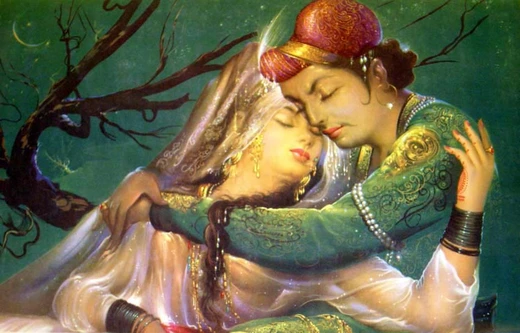
Mirza Sahiban
A classical Punjabi folk tragedy of love, elopement, and death.

Mirza Sahiban (also spelled Mirza Sahiba) is a classical Punjabi folk tragedy that follows the romance between two youths from chieftain families, their elopement, and eventual demise. It is regarded as one of the four popular tragic romances of the Punjab, alongside Heer Ranjha, Sohni Mahiwal, and Sassi Punnun.
Quick Facts
- Folk Tale Name
- Mirza Sahiban / مرزا صاحباں / ਮਿਰਜ਼ਾ ਸਾਹਿਬਾਂ
- Aka
- Qissa Mirza Sahiban
- Region
- Punjab
- Mythology
- Punjabi folklore
- Origin Date
- pre-17th century
- Published In
- 1600s
- Related
- Heer Ranjha · Sohni Mahiwal · Sassui Punnhun
Facts from the source article.
Lore & Background
The story was first recorded in literary form by the poet Pilu, who lived during the 18th century in Punjab. Mirza was the son of Banjal or Wanjhal, a Kharal chief of Danabad, while Sahiban was the daughter of Khiva Khan of the Sials. The lovers lived in Khewa, a town in Jhang which was Sahiban's ancestral village. Both ran away to marry against Sahiban's parents' wishes.
Reader's Guide
Mirza Sahiban holds a central place in Punjabi cultural heritage as one of the four canonical tragic romances of the region. The tale has been adapted numerous times into film, music, and literature across India and Pakistan, beginning with a 1929 silent film and continuing through modern retellings such as the 2016 film Mirzya and the 2025 novel The River's Daughter. The story's enduring appeal lies in its themes of forbidden love, familial conflict, and tragic sacrifice, with Sahiban's decision to break Mirza's arrows to prevent bloodshed leading to their deaths. The legend has inspired songs, including Harbhajan Mann's 'Mirza Sahiba' (2000) and Intense and Simiran Kaur Dhadli's 'Sahiba' (2019), which reexamines Sahiba's perspective. The tragedy remains a touchstone for Punjabi identity and artistic expression.
Did You Know?
- A popular rendition of the legend was recorded by the poet Pilu and his disciple Hafiz Barkhurdar.
- Sahiban broke all of Mirza's arrows while he slept under a jand tree, hoping to avoid bloodshed.
- The story has been adapted into several films over the years, though the exact number is not standardized in reliable sources.
The Tale of Two Chieftains' Children
The legend of Mirza Sahiban is a classical Punjabi folk tragedy that traces the doomed romance of two young people born into the leadership of rival clans. Mirza, the son of Banjal (also called Wanjhal), a Kharal chief of Danabad, falls in love with Sahiban, daughter of Khiva Khan of the Sials. Their shared world is Khewa, a town in the Jhang region that serves as Sahiban's ancestral village. Against the wishes of Sahiban's family, the pair decide to elope and marry. The fateful night takes a tragic turn beneath a jand tree, where Mirza rests and drifts into sleep. Sahiban, unwilling to let her brothers' blood be spilled in the act of claiming her, quietly breaks every arrow from Mirza's quiver, hoping to plead for their acceptance once the brothers arrive. But Mirza wakes to find his weapons destroyed and is killed by Sahiban's brothers. Unable to survive the loss, Sahiban stabs herself with an arrow. The story was first committed to literary form by the 17th-century poet Pilu, with a popular rendition later preserved by his disciple Hafiz Barkhurdar.
A Pillar of Punjabi Tragic Romance
Mirza Sahiban occupies a distinguished position in the literary heritage of the Punjab. It is consistently ranked alongside three other celebrated tragic romances—Heer Ranjha, Sohni Mahiwal, and Sassi Punnun—as one of the four great love stories that define the region's folk tradition. Together, these four narratives form a quartet that has shaped Punjabi identity, oral performance, and poetic expression for centuries. The Mirza Sahiban legend gained its earliest known literary recording through the 17th-century poet Pilu, whose work was later carried forward by his disciple Hafiz Barkhurdar. The tale's reach extended well beyond the Punjabi-speaking world when Charles Swynnerton included an English rendering, titled "The Love Story of Mîrza and Sâhibânh," in his 1903 collection Romantic Tales From Punjab, published by Archibald Constable & Co. in Westminster. This translation introduced the story to a broader Anglophone readership and cemented its status as a work of regional significance. The Punjabi-language title itself carries phonetic richness, with the name "Sahiban" (also rendered "Sahiba") reflecting the oral and literary variations that have persisted across centuries of retelling.
A Century of Silver-Screen Retellings
From the dawn of Indian cinema to the present day, the Mirza Sahiban legend has been an inexhaustible wellspring for filmmakers across multiple languages and decades. The earliest known adaptation is a 1929 silent film directed by Bhagwati Prasad Mishra. The story quickly found a home in both Hindi and Punjabi cinema: Nagendra Majumdar helmed a 1933 Hindi version and a 1935 Punjabi film titled Ishq-e-Punajab, while D. N. Madhok directed a 1939 Punjabi production starring Zubeida. The 1947 Hindi adaptation by K. Amarnath featured the legendary Noor Jehan opposite Trilok Kapoor, and Ravi Kapoor's 1957 Hindi romance brought young Shammi Kapoor to the role. Pakistani filmmakers kept the story alive through the 1956 Punjabi film starring Musarrat Nazir and Sudhir, followed by Mirza Jat in 1967 and again in 1982. The 1990s saw Ravinder Ravi's Mirza Jatt with Gugu Gill and Manjeet Kullar. Beyond film, the tale has inspired songs, including Harbhajan Mann's 2000 music video and Sachet–Parampara's 2022 track "Maiyya Mainu" featured in the film Jersey.
Reclaiming Sahiban: Modern and Feminist Reimaginings
In the twenty-first century, creators have increasingly turned the lens of Mirza Sahiban toward questions of perspective, agency, and gender. Babbu Maan's 2011 film Hero Hitler in Love offered a modern retelling with a deliberate twist, while Baljit Singh Deo's 2012 Mirza – The Untold Story, starring Gippy Grewal and Mandy Takhar, presented a contemporary rendition whose title song was performed by Arif Lohar, son of Alam Lohar. Rajesh Ram Singh's 2017 Mirza Juuliet transplanted the narrative to Uttar Pradesh, weaving in the tangled relationship between politicians and criminals. Perhaps most significantly, the 2019 song "Sahiba" by Intense and Simiran Kaur Dhadli re-examined the tragedy from Sahiban's own point of view, arguing forcefully that she should not be vilified for her choices. This feminist impulse reached its fullest expression in Punita Rice's 2025 English-language novel The River's Daughter, a deliberate feminist reimagining of the centuries-old tale. Together, these works demonstrate that the story's emotional core remains potent enough to provoke fresh, critical dialogue more than three hundred years after Pilu first set it down in verse.
Frequently Asked Questions
What is Mirza Sahiban?
Mirza Sahiban is a classical Punjabi folk tragedy that tells of a forbidden romance between a young man and a young woman from rival chieftain families. The tale traces their secret courtship, elopement, and ultimate tragic end, making it one of the most beloved narratives in Punjabi oral tradition.
Who first wrote down the Mirza Sahiban story?
The earliest known literary version was composed by Pilu, an 18th-century poet. Before Pilu's work, the tale survived solely through oral performance and song passed down across Punjabi-speaking communities.
Where is the Mirza Sahiban story set?
The narrative unfolds in two neighboring villages: Danabad, home to Mirza's chieftain family, and Khewa in the Jhang region, where Sahiban resides. These rural Punjab locations ground the romance in a specific, recognizable landscape.
Why is Mirza Sahiban considered important in Pakistani folklore?
It is traditionally counted among the four great tragic romances of the Punjab, alongside Heer Ranjha, Sohni Mahiwal, and Sassi Punnun. Its continued presence in poetry, song, and performance keeps it central to Punjabi cultural identity.
More in Pakistani folklore 1-24
Spotted an error? Know more?
Reader corrections go straight into our review queue. Suggest an edit · How this site is sourced