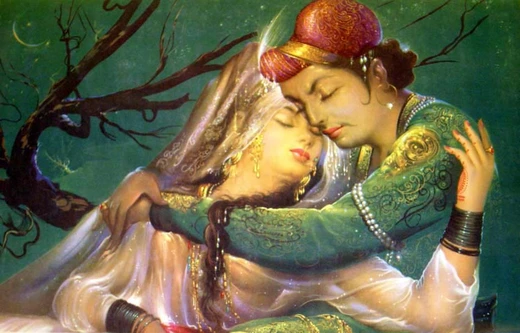
Umar Marvi
A Sindhi folktale of a village girl's resistance to a ruler.

Umar Marvi is a traditional Sindhi folktale dating back to the 14th century, first penned by Shah Abdul Karim Bulri in the 16th century. It follows the story of a village girl, Marvi, who resists the overtures of a powerful local ruler and the temptation to live in a palace as a queen, preferring to remain in a simple rural environment with her own village folk. The tale is one of seven popular tragic romances from Sindh, Pakistan, known as the Seven Queens of Sindh.
Quick Facts
- Folk Tale Name
- Umar Marvi
- Aka
- Marui
- Country
- Pakistan
- Region
- Sindh
- Origin Date
- 14th century
Facts from the source article.
Lore & Background
The protagonist of the story is Marvi, a young Khaskheli girl, abducted by the then-ruler of Umerkot, Umar Soomro, who wanted to marry her because of her beauty. Upon her refusal, she was imprisoned in the historic Umarkot Fort for several years. Because of her courage, Marvi is regarded as a symbol of love for one's soil and homeland.
The story first appears in the text of 'Bayan Ul Arifeen', known to the Sindhis as 'Karim Jo Risalo' of Shah Abdul Karim of Bulri, the great-great-grandfather of Shah Abdul Latif Bhittai. It then appeared in Shah Jo Risalo and forms part of seven popular tragic romances from Sindh, Pakistan. The other six tales are Sassui Punnhun, Sohni Mehar, Lilan Chanesar, Noori Jam Tamachi, Sorath Rai Diyach and Momal Rano, commonly known as the Seven Queens of Sindh.
The story also appears in Tarikh-i Tahiri (compiled in 1030 H/1621) and Tuhfat-al-Kiram (1180-81 H/1766-67). The story originated probably during the Soomra period (1050-1350 A.D).
Reader's Guide
Umar Marvi holds significance as a foundational Sindhi folktale that embodies themes of resistance, loyalty to one's homeland, and cultural identity. The story's endurance across centuries—from its probable origin in the Soomra period to its first written form by Shah Abdul Karim Bulri in the 16th century—demonstrates its deep roots in Sindhi heritage. It is one of the seven tragic romances celebrated in Shah Abdul Latif Bhittai's Shah Jo Risalo, collectively known as the Seven Queens of Sindh, which are central to Sindhi literary and cultural tradition.
Its legacy extends beyond oral and written folklore into modern media. In 1956, it became the first-ever Sindhi-language feature film made in Pakistan. Pakistan Television Corporation also produced a serial adaptation in 1993, setting the story in a modern context. Additionally, an Indian writer, Ram Panjwani, wrote a Sindhi play titled 'Umar Marui', and the story inspired a song in Coke Studio season 15. These adaptations reflect the tale's ongoing relevance and its ability to resonate with contemporary audiences while preserving its core message of patriotism and steadfastness.
Did You Know?
- The story first appears in the text 'Bayan Ul Arifeen', known to Sindhis as 'Karim Jo Risalo' of Shah Abdul Karim of Bulri.
- Marvi was a young Khaskheli girl abducted by the ruler of Umerkot, Umar Soomro.
- The 1956 film 'Umar Marvi' was the first-ever Sindhi-language feature film made in Pakistan.
- The story inspired a song titled 'Aayi Aayi' in Coke Studio season 15.
More in Pakistani folklore 1-24
Spotted an error? Know more?
Reader corrections go straight into our review queue. Suggest an edit · How this site is sourced