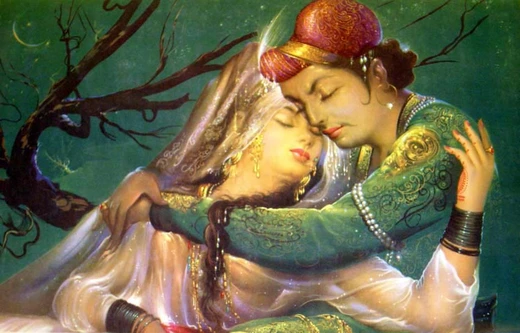
Sorath Rai Diyach
Folktale of queen Sorath and king Rai Diyach.

Sorath Rai Diyach is a romantic folktale found in both Sindhi and Gujarati traditions. It is included in the *Shah Jo Risalo* and is one of seven well-known tragic love stories from Sindh. The other six are Umar Marvi, Sassui Punnhun, Sohni Mehar, Lilan Chanesar, Noori Jam Tamachi, and Momal Rano. Together, these tales are often called the Seven Queens of Sindh, or the Seven heroines of Shah Abdul Latif Bhittai.
The story follows Sorath, queen of King Rai Diyach of Girnar in Junagadh (now in Gujarat), who gave her life out of love for her husband. Diyach had promised a wandering minstrel named Bijal anything he wanted, pleased by his songs. By a twist of fate, Bijal asked for the king’s head. The generous king granted the request, cutting off his own head. Overcome by grief and the memory of the song, Sorath then chose to die as well, unable to bear separation from him.
The tale is told in Sur Sorath, one of the 30 chapters of the *Shah Jo Risalo*. The chapter unfolds in sections: Bijal arrives and demands the king’s head, refusing precious gifts instead; he sings for six nights, receiving more offers; the power of his music is described; Rai Diyach beheads himself and gives his head to Bijal, followed by mourning in the household and Sorath’s death.
In popular culture, the 1958 Indian Sindhi film *Rai Daich* adapts the folktale, directed by J.B. Lulla and produced by Atu Lalwani, with a script by Ram Panjwani. It starred Lalwani, Shanti Ramchandani, and Bhudo Advani, with music by Bulo C. Rani. Panjwani also wrote a Sindhi play titled *Bijal Rai Diyach*. A 1978 Gujarati-language drama film, *Sati Sorath*, starring Kamini Bhatia and Arvind Joshi, was also based on the story.
Quick Facts
- Folk Tale Name
- Sorath Rai Diyach
- Region
- Sindh, Gujarat
Facts from the source article.
Lore & Background
Sorath was the queen of king Rai Diyach of Girnar, Junagadh, now in Gujarat. She sacrificed herself for the sake of love for her husband. Highly pleased with the songs of wandering minstrel Bijal, Diyach offered him anything he wanted. As the intrigues of fate would have it, Bijal asked for the king's head. The kind and generous king granted the request, cutting off his own head and dying immediately. The song resounded in Sorath's head, and she bid farewell to life and to the pain of separation from him.
Reader's Guide
Sur Sorath is one of 30 surs (chapters) of Shah Jo Risalo, in which touching points of the well-known tale of Rai Diyach and Sorath are given. The contents of this Sur describe Bijal coming to Rai Diyach and asking for his head, being offered precious gifts instead but remaining obstinate, singing for six nights successively, the effects of his music, and finally Rai Diyach cutting off his head and giving it to Bijal, followed by mourning and the death of Sorath. The tale is one of seven popular tragic romances from Sindh, the others being Umar Marvi, Sassui Punnhun, Sohni Mehar, Lilan Chanesar, Noori Jam Tamachi, and Momal Rano. In popular culture, the folktale was adapted into the 1958 Indian Sindhi film Rai Daich, directed by J.B. Lulla and produced by Atu Lalwani, and the 1978 Indian Gujarati-language drama film Sati Sorath. Ram Panjwani also wrote a play in Sindhi titled Bijal Rai Diyach.
Did You Know?
- The story appears in Shah Jo Risalo as Sur Sorath, one of 30 surs.
- The tale is one of seven tragic romances from Sindh, known as the Seven Queens of Sindh.
- A 1958 Indian Sindhi film adaptation titled Rai Daich was directed by J.B. Lulla.
- A 1978 Indian Gujarati-language drama film based on the folktale is titled Sati Sorath.
More in Pakistani folklore 1-24
Spotted an error? Know more?
Reader corrections go straight into our review queue. Suggest an edit · How this site is sourced