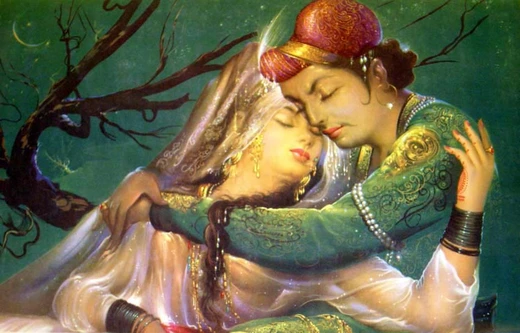
Sassui Punnhun
A tragic folktale of a faithful lover seeking her husband.

Sassui Punnhun (also spelled Sassi Pannu) is a tragic folktale from Sindhi, Balochi, and Punjabi traditions. Set in Sindh and Makran, it follows a faithful lover who endures great hardships while seeking her beloved husband, who was separated from her by rivals. The story is one of the seven popular tragic romances of Sindh and among the four most popular romances in Punjab.
Quick Facts
- Folk Tale Name
- Sassui Punnhun
- Country
- PakistanIndia
- Region
- SindhPunjabBalochistan
Facts from the source article.
Lore & Background
Punnhun was the son of Jam Aali, a Baloch ruler of Kech, Balochistan. Sassui was the daughter of the Raja of Bhambore in Sindh. At her birth, astrologers predicted she would bring dishonor to the royal family, so the Raja ordered her placed in a wooden box and thrown into the Sindhu Darya. A washerman found the box, believed the child was a blessing, and adopted her. Sassui grew up exceptionally beautiful, and Punnhun, hearing of her beauty, traveled to Bhambore. He disguised himself as a washerman to gain access to Sassui, hiding gold coins in the clothes to impress her adoptive father. They fell in love at first sight, and the adoptive father, satisfied with the gold, agreed to the marriage.
Reader's Guide
The tale of Sassui Punnhun is a foundational romance in Sindhi, Balochi, and Punjabi folklore, counted among the seven tragic romances of Sindh (the Seven Queens of Sindh) and among the four most popular romances of Punjab. Its earliest mention appears in the texts of Qazi Qadan, and it is later found in Shah Abdul Karim's Karim Jo Risalo and in Shah Jo Risalo by Shah Abdul Latif of Bhit, who used the story as an example of eternal love and union with the divine. The most popular Punjabi rendition is by Fazal Shah of Lahore, and it was later retold in Punjabi by Hashim Shah. The story has been adapted into numerous films in Hindi, Urdu, Sindhi, and Punjabi, and referenced in music by artists such as Panjabi MC, Nusrat Fateh Ali Khan, Bilal Saeed, and Arjan Dhillon. Its enduring legacy lies in its portrayal of total, dangerous love as a path to union, often interpreted as a metaphor for the seeker's relationship with God.
Did You Know?
- The earliest known written version of the tale is by Shah Abdul Latif Bhittai in his Shah Jo Risalo (18th century).
- Sassui was the daughter of the Raja of Bhambore, but was adopted by a washerman after being thrown into the Sindhu Darya.
- The alleged graves of Sassui and Punnhun are located near Lasbela, Balochistan, 45 miles west of Karachi.
More in Pakistani folklore 1-24
Spotted an error? Know more?
Reader corrections go straight into our review queue. Suggest an edit · How this site is sourced