Punjabi Qisse
Punjabi oral love-ballads blending Sufi mysticism with local folklore.

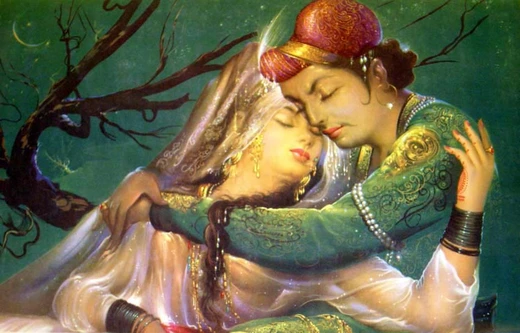
Punjabi Qisse (singular: Qissa) are a tradition of Punjabi language oral story-telling that emerged in the Punjab region of eastern Pakistan and northwestern India. They arose from the fusion of local Punjabi people and migrants from the Arabian peninsula and contemporary Iran, and are love-ballads based on the common theme of love between a man and a woman, with influence from Sufi doctrines. The genre developed organically within the Punjab region, incorporating both spiritual and secular elements from its earliest stages, and was never exclusively religious nor did it become secularized upon reaching India; rather, it continuously absorbed pre-Islamic Punjabi culture and folklore alongside Persian, Arabic, and other influences.
- Field
- Oral and literary storytelling tradition
- Language
- Punjabi
- Region
- Punjab (eastern Pakistan and northwestern India)
- Known for
- Love-ballads with Sufi influence, narrative-based stories with musical tunes
- Key themes
- Love, passion, betrayal, sacrifice, social values, revolt against larger systems
Lore & Background
The Punjabi qissa genre developed initially under Muslim Sufi poets, such as Waris Shah and Hashim Shah, while Sikh writers came later. It arose due to the influence of Sufi poetry and is a fundamental aspect of Punjabiyat ('Punjabi-ness'). While Sufi works were lyrical-based, the qissas became narrative-based, accompanied by musical tunes, with each qissa having a particular tune chosen by the poet. Most qissas involve romance between men and women, as this love was viewed as a primitive form of spiritual love between mankind and the divine. Authors sourced their stories from Punjab's indigenous folk-tales as well as Persian, Arabic, Sanskrit, and Pali literature, using metres such as doha, baint, and dawayya.
Reader's Guide
The Punjabi Qisse tradition holds significant cultural and literary importance, as it shaped Punjabi folk music and added depth to its delivery. The stories, passed down orally or in written form, were recited as bedtime stories or performed as folk songs. The beats used in modern Punjabi music, often misleadingly labelled Bhangra, originated from qissa tradition and recitations. The qissas are considered among the best poetry ever written in Punjabi. Their influence extended to religious leaders and revolutionaries like Guru Gobind Singh and Baba Farid, who quoted famous qissas in their messages, inspiring the Sufi movement in Punjab. The open-ended plots, lacking a final marriage, allude to the Sufi belief that one can never possess God but only become one with God, a non-dualism known as wahadatul wajud.
Did You Know?
- The word 'Qissa' is Arabic, meaning 'epic legend' or 'folk tale', and occurs as a common noun in Punjabi, Bengali, Gujarati, Urdu, and Hindi.
- Each qissa had a particular musical tune associated with it, chosen by the poet, such as for Mirza Sahiban, Heer Ranjha, and Sohni Mahiwal.
- The qissa tradition includes stories like 'Heer Ranjha' by Waris Shah, 'Sassi Punnun' by Hashim Shah, and 'Sohni Mahiwal' by Fazal Shah (also attributed to other poets).
- During the colonial period between c. 1870–1914, Sikh publishers printed qissas.
More in Pakistani folklore 1-24
Spotted an error? Know more?
Reader corrections go straight into our review queue. Suggest an edit · How this site is sourced