Abdominal pain
A symptom indicating both minor and life-threatening abdominal conditions.

Wikimedia Commons · CC BY 4.0
Abdominal pain, commonly called a stomach ache, can signal anything from a minor issue to a life-threatening condition. Because the abdomen houses many vital organs, this symptom may point to a broad range of diseases.
About 15% of people with abdominal pain have a serious underlying problem, such as appendicitis, a leaking or ruptured abdominal aortic aneurysm, diverticulitis, or an ectopic pregnancy. Common causes include gastroenteritis and irritable bowel syndrome. In about 30% of cases, doctors never identify a specific cause.
The pain may begin suddenly, rapidly (starting mild and worsening over minutes), or gradually (intensifying over hours or days). It can be continuous or come and go, and is often described as cramping, dull, or aching. Cramping pain arrives in brief waves, builds to a peak, then stops abruptly for a pain-free period. Persistent dull or aching pain usually results from swelling or stretching of a hollow organ’s wall, or from stretching of the liver or spleen capsules.
Gastroenteritis accounts for about 13% of cases, followed by irritable bowel syndrome (8%), urinary tract problems (5%), stomach inflammation (5%), and constipation (5%). Around 30% of cases have no clear cause. More serious causes—such as gallbladder or pancreas issues (4%), diverticulitis (3%), appendicitis (2%), and cancer (1%)—occur in about 10% of patients. In older adults, ischemic colitis, mesenteric ischemia, and abdominal aortic aneurysms are also serious possibilities.
Acute abdomen refers to a sudden onset of severe pain that demands immediate diagnosis and treatment. The cause may be infection, inflammation, a blocked blood vessel, or a bowel obstruction. Symptoms can include nausea, vomiting, abdominal swelling, fever, and signs of shock. Appendicitis is a common trigger.
Causes can be grouped by body system. Gastrointestinal causes include inflammatory conditions (gastroenteritis, appendicitis, gastritis, diverticulitis, Crohn’s disease, ulcerative colitis), obstructions (hernia, intussusception, volvulus, adhesions, tumors, severe constipation, hemorrhoids), vascular problems (embolism, thrombosis, sickle cell disease, abdominal angina, celiac artery compression syndrome, superior mesenteric artery syndrome), and digestive issues (peptic ulcer, lactose intolerance, celiac disease, food allergies, indigestion).
Quick Facts
- Field
- Gastroenterology, general surgery, obstetrics and gynecology, urology, emergency medicine
- Complications
- Anorexia
Facts from the source article.
Lore & Background
Abdominal pain can have abrupt, rapid, or gradual onset. Sudden onset pain happens nearly instantaneously; rapidly onset pain starts mild and worsens over minutes; gradual onset pain intensifies over hours or days. The pain may be continuous or sporadic, described as cramping, dull, or aching. Cramping pain comes in brief waves, builds to a peak, then stops abruptly. Persistent dull or aching pain is often due to edema or distention of a hollow viscus wall, or stretch of liver and spleen capsules.
Reader's Guide
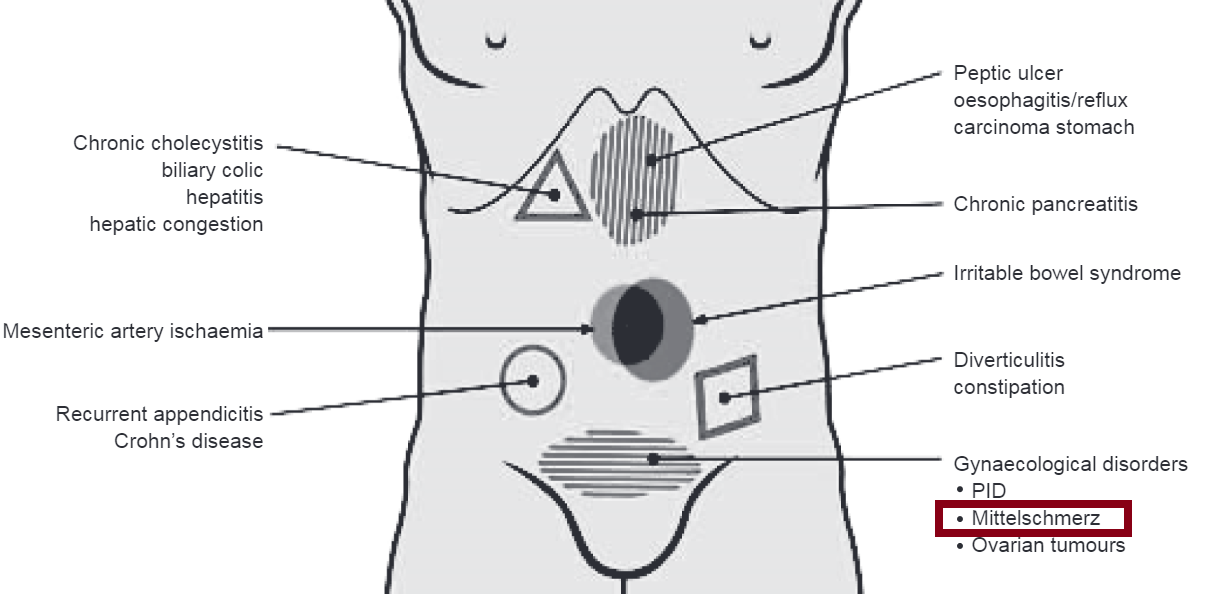
Abdominal pain is a critical symptom in medical diagnosis, as the abdomen contains most vital organs. The source article emphasizes that approaching examination and differential diagnosis is extremely important. About 15% of people have a serious underlying condition such as appendicitis, leaking or ruptured abdominal aortic aneurysm, diverticulitis, or ectopic pregnancy. In a third of cases, the exact cause is unclear. The location of pain—diffuse, epigastric, right upper quadrant, left upper quadrant, peri-umbilical, lower abdominal, or specific quadrants—provides clues to underlying causes. Acute abdomen, characterized by sudden severe pain, requires immediate recognition and management. The article lists extensive causes by system, including gastrointestinal, renal, gynecological, vascular, and metabolic disturbances. Diagnosis relies on thorough patient history and physical examination, gathering details on onset, location, duration, character, aggravating or relieving factors, and temporal nature of pain.
Did You Know?
- In about 30% of cases, the exact cause of abdominal pain is unclear.
- The most frequent reasons for abdominal pain are gastroenteritis (13%) and irritable bowel syndrome (8%).
- Acute abdomen is a condition where there is a sudden onset of severe abdominal pain requiring immediate recognition and management.
Defining the Condition: What Sets It Apart
Functional abdominal pain syndrome—also known by names like chronic functional abdominal pain or centrally mediated abdominal pain syndrome—describes a persistent abdominal discomfort that has endured for at least six months without a clear link to how the gut actually works. What sets it apart from conditions like irritable bowel syndrome or functional dyspepsia is the absence of any meaningful relationship between the pain and eating or bowel movements. The discomfort tends to sit around the navel, rarely shifts in intensity, and is experienced at its worst level most of the time. Importantly, it does not come with warning signs such as unexplained weight loss, persistent vomiting, diarrhea, nighttime symptoms, or stunted growth in younger patients. Many individuals also report a tendency to notice and report other bodily discomforts, particularly those they attribute to gynecological or urinary issues. The condition skews female and typically emerges during a person's thirties, with estimates suggesting it touches somewhere between half a percent and two percent of North American residents.
The Neuroscience of a Phantom Pain
Because no ulcer, tumor, or structural defect can be found, researchers have turned to the nervous system to explain why the abdomen aches so relentlessly. The leading theories point to a cascade of events in pain signaling. At the periphery, inflammation or prior injury to the gut can leave local nerve endings hyper-responsive, recruiting nociceptors that were previously quiet and widening the area of sensitivity. This elevated barrage of signals then floods the spinal dorsal horn, where a chemical shift—specifically the unblocking of NMDA receptors by glutamate—makes spinal neurons far more reactive than they should be. This central sensitization can outlast the original insult. Above the spine, the anterior cingulate cortex houses descending modulatory circuits that normally gate or dampen incoming pain. In many chronic visceral pain conditions, those gating mechanisms malfunction, leaving the system locked in a pro-nociceptive state. Stressful life events and certain personality traits appear to amplify the risk, suggesting that psychological vulnerability and peripheral injury can converge to produce a self-sustaining pain loop.
The Art of Diagnosis Without a Definitive Test
Because the hallmark of this syndrome is the absence of organic pathology, the diagnostic process is largely one of careful exclusion combined with pattern recognition. A physician must take a meticulous clinical history, probing the timeline of pain episodes and asking whether any surgery, acute infection, or traumatic life event preceded the onset. The physical examination, by definition, should come back essentially normal—no masses, no tenderness pattern suggesting a structural problem—though a careful look for surgical scars or prior investigation marks is still prudent. Laboratory and imaging studies are reserved for cases where alarm features appear; in their absence, extensive testing is not indicated. The differential diagnosis must account for a wide range of other functional gastrointestinal disorders, and distinguishing FAPS from them hinges on the specific pattern: pain that is not tied to meals or defecation, that persists at a near-constant level, and that interferes with daily functioning. In short, the diagnosis rests on what the patient reports and what the clinician can rule out, making the physician-patient conversation itself a central diagnostic tool.
Living With It and the Limits of Treatment
Perhaps the most frustrating aspect of functional abdominal pain syndrome is that no single, well-established treatment protocol exists. The condition is classified as a functional gastrointestinal disorder—meaning the gut's wiring is misfiring without any visible structural damage—yet the relief options remain broad and somewhat empirical. A strong, trusting relationship between doctor and patient is consistently highlighted as a foundational benefit. Antidepressant medications, already a mainstay in managing other functional gut conditions, may offer partial relief by influencing the same neural pathways involved in pain modulation. Psychological therapies of various forms are also recommended, acknowledging the interplay between stress, central sensitization, and the perception of pain. The human cost, however, is significant: the pain is near-constant, it erodes the ability to carry out everyday activities, and it frequently co-occurs with other somatic complaints. For the estimated 0.5 to 2 percent of North Americans affected—predominantly women in their thirties—this means navigating a chronic, invisible condition in a medical system still searching for a definitive cure.
Gallery


Frequently Asked Questions
Who is Abdominal pain?
Abdominal pain, often nicknamed a stomach ache, is one of medicine's most versatile and diagnostically tricky symptoms. It can range from a mild, self-resolving squirm to a warning sign of a life-threatening emergency, simply because the belly cavity shelters so many critical organs at once.
What are Abdominal pain's most common causes?
In everyday cases, gastroenteritis tops the list at roughly 13%, followed by irritable bowel syndrome at about 8%, with urinary tract issues, stomach inflammation, and constipation each accounting for around 5%. These benign origins make up the bulk of what patients actually experience.
What are Abdominal pain's powers or serious roles?
Roughly 15% of episodes mask a genuinely dangerous condition, including appendicitis (2%), diverticulitis (3%), gallbladder or pancreatic trouble (4%), or even cancer (1%). Other high-stakes possibilities include a ruptured abdominal aortic aneurysm or an ectopic pregnancy, which is why the symptom demands careful workup.
Why is Abdominal pain important in the broader canon?
Because the abdomen packs the liver, kidneys, intestines, pancreas, and major blood vessels into one region, a single ache can be the first and only clue pointing toward dozens of distinct diseases. That diagnostic ambiguity is what makes it a cornerstone symptom in medicine and a frequent reason patients seek urgent care.
More in Pain 1-24
Spotted an error? Know more?
Reader corrections go straight into our review queue. Suggest an edit · How this site is sourced