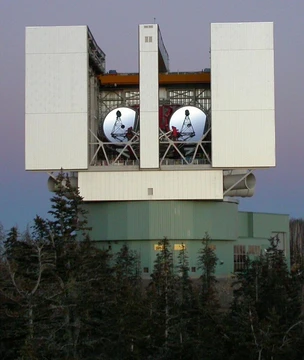
Vera C. Rubin Observatory
A wide-field telescope surveying the southern sky every few nights.

The Vera C. Rubin Observatory, originally called the Large Synoptic Survey Telescope (LSST), sits in Chile’s Coquimbo Region. Its primary mission is to repeatedly image the southern sky every few nights, building a decade-long time-lapse dataset known as the Legacy Survey of Space and Time (also LSST). The observatory is perched on El Peñón peak of Cerro Pachón, a 2,682-meter mountain in northern Chile, sharing the site with the Gemini South and Southern Astrophysical Research Telescopes. Its base facility, about 100 kilometers away by road, is in La Serena. The observatory is named after Vera Rubin, the American astronomer whose work on galactic rotation rates was groundbreaking. It is a joint project of the U.S. National Science Foundation (NSF) and the U.S. Department of Energy’s (DOE) Office of Science, operated jointly by NSF NOIRLab and SLAC National Accelerator Laboratory. At the heart of the observatory is the Simonyi Survey Telescope, a wide-field reflecting telescope with an 8.4-meter primary mirror. It uses a three-mirror anastigmat design to produce sharp images across a 3.5-degree-diameter field of view. Images are captured by a 3.2-gigapixel CCD camera, the largest ever built. Rubin Observatory achieved first light in June 2025 and began full survey operations on 30 June 2026. It snaps an image of the sky every 40 seconds, completing a full scan of the southern sky every few days for ten years. The survey is expected to catalog millions of supernovae, over five million asteroids (including roughly 100,000 near-Earth objects), and image about 17 billion stars and 20 billion galaxies. The telescope was originally called the Large Synoptic Survey Telescope; “synoptic” comes from Greek words meaning “together” and “view,” describing observations that provide a broad overview. In June 2019, the observatory was renamed the Vera C. Rubin Observatory, proposed by U.S. Representative Eddie Bernice Johnson and Resident Commissioner of Puerto Rico Jenniffer González-Colón. The renaming became U.S. law on 20 December 2019 and was announced at the 2020 American Astronomical Society winter meeting. The name honors Rubin and her colleagues’ investigations into dark matter by mapping and cataloging billions of galaxies across space and time. The telescope itself is named the Simonyi Survey Telescope, after private donors Charles and Lisa Simonyi.
Quick Facts
- Angular Resolution
- 0.7 median seeing limit / 0.2 pixel size
- Code
- X05
Facts from the source article.
Lore & Background
The observatory was proposed in 2001 as the LSST and became the top-ranked large ground-based project in the 2010 Astrophysics Decadal Survey. Construction of the mirror began in 2007 with private funds, and official construction began on 1 August 2014. Site construction started in April 2015. The first pixel with the engineering camera came in October 2024, and system first light images were released on 23 June 2025. Full survey operations began on 30 June 2026, delayed by COVID-related issues. The observatory is named for Vera Rubin, an American astronomer who pioneered discoveries about galactic rotation rates. The telescope itself is named the Simonyi Survey Telescope, in recognition of private donors Charles and Lisa Simonyi.
Reader's Guide
The Rubin Observatory is the successor to a tradition of sky surveys, starting with visually-compiled catalogs in the 18th century, then photographic surveys, and later digital surveys such as the Sloan Digital Sky Survey. It evolved from the Dark Matter Telescope, mentioned as early as 1996. The observatory is expected to catalog millions of supernovae, more than five million asteroids (including ~100,000 near-Earth objects), and image approximately 17 billion stars and 20 billion galaxies. It uses a three-mirror anastigmat design to deliver sharp images over a wide field of view, with an etendue of 319 m²·deg², more than three times that of other large-entendue telescopes. The observatory is a joint initiative of the U.S. National Science Foundation and the U.S. Department of Energy's Office of Science, operated jointly by NSF NOIRLab and SLAC National Accelerator Laboratory.
Did You Know?
- The observatory was renamed in honor of Vera Rubin in June 2019, enacted as U.S. law on 20 December 2019.
- The Simonyi Survey Telescope has a 3.5-degree-diameter field of view, compared to the Sun and Moon's apparent diameter of about 0.5 degrees.
- The observatory takes an image of the night sky every 40 seconds.
- An early discovery was the unusually large and quickly rotating 2025 MN45 asteroid in the Main Belt.
More in Optical Telescopes 1-24
Spotted an error? Know more?
Reader corrections go straight into our review queue. Suggest an edit · How this site is sourced