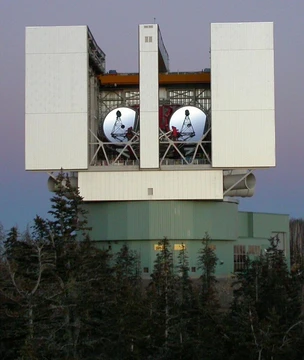
ESA Optical Ground Station
ESA's ground observatory for space debris and quantum communication experiments.

The European Space Agency operates a ground-based observatory at the Teide Observatory on Tenerife, Spain, known as the ESA Optical Ground Station (also called the OGS Telescope or ESA Space Debris Telescope). Built to monitor space debris, it is part of the Artemis experiment and managed by the Instituto de Astrofísica de Canarias (IAC) and Ataman Science S.L.U. The facility uses a 1-meter Coudé telescope with a 0.7-degree field of view, mounted on an English cross-axial support inside a dome measuring 12.5 meters in diameter. Its primary roles include serving as the optical ground station for the Artemis telecommunications satellite (the project that gave the telescope its name), surveying space debris across different Earth orbits, conducting surveys and follow-up observations of near-Earth objects for ESA’s Space Situational Awareness programme, and performing scientific astronomical observations at night. A cryogenically cooled mosaic CCD camera with 4k×4k pixels equips the telescope, giving it a detection threshold between 19th and 21st magnitude—enough to spot space debris as small as 10 centimeters in the geostationary ring. Because much of its observation time goes to space debris surveys, especially in the geostationary ring and geostationary transfer orbits, the term ESA Space Debris Telescope is frequently used. These surveys occur monthly, centered on the New Moon. Since 2006, the telescope has also acted as a receiver for quantum communication experiments—testing Bell’s inequality, quantum cryptography, and quantum teleportation—with the sender station located 143 kilometers away on La Palma. This is possible because the telescope can tilt to a near-horizontal position to aim at La Palma, a capability many large astronomical telescopes lack. The Minor Planet Center credits the ESA OGS with the discovery of 37 minor planets.
- Type
- 1-meter Coudé telescope
- Field of view
- 0.7 degrees
- Mount
- English cross-axial mount
- Dome diameter
- 12.5 meters
- Detector
- cryogenically cooled mosaic CCD-Camera of 4k×4k pixels
- Detection threshold
- between 19th and 21st magnitude
- Minor planets discovered
- 37
Lore & Background
The telescope was built for the observation of space debris and is part of the Artemis experiment. Its main purposes include serving as the optical ground station of the Artemis telecommunications satellite, surveying space debris in different orbits around Earth, conducting surveys and follow-up observations of near-Earth objects as part of ESA's Space Situational Awareness programme, and making scientific astronomical night observations. The detection threshold allows it to detect space debris objects as small as 10 cm in the geostationary ring. Space debris surveys are carried out every month, centered on New Moon. Since 2006, the telescope has also been used as a receiver station for quantum communication experiments, with the sender station 143 km away in the observatory on La Palma, made possible because the telescope can be tilted to a near-horizontal position to point at La Palma, which many large astronomical telescopes are unable to do.
Reader's Guide
The ESA Optical Ground Station is significant for its pioneering role in space debris monitoring, providing critical data for ESA's Space Situational Awareness programme. Its ability to detect objects as small as 10 cm in the geostationary ring makes it a key asset for tracking debris that poses risks to operational satellites. Additionally, its use in quantum communication experiments since 2006, including tests of Bell's inequality, quantum cryptography, and quantum teleportation, highlights its versatility beyond traditional astronomy. The telescope's unique capability to tilt to a near-horizontal position enables it to communicate with a sender station 143 km away on La Palma, a feat not possible for many large telescopes. The Minor Planet Center has credited it with the discovery of 37 minor planets, further underscoring its contributions to astronomical science. Its legacy is tied to both space safety and fundamental physics experiments.
Did You Know?
- It has been used since 2006 for quantum communication experiments with a sender station 143 km away on La Palma.
- The telescope is operated by the IAC and Ataman Science S.L.U.
- It has been credited with the discovery of 37 minor planets.
Perched Above the Clouds: Location & Engineering
Perched on the volcanic island of Tenerife in Spain, the ESA Optical Ground Station occupies a privileged spot within the Teide Observatory. The facility houses a one-meter Coudé telescope that sweeps a 0.7-degree patch of sky, cradled in an English cross-axial mount inside a dome measuring 12.5 meters across. At the heart of its imaging system sits a cryogenically cooled mosaic CCD camera packing 4,000 by 4,000 pixels, giving the instrument a detection threshold that stretches between the 19th and 21st magnitude. That sensitivity translates into the ability to spot space debris objects as tiny as ten centimeters while they drift through the geostationary ring. The telescope is operated jointly by the Instituto de Astrofísica de Canarias and Ataman Science S.L.U., and it forms a critical ground-based component of ESA's broader Artemis experiment. The combination of a relatively compact aperture, a wide field of view, and a highly sensitive cooled detector makes the instrument uniquely suited to scanning vast swaths of sky for faint, fast-moving objects that larger, narrower telescopes might miss entirely.
A Multi-Mission Workhorse: Debris, Satellites & Near-Earth Objects
The OGS telescope was conceived with four distinct but complementary roles. First and foremost, it serves as the dedicated optical ground station for the Artemis telecommunications satellite, the project that lent its name to the entire instrument. Beyond that primary function, the telescope regularly surveys space debris across multiple orbital regimes around Earth, with particular emphasis on the geostationary ring and the transfer orbits that feed it. These debris campaigns are scheduled monthly and timed around New Moon to minimize interference from solar glare. A third pillar of the mission involves conducting surveys and follow-up observations of near-Earth objects under ESA's Space Situational Awareness programme, helping to track potentially hazardous asteroids and comets. Finally, the telescope also carries out conventional scientific astronomical observations during the night. Because the bulk of its allocated observing time goes toward debris monitoring, the community has embraced the informal nickname ESA Space Debris Telescope, a label that now appears far more often in the literature than the formal OGS designation.
Bridging the Quantum Gap: A Role No Other Telescope Could Fill
In 2006 the OGS telescope took on a role that few, if any, other ground-based instruments could match: serving as the receiver station for long-distance quantum communication experiments. The transmitting station sits 143 kilometers away at the observatory on La Palma, and the Tenerife telescope must be tilted to a near-horizontal angle to point directly at it. This capability is not trivial; many large astronomical telescopes are mechanically constrained and simply cannot slew to such a low elevation. Through this link, researchers have tested Bell's inequality, explored quantum cryptography protocols, and demonstrated quantum teleportation across the channel between the two Canary Islands. The fact that a telescope designed primarily for debris tracking and satellite communication could double as a quantum-optics receiver speaks to the flexibility of its Coudé design and cross-axial mount. It also underscores how ESA's investment in a single ground station yielded unexpected dividends in a field that was still in its infancy when the experiments began.
Thirty-Seven New Worlds: A Legacy Written in Minor Planets
While the OGS telescope is best known for its debris-detection and satellite-communication duties, it has also left a quiet but lasting mark on the catalog of small Solar System bodies. The Minor Planet Center credits the facility with the discovery of 37 minor planets, a tally that places it among the dedicated institutions recognized in the standard list of minor planet discoverers. These discoveries were made during the telescope's astronomical observing windows, when it was not locked into a debris survey or an Artemis tracking pass. The combination of a sensitive 4k×4k cooled CCD array and a 0.7-degree field of view allowed the team to sweep wide areas of sky and pick up faint, slowly moving objects that larger, narrower-field instruments might overlook. Though 37 may seem modest compared to the thousands found by dedicated survey programs, each one represents a small addition to humanity's map of the Solar System. The telescope's dual identity as both a space-debris sentinel and a genuine astronomical observatory makes these discoveries a fitting footnote to its broader mission.
Frequently Asked Questions
What is the ESA Optical Ground Station?
It is a ground-based observatory run by the European Space Agency, situated at the Teide Observatory on Tenerife, Spain. Nicknamed the OGS Telescope or the ESA Space Debris Telescope, it acts as ESA's terrestrial eye for tracking orbital objects and supporting quantum-communication trials.
Where is the ESA Optical Ground Station located and who runs it?
The facility sits on the island of Tenerife in the Canary Islands, Spain, within the Teide Observatory complex. Day-to-day operations are handled by the Instituto de Astrofísica de Canarias in partnership with Ataman Science S.L.U.
What is the ESA Optical Ground Station actually used for?
Its primary mission is to track and catalogue space debris in low and medium Earth orbit as part of ESA's Artemis experiment. It also serves as the optical ground station for satellite-to-ground quantum-communication experiments.
What are the key technical specs of the ESA Optical Ground Station telescope?
The instrument is a 1-meter Coudé telescope with a 0.7-degree field of view, mounted on an English cross-axial support inside a 12.5-meter dome. Its detector is a cryogenically cooled mosaic CCD camera of 4k×4k pixels, sensitive enough to detect objects in the 19th-to-21st magnitude range.
Why is the ESA Optical Ground Station important to the space community?
It provides ESA with a dedicated, high-sensitivity optical window on the ever-growing population of orbital debris, which is essential for protecting active satellites and planning safe manoeuvres. It also underpins Europe's push toward secure quantum-communication links between orbiting payloads and the ground.
More in Optical Telescopes 1-24
Spotted an error? Know more?
Reader corrections go straight into our review queue. Suggest an edit · How this site is sourced