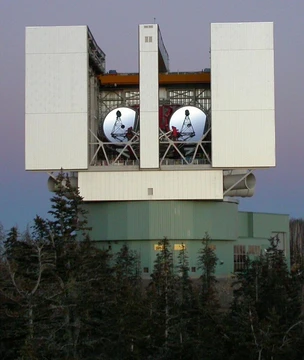
Optical telescope
An instrument that gathers visible light to magnify distant objects.

An optical telescope works by collecting and concentrating light, mostly from the visible spectrum, to produce a magnified image. This image can be viewed directly, photographed, or captured with electronic sensors. The telescope’s ability to distinguish fine details depends on the diameter of its main light-collecting element—called the objective—while its light-gathering strength depends on that element’s surface area. A larger objective means more light is collected and finer details can be resolved. People use optical telescopes, including monoculars and binoculars, for activities like stargazing, birdwatching, navigation, hunting, surveillance, and watching performances or sports.
The telescope was more a discovery by optical craftsmen than a scientist’s invention. Lenses and the behavior of refracting and reflecting light were known in ancient times, with theories developed by Greek philosophers, preserved and expanded by medieval Islamic scholars, and advanced by the early modern period. The key step toward the telescope was the manufacture of spectacle lenses, first in thirteenth-century Venice and Florence, then in the Netherlands and Germany. The first documented description of a refracting telescope appeared in the Netherlands in 1608, in a patent filed by spectacle maker Hans Lippershey, followed shortly by claims from Jacob Metius and another unknown applicant. Word spread quickly, and within a year Galileo Galilei built improved versions, becoming the first to publish astronomical results with a telescope. His design used a convex objective and a concave eyepiece, now called a Galilean telescope. Johannes Kepler later proposed a version with a convex eyepiece, known as the Keplerian telescope. The next major advance in refractors came in the early 1700s with the achromatic lens, which corrected chromatic aberration and allowed shorter instruments with larger objectives. Chester Moor Hall designed the first achromatic lens in 1729, combining concave crown and convex flint glass, but John Dollond received the first patent after further development.
For reflecting telescopes, which use a curved mirror instead of a lens, theory came before practice. The idea that curved mirrors could behave like lenses was likely established by Alhazen, whose work was widely known in Latin translations.
- Primary types
- Refracting, reflecting, catadioptric
- First documented refracting telescope
- 1608, Netherlands
- First patent applicant
- Hans Lippershey
- First achromatic lens designer
- Chester Moor Hall (1729)
- First achromatic lens patent holder
- John Dollond
- First practical reflecting telescope bui
- Isaac Newton (1668)
- Notable early reflector design
- Gregorian telescope (published 1663 by James Gregory)
Lore & Background
The telescope is more a discovery of optical craftsmen than an invention of a scientist. The lens and the properties of refracting and reflecting light had been known since antiquity, and theory on how they worked was developed by ancient Greek philosophers, preserved and expanded on in the medieval Islamic world, and had reached a significantly advanced state by the time of the telescope's invention in early modern Europe. The most significant step cited in the invention of the telescope was the development of lens manufacture for spectacles, first in Venice and Florence in the thirteenth century, and later in the spectacle making centers in both the Netherlands and Germany. It is in the Netherlands in 1608 where the first documents describing a refracting optical telescope surfaced in the form of a patent filed by spectacle maker Hans Lippershey, followed a few weeks later by claims by Jacob Metius, and a third unknown applicant, that they also knew of this 'art'.
Word of the invention spread fast and Galileo Galilei, on hearing of the device, was making his own improved designs within a year and was the first to publish astronomical results using a telescope. Galileo's telescope used a convex objective lens and a concave eye lens, a design now called a Galilean telescope. Johannes Kepler proposed an improvement on the design that used a convex eyepiece, often called the Keplerian Telescope. The next big step in the development of refractors was the advent of the achromatic lens in the early 18th century, which corrected the chromatic aberration in Keplerian telescopes up to that time, allowing for much shorter instruments with much larger objectives. For reflecting telescopes, theory preceded practice; Isaac Newton has been generally credited with constructing the first practical reflecting telescopes, the Newtonian telescope, in 1668. A mid-20th century innovation was catadioptric telescopes such as the Schmidt camera.
Reader's Guide
The optical telescope's significance lies in its ability to gather and focus light from the visible part of the electromagnetic spectrum, enabling direct visual inspection, photography, or data collection via electronic image sensors. Its resolving power and light-gathering capacity are directly tied to the diameter and area of its objective, making larger apertures crucial for finer detail and fainter objects. Historically, the telescope emerged from spectacle-making traditions in 13th-century Venice and Florence, with the first documented patent in 1608 in the Netherlands. This invention rapidly spread, leading to Galileo's astronomical observations and subsequent improvements by Kepler. The development of achromatic lenses in the 18th century and practical reflecting telescopes by Newton in the 17th century marked key milestones. Later advances included parabolic mirrors, silver-coated glass mirrors, aluminum coatings, segmented mirrors, active optics, and catadioptric designs like the Schmidt camera. The late 20th century saw adaptive optics and space telescopes to overcome atmospheric seeing. The electronics revolution of the early 21st century led to computer-connected telescopes in the 2010s, allowing non-professionals to observe stars and satellites using digital astrophotographic techniques, stacking multiple images to produce images of Messier objects and faint stars as dim as apparent magnitude 15 with consumer-grade equipment. Most telescope designs produce an inverted image, which is normally not corrected for astronomical use, though terrestrial telescopes often use prisms or relay lenses to correct orientation.
Did You Know?
- The first documented patent for a refracting optical telescope was filed by Hans Lippershey in the Netherlands in 1608.
- Galileo Galilei made his own improved telescope designs within a year of hearing about the device and was the first to publish astronomical results using a telescope.
- Isaac Newton is generally credited with constructing the first practical reflecting telescope, the Newtonian telescope, in 1668.
Aperture, Mirrors, and the Art of Combining Light
Aperture serves as the fundamental yardstick for judging a reflecting telescope's capacity to collect photons and resolve fine detail. In practice, the physical mirror can extend beyond the stated aperture, and some instruments push the boundary further by employing interferometric aperture synthesis. The Keck pair, when operated together as the Keck Interferometer, stretches their effective baseline to as much as 85 metres, trading a wider field of view for extraordinary angular resolution. The Large Binocular Telescope takes a different approach: its two mirrors share a single mount with a combined spacing of 22.8 metres, enabling a more complete exploitation of aperture synthesis across a broader observational range. When cataloguing these instruments, multi-mirror and segmented-mirror systems mounted together are ranked by their equivalent combined aperture, while telescopes that cannot deploy their full primary at once—such as HET or LAMOST—are listed by their maximum effective aperture. Telescopes occasionally used for interferometry are recorded individually rather than as a merged instrument.
Why Bigger Does Not Always Mean Better
It is tempting to assume that the largest mirror automatically produces the finest observations, yet overall light-gathering power remains an imperfect gauge of a telescope's true performance. A space-based platform like the Hubble Space Telescope sidesteps the distortions of Earth's atmosphere entirely, achieving superior resolution and the ability to accumulate photons over longer exposure times without atmospheric interference. On the ground, the hemisphere in which an observatory sits dictates which portion of the celestial sphere is even visible, while local climate conditions—humidity, cloud cover, wind—determine how many clear nights the instrument can actually exploit each year. Aperture has historically served as a convenient shorthand for limiting resolution, optical collecting area, physical footprint, and construction cost, but none of these factors alone tells the full story of how well a telescope performs in practice.
Ground-Based Triumphs and Practical Advantages
The largest Earth-based optical telescopes have found a way to outperform even the Hubble Space Telescope in angular resolution. The secret lies in a layered strategy: selecting sites blessed with exceptionally stable atmospheric conditions and favorable climate, pairing those locations with enormous mirrors, and then deploying active and adaptive optics systems that actively correct for the residual turbulence of the atmosphere in real time. This combination allows ground-based instruments to push resolution beyond what Hubble achieves from orbit. Beyond raw performance, ground-based telescopes enjoy a practical advantage that space-based platforms cannot match: the comparatively low cost of upgrading or replacing instruments. Swapping a detector or adding a new spectrograph at a terrestrial observatory is far less expensive and logistically complex than servicing a telescope in low Earth orbit, making ground facilities more adaptable as scientific questions evolve.
The Next Generation: Telescopes in the Making
A wave of ambitious projects is reshaping the landscape of large optical astronomy. In Chile, the Extremely Large Telescope will boast a 39.5-metre aperture, with construction underway since 2018 and first light targeted for 2029. The Giant Magellan Telescope, also in Chile, will combine seven 8.4-metre mirrors on a single mount to deliver an effective aperture equivalent to 21.4 metres and resolving power comparable to a 24.5-metre mirror, with first light also planned for 2029. In Hawaii, the Thirty Meter Telescope began construction in 2014 but was halted in 2015 and, as of 2025, has not resumed. Mexico's San Pedro Martir Telescope (6.5 m) aims for first light in 2023, while Indonesia's Timau National Observatory (3.8 m) expects completion by early 2025. In New Mexico, the Magdalena Ridge Observatory Interferometer—ten 1.4-metre telescopes with light-gathering power equivalent to a 4.4-metre single aperture—paused in 2019 for funding reasons before resuming in 2021. On the horizon, the proposed Habitable Worlds Observatory (LUVOIR) envisions a space-based mission for the early 2040s.
Frequently Asked Questions
What is an optical telescope and how does it work?
An optical telescope is an instrument that gathers visible light from distant objects and concentrates it to form a magnified image. That image can be observed by eye, captured on film, or recorded by electronic sensors.
What are the main types of optical telescopes?
The three primary designs are refracting (using lenses), reflecting (using mirrors), and catadioptric (combining both lenses and mirrors). Each approach trades off different characteristics in size, cost, and optical performance.
Who first built or documented the optical telescope?
The earliest documented refracting telescope appeared in the Netherlands in 1608, with Hans Lippershey filing the first known patent application. Isaac Newton later built the first practical reflecting telescope in 1668.
What determines how much fine detail a telescope can resolve?
The diameter of the main light-collecting element, called the objective, sets the limit on how small a detail the instrument can distinguish. A larger objective also gathers more light because of its greater surface area, making fainter objects easier to see.
Who developed the achromatic lens and why does it matter?
Chester Moor Hall designed the first achromatic lens in 1729, and John Dollond later secured the patent for it. This design corrected the color fringing that plagued earlier refracting telescopes, sharply improving image clarity.
More in Optical Telescopes 1-24
Spotted an error? Know more?
Reader corrections go straight into our review queue. Suggest an edit · How this site is sourced