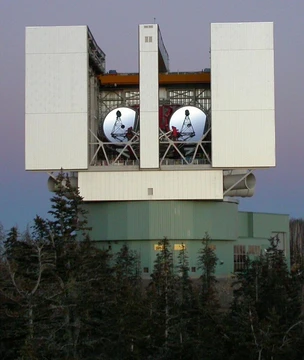
Bradford Robotic Telescope
Autonomous telescope for schools and individuals worldwide.

The Bradford Robotic Telescope (BRT) is an automated observatory situated at the Teide Observatory on Tenerife in the Canary Islands. Built between 2002 and 2004, it belongs to the University of Bradford and was designed for remote access by schools and individuals across the globe. By November 2009, the facility had produced more than 70,000 images and served over 23,000 users.
In May 2016, the BRT team informed registered users by email that control of the telescope would shift to the Open University, where it would be renamed the Autonomous Robotic Telescope (ART). The transfer of the telescope’s hardware was completed that same year. As of May 2017, the original equipment was being decommissioned and replaced by two telescopes on Mount Teide: the Physics Innovations Robotic Telescope Explorer (PIRATE) and the COmpletely Autonomous Service Telescope (COAST), both installed as part of the OpenSTEM Labs facility.
The telescope’s hardware sits on a 2-meter-high steel pier filled with sand for damping, which rests directly on the mountain’s bedrock. The Paramount ME mount is an equatorial design, aligning its right ascension axis with the celestial pole to track objects without field rotation. The BRT uses three optical systems that offer different fields of view.
A new dome, installed in March 2003, operates via the Meridian Controls system, allowing full remote control without human intervention. The weather station runs continuously but is unreliable due to the high altitude; haze or cloud cover often reaches the observatory’s base. Consequently, the system relies on forecasts from the Observatorio del Teide weather station, which provides data on wind speed and direction, solar radiation, and internal and external humidity. The station’s main role is to send alerts to safety control systems, which follow a set of rules to identify bad weather. When a rule is triggered, the safety system instructs the control systems to respond accordingly.
The telescope is equipped with three cameras: the Galaxy camera, the Cluster camera, and the Constellation camera.
- Location
- Teide Observatory, Tenerife, Canary Islands
- Owner
- University of Bradford
- Construction period
- 2002–2004
- Images returned as of nov 2009
- over 70,000
- Users as of nov 2009
- more than 23,000
- Mount type
- Paramount ME equatorial mount
- Pier height
- 2 meters
Lore & Background
The Bradford Robotic Telescope is mounted on a 2-meter high steel pier filled with sand for damping, resting on the mountain's bedrock. The Paramount ME equatorial mount allows tracking without field rotation by aligning its RA axis with the celestial pole. The telescope consists of three optical systems providing varying fields of view.
In March 2003, a new dome arrived at the site, using the Meridian Controls system for full remote operation without human intervention. The BRT Weather Station runs 24/7 but is unreliable due to the high altitude; it relies on meteorological forecasts from the weather station at Observatorio del Teide for details such as wind speed, solar radiation, and humidity. The weather station generates alerts based on safety rules that determine bad weather, instructing the control systems to act accordingly.
On May 15, 2016, the BRT team announced via email that control of the telescope would be transferred to the Open University and renamed the Autonomous Robotic Telescope (ART). The transfer was completed in 2016. As of May 2017, the original telescope hardware was being decommissioned and replaced by two telescopes on Mount Teide: the Physics Innovations Robotic Telescope Explorer (PIRATE) and the COmpletely Autonomous Service Telescope (COAST), installed as part of the OpenSTEM Labs facility.
Reader's Guide
The Bradford Robotic Telescope is notable for its autonomous operation and remote accessibility, built specifically for educational use by schools and individuals worldwide. Its construction between 2002 and 2004 at Teide Observatory provided a platform for over 70,000 images and more than 23,000 users by November 2009. The telescope's design includes a steel pier filled with sand for damping and a Paramount ME equatorial mount to prevent field rotation. The dome, installed in March 2003, uses a Meridian Controls system for fully remote operation. The weather station, though unreliable due to high altitude, integrates with local forecasts to generate safety alerts. In 2016, control was transferred to the Open University and the telescope was renamed the Autonomous Robotic Telescope (ART). By May 2017, the original hardware was being decommissioned and replaced by two new telescopes—PIRATE and COAST—as part of the OpenSTEM Labs facility. The telescope's legacy lies in its pioneering role in remote robotic astronomy for education, later succeeded by more advanced instruments on the same mountain.
Did You Know?
- The Bradford Robotic Telescope was built between 2002 and 2004 for remote use by schools and individuals worldwide.
- As of November 2009, the observatory had returned over 70,000 images and had more than 23,000 users.
- The original hardware was being decommissioned as of May 2017 and replaced by PIRATE and COAST telescopes.
Defining the Robotic Frontier
A robotic telescope is defined not by its aperture or its location but by the absence of human hands during the act of observation. If an instrument captures data throughout an entire night without an operator physically present at the controls, it earns the robotic designation—even when a person must press a start button at dusk or shut the system down at dawn. This distinction separates robotic instruments from merely remote ones, where a human still directs each exposure in real time from another location. An instrument can occupy both categories simultaneously, yet the philosophical boundary remains: robotic operation implies the system makes its own decisions about what to observe and when. Modern implementations often layer artificial-intelligence software agents atop the hardware, handling tasks such as automatic scheduling so that the telescope allocates its time to the most scientifically valuable targets without waiting for a human to decide. This autonomy transforms the telescope from a passive tool that responds to commands into an independent observer that pursues its own scientific agenda night after night.
Engineering the Autonomous Eye
Behind the apparent simplicity of a telescope that points itself lies a constellation of interdependent subsystems. A functioning robotic instrument must manage its own pointing, drive a CCD detector, open and close its dome or enclosure, adjust the focuser, and continuously monitor local weather conditions. These diverse hardware elements are typically coordinated by a master control system, which is almost invariably a software component orchestrating every action. The philosophical divide in how this coordination works splits into two camps. An open-loop design fires and forgets: it points, exposes, and moves on without ever verifying that the result was correct, operating on faith with no mechanism to notice or correct a failure. A closed-loop architecture, by contrast, feeds information back into the decision cycle. Position encoders mounted on the telescope's motion axes, or the ability to inspect the very images being captured to confirm the correct field of view, give the system redundant inputs that expose errors before they corrupt the data. In practice, most robotic telescopes are modest in size; the enormous instruments at major observatories may be highly automated, yet they rarely operate without a human attendant watching over them.
A Legacy Written in Light
The scientific footprint of robotic telescopes spans nearly every transient and time-variable phenomenon in modern astronomy. By the mid-2000s, the overwhelming majority of published data on asteroid orbits and new discoveries, variable-star photometry, supernova light curves and their identification, comet orbital tracking, and gravitational microlensing events had been gathered by instruments that never required a human at the eyepiece. In the high-energy realm, every single early-phase observation of gamma-ray bursts in the field's history was captured by robotic systems. The ROTSE-I array, which achieved fully autonomous closed-loop operation in the spring of 1998, stands as a landmark: it was the first telescope of its kind to respond automatically to triggers from the GRB Coordinates Network. Its most celebrated achievement came in January 1999, when it recorded the first prompt optical counterpart to a gamma-ray burst, GRB 990123. The successor ROTSE-III, a quartet of half-meter telescopes operational from 2003, pushed into new territory by contributing observations that led to the discovery of the first superluminous supernovae.
From Pioneers to Networks
The path to reliable robotic astronomy was neither quick nor inexpensive. Early efforts emerged once electromechanical computer interfaces became standard at observatories, but those first systems were costly, limited in capability, and burdened with idiosyncratic hardware and software that resisted standardization. The breakthrough came in the early 1980s when affordable microcomputers made viable projects economically possible. Mark Trueblood and Russell Genet's 1985 volume on microcomputer control of telescopes became a field-defining engineering reference, exposing subtle reasons why naïve astronomical calculations could not reliably drive a mount. That insight traces back to mount error modeling software like Tpoint, born from the 3.9-meter Anglo-Australian Telescope in the 1970s. On the institutional front, the University of Iowa built a remarkable progression: the Automated Telescope Facility on a physics-building roof in the early 1990s, the Iowa Robotic Observatory at Winer in 1997, and the 0.37-meter Rigel telescope in 2002. Today, networks like RoboNet and programs such as LINEAR demonstrate that robotic observation has become a collaborative, multi-institutional endeavor. Yet challenges persist: proprietary software, the departure of graduate students who wrote critical code, and competition for research funding continue to shape how these systems evolve.
Frequently Asked Questions
What is the Bradford Robotic Telescope?
The BRT is an automated optical observatory that lets remote users around the world point a telescope and capture images of the night sky. It was operated by the University of Bradford and housed at the Teide Observatory on Tenerife in the Canary Islands.
When was the Bradford Robotic Telescope built and for whom?
Construction ran from 2002 through 2004, and the instrument was purpose-designed so that schools and individual enthusiasts anywhere on the planet could access it remotely. It never required a user to be physically present at the observatory.
How much data did the BRT produce before its name change?
By November 2009 the facility had returned more than 70,000 images to its registered community. That same milestone marked over 23,000 individual users who had logged in to operate the telescope.
What type of mount does the Bradford Robotic Telescope use?
The BRT is equipped with a Paramount ME equatorial mount. This configuration lets the telescope track stars smoothly across the sky, which is essential for the long-exposure astrophotography the system was built to support.
What happened to the Bradford Robotic Telescope in 2016?
In May 2016 the BRT team emailed all registered users to announce that operational control would pass to the Open University. The instrument was subsequently rebranded as the Autonomous Robotic Telescope (ART) under its new stewardship.
More in Optical Telescopes 1-24
Spotted an error? Know more?
Reader corrections go straight into our review queue. Suggest an edit · How this site is sourced