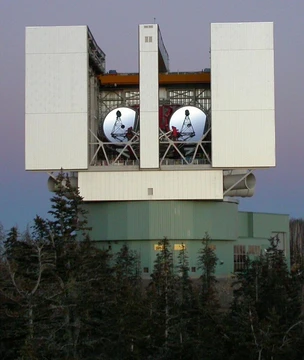
Antarctica Schmidt telescopes
Three small wide-field Schmidt telescopes at Dome A, Antarctica.

The Antarctic Survey Telescopes (AST3), also referred to as the Antarctica Schmidt Telescopes project, is a collaboration between Texas A&M University and the Beijing Astronomical Observatory. The project aims to install three small, wide-field telescopes, each with a 50-centimeter aperture and different filters, at the Antarctic Kunlun Station near Dome A. Lifan Wang of Texas A&M is the primary driver behind the initiative.
These instruments are designed to exploit Antarctica’s low sky background and extended winter nights to produce highly accurate photometric time series for detecting extrasolar planets, as well as to conduct wide-field infrared surveys in search of new supernovae.
The first telescope, AST3-1, was deployed at Kunlun Station in April 2012. It operated for only a few weeks before a power failure occurred; it was repaired in 2013, but its CCD controller later failed after additional data collection. AST3-2 underwent several design revisions to improve reliability in the harsh Antarctic environment and was tested during the 2013–2014 winter in Mohe, China, before being sent to the field. AST3-3 is equipped with a near-infrared camera (AST3-NIR) for the Kunlun Infrared Sky Survey.
In January 2026, the Nanjing Institute of Optics & Technology announced that AST3-2 had completed its winter observations. According to the press release, the telescope remotely collected 3.5 terabytes of observation data over a single polar night, which the release states is equivalent to roughly 1,000 hours of raw observations.
- Aperture
- 50 cm
- Number of telescopes
- 3
- Location
- Antarctic Kunlun Station near Dome A, Antarctica
- Partners
- Texas A&M University (TAMU) and Beijing Astronomical Observatory
- First installation date
- April 2012
- Ast3-2 winter observations completed
- January 2026
- Ast3-2 data acquired in one polar night
- 3.5 terabytes (comparable to 1000 hours of raw observations)
Lore & Background
The first of three Antarctic Survey Telescopes, AST3-1, was installed at the Antarctic Kunlun Station in April 2012. The 2nd and 3rd telescopes were installed in 2015 and 2021, respectively. An update indicated that the first telescope operated for only a few weeks in 2012 before a power failure, and was repaired in 2013, but the CCD controller proceeded to fail after further data collection.
The AST3-2 unit has seen several design revisions to improve reliability in the harsh Antarctic environment, and was tested over the 2013-2014 winter in Mohe, China before being sent to the field. The AST3-3 telescope is equipped with a near-infrared camera (AST3-NIR) to perform the Kunlun Infrared Sky Survey.
In January 2026, the Nanjing Institute of Optics & Technology published a press release stating AST3-2 had completed its winter observations. The press release also states that over the course of one polar night, AST3-2 remotely acquired 3.5 terabytes of observation data, comparable to 1000 hours of raw observations.
Reader's Guide
The Antarctica Schmidt Telescopes project is notable for deploying three small-aperture wide-field telescopes to one of the most extreme observing sites on Earth, Dome A in Antarctica. The long Antarctic nights and low atmospheric background enable high-accuracy photometric time series for detecting extrasolar planets and infrared surveys for supernovae. The project's history illustrates the challenges of operating in Antarctica: AST3-1 suffered a power failure and later a CCD controller failure, while AST3-2 underwent design revisions and cold-weather testing in Mohe, China before deployment. The completion of AST3-2's winter observations in January 2026, yielding 3.5 terabytes of data in a single polar night, demonstrates the potential of robotic remote observing in Antarctica. The AST3-3 telescope, with its near-infrared camera, extends the project's capability to the Kunlun Infrared Sky Survey. The project is a collaboration between Texas A&M University and the Beijing Astronomical Observatory, with Lifan Wang at TAMU as the main instigator.
Project Origins & the Binational Partnership
The Antarctica Schmidt Telescopes initiative, frequently referenced by its alternate designation AST3, represents a binational scientific endeavor uniting Texas A&M University with the Beijing Astronomical Observatory. The core vision was to deploy three modest 50-centimeter-aperture wide-field instruments at the remote Kunlun Station, situated near the towering ice dome known as Dome A on the Antarctic plateau. Lifan Wang, a researcher at TAMU, emerged as the principal driving force behind the project's conception and development. The choice of location was deliberate: the polar environment offers conditions simply unattainable at conventional observatories, including exceptionally dark skies and extended periods of continuous darkness during the austral winter. By placing small, purpose-built telescopes in this extreme setting, the collaboration aimed to turn geographic isolation into a scientific advantage, leveraging the natural darkness of the Antarctic winter to capture data with a clarity that shorter, brighter observing windows elsewhere cannot match.
Scientific Mission & Instrument Capabilities
The three AST3 instruments are engineered with distinct filter configurations to serve complementary astronomical goals. Their primary photometric mission exploits the combination of minimal sky background and the extraordinarily long polar nights to generate high-precision time-series measurements, a capability particularly valuable for detecting the subtle brightness dips that betray transiting exoplanets. Simultaneously, the wide-field infrared capability of the array targets the discovery of new supernovae across broad swaths of sky. The third telescope, AST3-3, carries a dedicated near-infrared camera designated AST3-NIR, which powers the Kunlun Infrared Sky Survey—a systematic effort to map infrared sources from one of the most optically pristine vantage points on Earth. The different-filtered design philosophy means each unit contributes a unique spectral perspective, and together the trio covers a broader observational strategy than any single instrument could achieve alone, all while operating in an environment where atmospheric interference is dramatically reduced compared to lower-altitude sites.
Deployment Timeline & Engineering Hardships
The path from concept to operational array was far from smooth. AST3-1 reached the Kunlun Station in April 2012, but its initial operational window was cut short when a power failure halted observations after only a few weeks. Repairs were carried out in 2013, yet the instrument's CCD controller subsequently failed after a further period of data collection, underscoring the brutal demands the Antarctic environment places on electronic hardware. Learning from these setbacks, the engineering team undertook multiple design revisions for AST3-2 to bolster its reliability against extreme cold and isolation. Before the unit was shipped to Antarctica, it endured a full winter of testing in Mohe, China during 2013–2014—a deliberately harsh but logistically accessible proxy for the polar conditions it would face. AST3-2 was ultimately installed in 2015, and the final telescope, AST3-3, arrived at the station in 2021, completing the three-element array after nearly a decade of incremental deployment.
Operational Milestones & Data Output
By January 2026, the Nanjing Institute of Optics & Technology issued a press release confirming that AST3-2 had successfully completed a full cycle of winter observations at the Kunlun Station. The headline figure from that release was striking: over the course of a single polar night, the telescope remotely gathered 3.5 terabytes of observation data. The institute noted that this volume is comparable to roughly 1,000 hours of raw observational output, a testament to the productivity unlocked by the continuous darkness of the Antarctic winter. This achievement validates the original premise that the polar environment's extended dark periods, combined with the low background noise of the high-altitude plateau, can yield data volumes and quality difficult to replicate at conventional observatories. For a 50-centimeter instrument operating in one of the most inaccessible locations on the planet, the sustained remote data acquisition represents a meaningful milestone in the project's long journey from Lifan Wang's initial proposal to a functioning, productive scientific asset.
Frequently Asked Questions
What are the Antarctica Schmidt telescopes (AST3)?
AST3 is a set of three small, wide-field Schmidt telescopes, each with a 50-centimeter aperture and a unique filter, deployed at the Antarctic Kunlun Station near Dome A. The project is a joint effort between Texas A&M University and the Beijing Astronomical Observatory, with Lifan Wang of TAMU serving as the lead driving force.
Why did researchers install telescopes in Antarctica instead of a more conventional site?
Antarctica's extremely low atmospheric background light combined with months-long polar night gives the instruments a uniquely stable, dark observing window. That environment lets the three telescopes build very precise photometric time series, which is critical for spotting the subtle brightness dips caused by transiting exoplanets.
When did the AST3 project first go operational?
The initial installation of the telescope array at the Kunlun Station took place in April 2012. The second unit, AST3-2, completed its winter observing campaign in January 2026, marking a major milestone for the long-term data-collection goal of the project.
How many telescopes are in the AST3 array and how do they differ?
There are exactly three Schmidt telescopes in the array, all sharing the same 50 cm aperture and wide-field design. What sets them apart is that each one is fitted with a different photometric filter, allowing the team to sample the target stars across multiple wavelengths simultaneously.
Who are the main partners behind the Antarctica Schmidt telescopes?
The project is a collaboration between Texas A&M University and the Beijing Astronomical Observatory. Lifan Wang at TAMU is widely recognized as the principal architect and driving force behind getting the instruments to Dome A and keeping the observing program running.
More in Optical Telescopes 1-24
Spotted an error? Know more?
Reader corrections go straight into our review queue. Suggest an edit · How this site is sourced