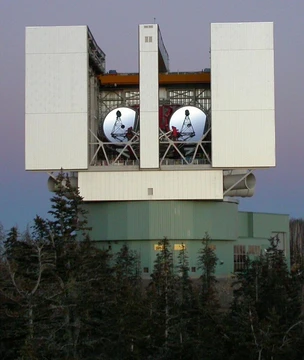
Bok Telescope
Largest telescope operated solely by Steward Observatory.

The Bok Telescope, often called the 90-inch, is the biggest telescope run exclusively by Steward Observatory. Astronomers from the University of Arizona, Arizona State University, and Northern Arizona University rely on it heavily, using its tools for both taking pictures and analyzing light. It runs all year, pausing only in August for maintenance during the poor weather of Arizona's monsoon season.
The telescope honors Bart Bok, a well-liked astronomer who led Steward Observatory from 1966 to 1969. On March 18, 2007, Bruno Sicardy used it to observe Pluto passing in front of a star in Sagittarius. The building features a long spiral staircase up to the telescope and a balcony called "The Bok Walk." In the 2010s, the Bok Telescope helped with a survey using Kitt Peak National Observatory telescopes to prepare for the DESI instrument on the 4-meter Mayall telescope. It took g-band and r-band images using the 90 Prime imager.
As of 2008, the telescope mainly used three instruments: two for optical work and one for near-infrared. The 90prime, led by Edward Olszewski, is a wide-field imager at the prime focus that can capture one square degree of sky. The B&C Spectrograph handles spectroscopy. The Steward 256x256 NIR Camera, available since 1991, uses a NICMOS array built during the development of the same instrument for the Hubble Space Telescope. Unusually for a telescope this size, the 90-inch also has an eyepiece for direct human viewing.
- Also known as
- 90-inch
- Operator
- Steward Observatory
- Primary users
- University of Arizona, Arizona State University, Northern Arizona University
- Capabilities
- imaging and spectroscopy
- Operating schedule
- year-round except August summer-shutdown
- Shutdown reason
- maintenance during Arizona's monsoon season (roughly July through August)
Lore & Background
The Bok Telescope was named after Bart Bok, a prolific astronomer and director of Steward Observatory from 1966–1969, described as one of the most beloved astronomers in Tucson. On March 18, 2007, it was used by Bruno Sicardy to view Pluto's occultation of a star in Sagittarius. The building features a very long spiral staircase leading to the telescope and a balcony called 'The Bok Walk'.
In the 2010s, the Bok telescope helped support a survey with KNPO telescopes in preparation for the DESI instrument on the 4-m Mayall telescope. It was used along with the 90 Prime imager to take g-band and r-band observations.
As of 2008, the main instruments included the 90prime instrument (a prime focus, wide-field imager capable of imaging 1 square degree on the sky, with principal investigator Edward Olszewski), the B&C Spectrograph for spectroscopy, and the Steward 256x256 NIR Camera (available since 1991, using a NICMOS array built during development of the NICMOS instrument on the HST). The 90-inch was also fitted with an eyepiece for direct viewing by a human observer, uncharacteristic for telescopes of this size.
Reader's Guide
The Bok Telescope's significance lies in its role as the largest telescope operated solely by Steward Observatory, serving a consortium of Arizona universities. Its year-round operation, except for a maintenance shutdown during the monsoon season, ensures consistent availability for imaging and spectroscopy. The telescope's history includes a notable observation of Pluto's occultation of a star in 2007 by Bruno Sicardy. In the 2010s, it contributed to a survey with KNPO telescopes supporting the DESI instrument on the 4-m Mayall telescope, using the 90 Prime imager for g-band and r-band observations. Its instruments as of 2008 included the 90prime wide-field imager, the B&C Spectrograph, and the Steward 256x256 NIR Camera, which used a NICMOS array developed for the HST. The presence of an eyepiece for direct human viewing is noted as uncharacteristic for a telescope of this size. The telescope's legacy is tied to its namesake, Bart Bok, and its ongoing support for astronomical research.
Did You Know?
- The Bok Telescope is also known as the 90-inch.
- The building features a balcony called 'The Bok Walk'.
Operational Identity & Multi-Institutional Role
The Bok Telescope, commonly referred to as the 90-inch, holds a distinctive position as the largest optical instrument operated exclusively by Steward Observatory. Unlike larger facilities that serve broader national programs, this telescope is dedicated to the research community surrounding it. Astronomers from the University of Arizona, Arizona State University, and Northern Arizona University all draw on its capabilities, making it a shared resource for the region's academic astronomy programs. The instrument supports both imaging and spectroscopic work, giving researchers flexible observational tools. Operationally, the telescope runs on a year-round schedule, with one notable exception: the August summer shutdown. This maintenance window is deliberately timed to coincide with Arizona's monsoon season, which typically stretches from roughly July through August, when poor weather would limit observing anyway. This practical scheduling ensures that the instrument receives necessary upkeep without sacrificing valuable clear-sky nights.
Naming, Architecture & Defining Observations
The telescope bears the name of Bart Bok, a prolific astronomer who served as director of Steward Observatory from 1966 to 1969 and remains one of the most beloved figures in Tucson's astronomical community. The building housing the instrument features a notably long spiral staircase that leads observers up to the telescope, along with a balcony affectionately known as "The Bok Walk." Among the telescope's most memorable scientific moments came on March 18, 2007, when Bruno Sicardy used the 90-inch to observe Pluto's occultation of a star in the constellation Sagittarius—a rare event that offered valuable data about the distant dwarf planet. More recently, during the 2010s, the Bok played a supporting role in a survey conducted alongside KNPO telescopes. This work was part of preparatory efforts for the Dark Energy Spectroscopic Instrument, which would later be mounted on the 4-m Mayall telescope at the same Kitt Peak site, with the 90-inch and its 90 Prime imager capturing g-band and r-band observations.
Instrument Suite & Technical Capabilities
As of 2008, the Bok Telescope's instrument suite comprised three primary tools: two designed for optical work and one for near-infrared observations. The 90prime, with Edward Olszewski as its principal investigator, served as a prime-focus wide-field imager capable of capturing a full square degree of sky in a single exposure—a remarkable field of view for a 90-inch aperture. The B&C Spectrograph handled spectroscopic measurements in the optical range. For near-infrared work, the Steward 256x256 NIR Camera has been available at the telescope since 1991. Notably, this camera employed a NICMOS array, the same type of detector developed during the creation of the NICMOS instrument aboard the Hubble Space Telescope, linking the ground-based instrument to one of astronomy's most celebrated space observatories. In a touch that is quite unusual for a telescope of this size, the 90-inch was also fitted with an eyepiece, allowing a human observer to look directly through the instrument.
Legacy & Broader Scientific Impact
The Bok Telescope occupies a unique niche in the landscape of large optical astronomy. While it is not the largest telescope at Kitt Peak National Observatory, its status as the largest instrument operated solely by Steward Observatory gives it a special institutional identity. Its multi-university user base—spanning the University of Arizona, Arizona State, and Northern Arizona—positions it as a critical training and research platform for the broader Arizona academic community. The telescope's involvement in preparing the DESI instrument on the Mayall telescope demonstrates how even a 90-inch facility can contribute to cutting-edge cosmological surveys. The connection between its near-infrared camera and the Hubble Space Telescope's NICMOS instrument further underscores how components developed for space-based astronomy find productive second lives on the ground. Together, these threads illustrate a telescope that punches well above its aperture in terms of institutional importance and scientific reach.
Frequently Asked Questions
What is the Bok Telescope?
The Bok Telescope, commonly nicknamed the "90-inch," is the largest optical telescope that Steward Observatory operates on its own. It serves as a key instrument for researchers at several Arizona universities.
Who is the Bok Telescope named after?
It honors Bart Bok, a popular astronomer who served as director of Steward Observatory between 1966 and 1969.
What can the Bok Telescope do?
The instrument supports both imaging and spectroscopic work, meaning it can capture photographs of celestial objects and break their light into component wavelengths for detailed analysis.
Why does the Bok Telescope go offline in August?
The telescope pauses operations each August so staff can perform maintenance during Arizona's monsoon season, when heavy summer storms make observing conditions unreliable.
Who has access to the Bok Telescope?
Researchers from the University of Arizona, Arizona State University, and Northern Arizona University are the primary groups that use the instrument for their observations.
More in Optical Telescopes 1-24
Spotted an error? Know more?
Reader corrections go straight into our review queue. Suggest an edit · How this site is sourced