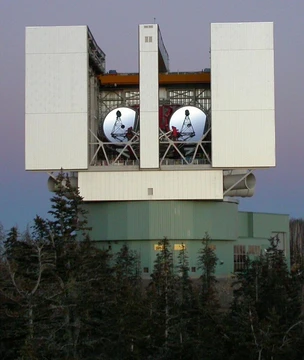
Asteroid Terrestrial-impact Last Alert System
Robotic survey providing days to weeks of warning for smaller asteroid impacts.

The Asteroid Terrestrial-impact Last Alert System, or ATLAS, is a robotic network designed to spot smaller asteroids that are on course to hit Earth, typically giving only a few weeks to days of warning. NASA funds the project, and the University of Hawaii’s Institute for Astronomy runs it. The system now uses five telescopes, each half a meter across. Two are in Hawaii, separated by 160 kilometers—one on Haleakalā and the other on Mauna Loa. Another sits at the Sutherland Observatory in South Africa, one at El Sauce Observatory in Chile, and the newest was installed at Teide Observatory in Spain in February 2025, though its data had not yet appeared on the ATLAS website as of May 2025.
ATLAS started with a single telescope at Haleakalā in 2015. By 2017, a two-telescope version in Hawaii was fully operational. With additional NASA funding, two more telescopes were added in the Southern Hemisphere, coming online in early 2022. Each telescope scans a quarter of the visible sky four times every clear night. Before the southern pair, the system could cover the entire observable sky four times over every two clear nights; afterward, it achieved that same coverage every night, and it also closed a blind spot in the far southern sky.
Earth’s history has been shaped by major impacts, from the formation of the Moon to the origin of water and mass extinctions. The 10-kilometer-wide asteroid that struck 66 million years ago, creating the Chicxulub crater, is widely blamed for wiping out the non-avian dinosaurs and three-quarters of all species. Another impact, 37 million years ago, carved out the Mistastin crater and produced temperatures above 2,370 °C—the hottest ever recorded naturally on Earth’s surface.
In recorded history, hundreds of impacts and air bursts have been documented, though only a tiny fraction have caused deaths, injuries, or significant property damage. Stony asteroids about 4 meters across hit the atmosphere roughly once a year. Those around 7 meters arrive every five years or so, packing the energy of the Hiroshima bomb—about 16 kilotons of TNT—though about a third of that energy dissipates as an air burst. Most of these small objects explode high up and vaporize completely. Asteroids 20 meters wide strike about twice per century.
Quick Facts
- Code
- T05 (ATLAS-HKO) / T08 (ATLAS-MLO) / W68 (ATLAS-CHL) / M22 (ATLAS-SAAO) / R17 (ATLAS-TDO)
Facts from the source article.
Lore & Background
ATLAS began observations in 2015 with one telescope at Haleakala, and a two-Hawaii-telescopes version became operational in 2017. Replacement of the initially substandard Schmidt corrector plates of both telescopes in June 2017 improved their image quality and sensitivity by one magnitude. In August 2018, the project obtained US$3.8 million of additional NASA funding to install two telescopes in the Southern Hemisphere, which became operational in early 2022. The newest telescope at Teide Observatory in Spain was commissioned in February 2025, but as of May 2025 does not show results on the ATLAS web page.
Each telescope surveys one quarter of the whole observable sky four times per clear night. The addition of the two southern telescopes improved ATLAS's four-fold coverage of the observable sky from every two clear nights to nightly, as well as filled its previous blind spot in the far southern sky. The full ATLAS concept consists of eight telescopes, spread over the globe for 24h/24h coverage of the full night sky.
Reader's Guide
The Last Alert part of the ATLAS name acknowledges that the system will find smaller asteroids years too late for potential deflection but would provide the days or weeks of warning needed to evacuate and otherwise prepare a target area. According to ATLAS project lead John Tonry, 'that's enough time to evacuate the area of people, take measures to protect buildings and other infrastructure, and be alert to a tsunami danger generated by ocean impacts.' Most of the more than 1 billion rubles (approximately $33M USD at the time) damage and of the 1500 injuries caused by the 17-m Chelyabinsk meteor impact in 2013 were from window glass broken by its shock wave. With even a few hours advance warning, those losses and injuries could have been much reduced by actions as simple as propping all windows open before the impact and staying away from them.
As long as their radiant is not too close to the Sun, the automated system provides a one-week warning for a 45 metres (150 ft) diameter asteroid, and a three-week warning for a 120 m (390 ft) one. By comparison, the February 2013 Chelyabinsk meteor impact was from an object estimated at 17 m (60 ft) diameter. Its arrival direction happened to be close to the Sun and it therefore was in the blind spot of any Earth-based visible light warning system. A similar object arriving from a dark direction would be detected by ATLAS a few days in advance.
Did You Know?
- ATLAS currently has five 0.5-meter telescopes, with the newest at Teide Observatory in Spain commissioned in February 2025.
- The Chelyabinsk meteor of 2013, which caused over 1 billion rubles in damage and 1500 injuries, was from a 17-meter object arriving from near the Sun, a blind spot for ATLAS.
- ATLAS's two southern telescopes, added in early 2022, filled its previous blind spot in the far southern sky and improved coverage to nightly.
Mission & Design Philosophy
ATLAS is a robotic survey system designed specifically to spot smaller near-Earth objects during their final approach to our planet. Unlike larger asteroids that can be tracked years or even decades ahead, the sub-140-meter objects that pose a regional threat are only visible when they are already very close to Earth. ATLAS fills this critical gap by providing a last-chance warning window of a few weeks to days before impact. The system is optimized for this specific detection challenge, scanning the sky repeatedly to catch objects that other surveys might miss in their final approach. The "Last Alert" designation in its name reflects this reality: by the time ATLAS spots these smaller bodies, there is no time left for deflection missions, which would require years of preparation and travel. The warning instead serves to alert populations in the impact zone, allowing for emergency response and damage mitigation.
Global Telescope Network & Phased Expansion
The ATLAS network has grown from a single instrument to a five-telescope global array. Observations commenced in 2015 with one 0.5-meter telescope at Haleakala on Maui. By 2017, a second Hawaiian telescope at Mauna Loa brought the system to a two-site configuration. NASA subsequently funded two additional telescopes in the Southern Hemisphere, which came online in early 2022: one at Sutherland Observatory in South Africa and another at El Sauce Observatory in Rio Hurtado, Chile. The most recent addition, at Teide Observatory in Spain, was commissioned in February 2025, though as of May 2025 it had not yet published results on the ATLAS web page. Each individual telescope surveys one quarter of the observable sky four times per clear night. The two southern sites were particularly important because they eliminated ATLAS's previous blind spot in the far southern sky and improved the system's four-fold sky coverage from every two clear nights to nightly.
The Threat Landscape ATLAS Addresses
The motivation for ATLAS stems from a sobering statistical reality: stony asteroids roughly four meters across enter Earth's atmosphere about once per year, while seven-meter objects arrive roughly every five years, carrying kinetic energy comparable to the Hiroshima bomb. Twenty-meter asteroids strike approximately twice per century. The 2013 Chelyabinsk event, involving a roughly 20-meter object, remains the largest continental impact since the 1908 Tunguska event and the only historical impact known to have caused widespread injuries. Stephen Hawking identified a large asteroid collision as the greatest threat to our planet in his 2018 book, and the B612 Foundation declared in the same year that a devastating impact is a certainty. The US National Science and Technology Council warned in June 2018 that America was unprepared for such an event. While kilometer-class asteroids are now 97% cataloged and none will hit Earth for at least a century, the smaller, more frequent, and harder-to-detect objects remain an ongoing and unmitigated risk.
Institutional Framework & Operational Model
ATLAS is funded by NASA but developed and operated by the University of Hawaii's Institute for Astronomy, representing a public-university partnership in planetary defense. The system is fully robotic, meaning it operates without the need for human operators at the telescope sites, enabling consistent and automated sky surveys across its distributed network. Each telescope carries a specific observatory code—T05 for Haleakala, T08 for Mauna Loa, M22 for Sutherland, W68 for El Sauce, and R17 for Teide—reflecting its integration into the broader astronomical survey infrastructure. The project's growth was phased: initial Hawaiian operations were followed by a NASA-funded expansion into the Southern Hemisphere, demonstrating a deliberate strategy to build global coverage incrementally. The system's design philosophy prioritizes breadth of sky coverage and frequency of observation over the depth of individual measurements, making it well-suited to catching fast-moving, faint objects in their final approach rather than precisely characterizing well-known asteroids.
Frequently Asked Questions
What is the Asteroid Terrestrial-impact Last Alert System (ATLAS)?
ATLAS is a robotic sky-survey network built specifically to catch smaller near-Earth asteroids that are on a collision course with our planet. It is funded by NASA and operated by the University of Hawaii's Institute for Astronomy, having gone operational in 2015.
How much advance warning can ATLAS provide before an asteroid impact?
The system is designed to give roughly a few days to a few weeks of notice for smaller, harder-to-detect asteroids. That shorter window reflects its focus on objects too small for longer-range detection methods.
Where are ATLAS's telescopes located around the world?
The five half-meter telescopes sit at four sites: Haleakalā and Mauna Loa in Hawaii (about 160 km apart), Sutherland Observatory in South Africa, El Sauce Observatory in Chile, and Teide Observatory in Spain. This spread ensures both hemispheres are covered for continuous monitoring.
Who pays for and runs the ATLAS project?
NASA provided the initial $5 million in funding plus an additional $3.8 million to support the network. Day-to-day operations are handled by the University of Hawaii's Institute for Astronomy.
How many telescopes are in the ATLAS network and what is their aperture?
The network comprises five telescopes, each with a 0.5-meter (half-meter) diameter. Together they form a coordinated robotic survey rather than a single large instrument.
More in Optical Telescopes 1-24
Spotted an error? Know more?
Reader corrections go straight into our review queue. Suggest an edit · How this site is sourced