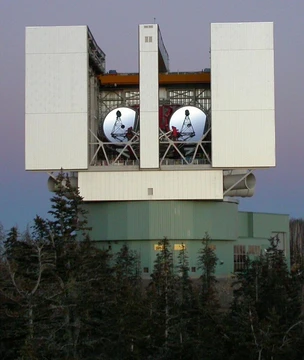
Dragonfly Telephoto Array
Ground-based array of telephoto lenses for ultra-low surface brightness galaxies.

The Dragonfly Telephoto Array is a ground-based telescope system built by the Dunlap Institute for Astronomy & Astrophysics at the University of Toronto. Instead of a traditional mirror, it uses a collection of telephoto camera lenses to study objects beyond our galaxy. Its primary job is to capture images of galaxies with extremely low surface brightness in visible light, a task made easier by the special coatings on its lenses that cut down on scattered light.
The array was designed by Roberto Abraham from the University of Toronto and Pieter van Dokkum from Yale University. It began operation in 2013 with eight off-the-shelf Canon 400mm f/2.8 lenses. That number grew to ten, and by 2016 it had expanded into two clusters of 24 lenses each, for a total of 48. The setup is built so that more lenses can be added to increase the effective aperture. With all 48 lenses, the array gathers as much light as a single 400mm f/0.4 lens, or a refracting telescope with a 990-millimeter objective. In March 2021, plans were announced to add another 120 lenses. Because it uses lenses instead of mirrors, the array avoids some of the light-scattering problems that come from dust and slight imperfections on a mirror’s surface, as well as diffraction issues caused by obstructions in a reflector’s optical path.
The Dragonfly Telephoto Array sits in southern New Mexico, hosted at the Remote Astronomical Society Observatory of New Mexico.
The array has been used to discover Dragonfly 44, a galaxy about as massive as the Milky Way but made up of 99.9% dark matter. It also found NGC 1052-DF2, which early measurements suggested had very little dark matter. Later work indicated that galaxy might be closer to Earth than first thought, which would mean it contains a normal amount of dark matter. That distance debate continued, but a follow-up observation using the Hubble Space Telescope measured the tip of the red-giant branch distance to NGC 1052-DF2, confirming earlier surface brightness fluctuation measurements and settling the ambiguous distance.
- Designers
- Roberto Abraham of the University of Toronto and Pieter van Dokkum of Yale University
- Commissioned
- 2013
- Initial lenses
- 8 commercially available Canon EF 400mm f/2.8L IS II USM camera lenses
- Lenses by 2016
- two clusters of 24 lenses each (48 total)
- Equivalent aperture
- 400 mm f/0.4 lens
- Equivalent objective diameter
- 990 mm (39 in)
- Location
- southern part of New Mexico, hosted at the Remote Astronomical Society Observatory of New Mexico
Lore & Background
The telescope was designed by Roberto Abraham of the University of Toronto and Pieter van Dokkum of Yale University. It was commissioned in 2013 and initially had eight commercially available Canon EF 400mm f/2.8L IS II USM camera lenses. This was first increased to ten lenses, and then extended to two clusters of 24 lenses each in 2016. The array is designed to accommodate the addition of lenses to increase its effective aperture with each additional lens. With 48 lenses, the instrument has a light gathering power equivalent to a 400 mm f/0.4 lens, or a refracting telescope with an objective lens diameter of 990 mm (39 in). In March 2021 plans were announced to add 120 more lenses.
By using a lens based refractor design rather than a mirror based reflector design, the telescope suffers less from issues introduced by diffraction and light scattering. Reflector designs have more light scattering due to interactions with dust and any slight roughness on the mirror. Issues with diffraction occur due to the need to place obstructions in the optical path of reflecting telescopes.
Reader's Guide
The Dragonfly Telephoto Array has been used to discover notable galaxies that challenge understanding of dark matter. Astronomers used it to discover Dragonfly 44, a galaxy roughly as massive as the Milky Way, with 99.9% of its mass composed of dark matter. At the other end of the scale, it was also used to discover NGC 1052-DF2, which measurements with other instruments initially suggested was a galaxy with very little dark matter. Further work indicated that NGC 1052-DF2 was closer to the Earth than previously thought; if this is the case then the galaxy would appear to contain a typical amount of dark matter. This distance debate was continued and rebutted by a follow up observation which measured the tip of the red-giant branch distance to NGC 1052-DF2 using Hubble Space Telescope, confirming the earlier surface brightness fluctuation measurements and resolving the ambiguous distance. The array's design, using specially coated lenses to reduce scattered light, makes it uniquely suited for detecting extremely faint structures that other telescopes might miss.
Did You Know?
- The Dragonfly Telephoto Array was developed at the Dunlap Institute for Astronomy & Astrophysics of the University of Toronto in Canada.
- It was commissioned in 2013 with eight Canon EF 400mm f/2.8L IS II USM camera lenses.
- The array discovered Dragonfly 44, a galaxy with 99.9% of its mass composed of dark matter.
Origins & Modular Engineering
The Dragonfly Telephoto Array traces its intellectual roots to a collaboration between Roberto Abraham at the University of Toronto and Pieter van Dokkum at Yale University. Commissioned in 2013 at the Dunlap Institute for Astronomy & Astrophysics, the project began with a modest complement of eight commercially available Canon EF 400mm f/2.8L IS II USM camera lenses. What set the design apart from the start was its modularity: the structure was engineered so that additional lenses could be added to grow the effective aperture incrementally. That vision proved practical. The array expanded to ten lenses, and by 2016 it had reached two clusters of twenty-four lenses each, totaling forty-eight. At that scale, the combined light-gathering power matched what would otherwise require a single 990-millimetre refracting objective. In March 2021, plans were announced to push the count even further with another 120 lenses. The instrument is situated in the southern part of New Mexico, hosted at the Remote Astronomical Society Observatory.
Optical Philosophy: Why Lenses Over Mirrors
The Dragonfly Telephoto Array makes a deliberate choice that distinguishes it from most large research telescopes: it is a refractor, built around lenses rather than mirrors. This design decision carries significant optical consequences. Mirror-based reflectors inevitably introduce light scattering because of interactions between incoming photons and microscopic dust or surface roughness on the reflective coating. They also require structural obstructions placed directly in the optical path, which generate diffraction patterns that smear faint light. By contrast, a pure lens-based refractor avoids both problems. The Dragonfly's lenses are further enhanced with specially coated optical glass that suppresses scattered light, making the array exceptionally well suited to its primary mission: capturing images of ultra-low surface brightness galaxies at visible wavelengths. Where a reflector might lose precious photons to internal scattering or diffraction, the Dragonfly's clean optical path preserves the faint extended light that defines these elusive objects.
Dragonfly 44 and the Dark Matter Frontier
Among the most striking outcomes of the Dragonfly Telephoto Array's research programme is the discovery of Dragonfly 44, a galaxy whose total mass is roughly comparable to that of the Milky Way yet whose luminous matter accounts for only a tiny fraction of the whole. Approximately 99.9 percent of its mass is attributed to dark matter, making it one of the most extreme dark-matter-dominated systems identified to date. The array's sensitivity to ultra-low surface brightness structures was precisely what allowed astronomers to detect and characterise such a diffuse object. At the opposite extreme of the dark-matter spectrum, the same instrument played a key role in identifying NGC 1052-DF2, a galaxy that initial measurements with other instruments suggested contained very little dark matter. That finding sparked considerable debate, because a galaxy so deficient in dark matter would challenge standard models of galactic formation. The Dragonfly's ability to resolve faint, extended structures placed it at the centre of one of the most active discussions in modern extragalactic astronomy.
The NGC 1052-DF2 Distance Controversy
The initial claim that NGC 1052-DF2 was nearly devoid of dark matter rested on a particular distance estimate. Subsequent work proposed that the galaxy was actually closer to Earth than originally thought, and if that revised distance held, the galaxy would possess a more typical dark-matter content, defusing the apparent anomaly. The debate persisted, with researchers on both sides presenting competing measurements. The dispute was ultimately addressed through a follow-up observation using the Hubble Space Telescope, which measured the tip of the red-giant branch distance to NGC 1052-DF2. That independent determination confirmed the earlier surface-brightness-fluctuation measurements that had underpinned the original low-dark-matter interpretation, thereby resolving the ambiguous distance question. The episode illustrated both the power and the fragility of distance-dependent conclusions in extragalactic astronomy: a single parameter, measured with sufficient precision, could swing a galaxy between being a standard system and a potential challenge to galactic formation theory. The Dragonfly's role in surfacing the object in the first place made it an essential participant in that broader scientific dialogue.
Frequently Asked Questions
What is the Dragonfly Telephoto Array?
It is a ground-based telescope system operated by the Dunlap Institute for Astronomy & Astrophysics at the University of Toronto that swaps a conventional primary mirror for a cluster of telephoto camera lenses to observe objects outside the Milky Way.
Who designed the Dragonfly Telephoto Array?
The instrument was conceived by Roberto Abraham at the University of Toronto together with Pieter van Dokkum at Yale University, and construction got underway around 2013.
What does the Dragonfly Telephoto Array actually observe?
Its core mission is to photograph galaxies with extremely low surface brightness in visible light—faint, diffuse objects that are nearly invisible to ordinary survey telescopes.
How does the Dragonfly Telephoto Array differ from a traditional telescope?
Instead of one large reflective mirror, it bundles multiple Canon EF 400 mm f/2.8L telephoto lenses into a single array, and specialized anti-scatter coatings on the glass preserve the weak signal from those dim galaxies.
How big is the Dragonfly Telephoto Array's effective collecting area?
Once the system grew to two clusters of 24 lenses (48 total) by 2016, the combined optics delivered an equivalent aperture of roughly 990 mm (about 39 in) at f/0.4, giving it a wide, fast field of view well suited to sweeping up faint extended structures.
More in Optical Telescopes 1-24
Spotted an error? Know more?
Reader corrections go straight into our review queue. Suggest an edit · How this site is sourced