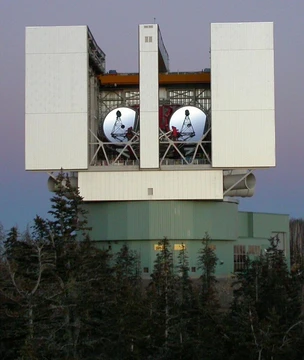
UK Schmidt Telescope
A 1.24 m Schmidt survey telescope at Siding Spring Observatory.

The UK Schmidt Telescope (UKST) is a 1.24 metre Schmidt telescope operated by the Australian Astronomical Observatory (formerly the Anglo-Australian Observatory). Located adjacent to the 3.9 metre Anglo-Australian Telescope at Siding Spring Observatory, Australia, it is very similar to the Samuel Oschin telescope in California. The telescope can detect objects down to magnitude 21 after an hour of exposure on photographic plates.
Quick Facts
- Diameter
- 1.24 m
Facts from the source article.
Lore & Background
The UK Schmidt Telescope was originally built and operated by the United Kingdom, starting from 1973, and was merged with the former Anglo-Australian Observatory in 1988. It has been wholly operated by Australia since the UK withdrew from the AAO in 2010, though the name is unchanged. The UKST is a Schmidt camera, with a design based on the Oschin Schmidt Telescope.
It is a survey telescope with a 6° by 6° field of view, originally imaged onto a 35 cm square glass photographic plate, and was the primary source of optical survey data in the southern sky from the 1970s to after 2000. The original sky survey plates were digitally scanned by the Space Telescope Science Institute to create the Guide Star Catalog for the Hubble Space Telescope, and the Digitized Sky Survey.
Although the UKST was originally used to take photographs of the sky, traditional photographic glass (and film) became largely superseded by large electronic CCD detectors in the late 1990s, and after 2000 the UKST was used mostly for multi-object spectroscopy with the 6 degree Field (6dF) instrument. 6dF uses a robot to position up to 150 optical fibres on a metal plate mounted at the focal plane of the UKST, which then carry light from the targets to a spectrograph which sits on the floor of the dome.
Reader's Guide
The UK Schmidt Telescope's significance lies in its role as the primary source of optical survey data in the southern sky from the 1970s to after 2000. Its original photographic plates were digitally scanned by the Space Telescope Science Institute to create the Guide Star Catalog for the Hubble Space Telescope and the Digitized Sky Survey, making it a foundational resource for astronomy. After 2000, it transitioned to multi-object spectroscopy with the 6dF instrument, completing the 6dF Galaxy Survey (6dFGS), a redshift survey of 120,000 infrared-selected galaxies in 2005. From 2003–2013, it carried out the RAdial Velocity Experiment (RAVE) to measure radial velocities and metallicities of around 0.5 million stars in the Milky Way Galaxy. Two new spectroscopic surveys called TAIPAN and Funnelweb were planned post-2015, extending its legacy.
Did You Know?
- The 6dF Galaxy Survey (6dFGS) completed in 2005 surveyed 120,000 infrared-selected galaxies.
- From 2003–2013, the UKST carried out the RAVE survey of around 0.5 million stars.
More in Optical Telescopes 1-24
Spotted an error? Know more?
Reader corrections go straight into our review queue. Suggest an edit · How this site is sourced