Synoptic Optical Long-term Investigations of the Sun
A synoptic facility for long-term solar observations.

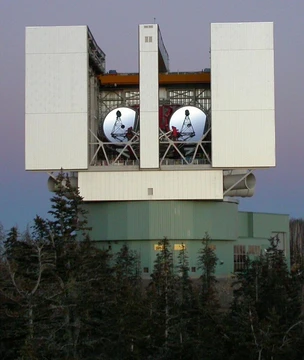
SOLIS (Synoptic Optical Long-term Investigations of the Sun) is a long-term solar observation facility funded by the National Science Foundation and built by the National Solar Observatory. It is run by the NSO Integrated Synoptic Program. The system consists of three instruments on a single platform: the Vector Spectromagnetograph (VSM), the Integrated Sunlight Spectrometer (ISS), and the Full-Disk Patrol (FDP). The VSM uses a 50 cm quasi-Ritchey-Chretien telescope with a primary mirror operating at f/1.6. Its secondary mirror is made from a single silicon crystal, and the mirrors have protected silver coatings. The telescope is sealed with a 74 cm fused silica window to improve internal seeing. Originally filled with helium at ambient pressure and temperature, it was switched to nitrogen in 2014 due to rising helium costs, which slightly reduced image sharpness. The VSM produces daily full-disk maps of the solar magnetic field in both the photosphere and chromosphere, continuing a 40-year record. The ISS captures spectra of the Sun as a whole, treating it like a distant star, which helps model how a star’s magnetic field affects its spectrum—useful for studying exoplanet systems. The FDP takes full-disk images in various spectral lines at up to 10-second intervals. SOLIS was located at Kitt Peak until July 2014, then moved temporarily to a University of Arizona farm in Tucson until October 2017, and is now being permanently relocated to Big Bear Solar Observatory. Construction of the new facility began in April 2021 and was mostly finished by year’s end; the main telescope mount was installed in December 2021. In September 2024, the VSM and FDP were installed on the mount. Once operational, SOLIS will continue providing unique, long-term solar observations to study the solar activity cycle, sudden energy releases in the solar atmosphere, and changes in solar irradiance and their link to global change.
Quick Facts
- Organization
- NSO Integrated Synoptic Program (NISP)
- Location
- Big Bear Solar Observatory, California
- Built
- 2003
Facts from the source article.
Lore & Background
SOLIS is a single set of three instruments mounted on a common observing platform: the 50 cm aperture Vector Spectromagnetograph (VSM), the 8 mm aperture Integrated Sunlight Spectrometer (ISS), and the 14 cm aperture Full-Disk Patrol (FDP). The VSM telescope is a quasi-Ritchey-Chretien design with a primary mirror operating at f/1.6. The ~400 W of solar light from the primary is reflected by a secondary mirror fabricated from a single silicon crystal. The final f/6.6 full-disk solar image is focused on a spectrograph slit that is cooled by a flow of chilled water-propylene glycol solution. The mirrors are coated with protected silver. To improve internal seeing, the VSM is sealed by a 74 cm diameter, 6 mm thick fused silica window. Originally, it was filled with helium at about ambient pressure and temperature; in 2014, helium was replaced by nitrogen due to the increasing cost of helium, which slightly degraded image sharpness.
Reader's Guide
SOLIS provides full-disk vector maps of the solar magnetic field both in the photosphere and chromosphere on a daily basis, continuing the 40-year record of NSO magnetic field observations. The ISS obtains spectra of the Sun integrated over the solar disk, so the Sun appears as it would as a much more distant star. The combination of data from the ISS and the VSM is useful for studies of exoplanet systems, as it allows modeling of the influence of a star's magnetic field on its spectrum, giving clues to the activity level that exoplanets may be subject to. The FDP provides full-disk images in a variety of spectral lines with a cadence as high as 10 seconds. Once back to operations, SOLIS will provide unique observations of the Sun on a continuing basis for several decades to understand the solar activity cycle, sudden energy releases in the solar atmosphere, and solar irradiance changes and their relationship to global change.
Did You Know?
- The VSM secondary mirror is fabricated from a single silicon crystal.
- The VSM was originally filled with helium, replaced by nitrogen in 2014 due to rising helium costs.
- The FDP provides full-disk images with a cadence as high as 10 seconds.
- SOLIS was located on top of the Vacuum Telescope building at Kitt Peak National Observatory until July 2014.
More in Optical Telescopes 1-24
Spotted an error? Know more?
Reader corrections go straight into our review queue. Suggest an edit · How this site is sourced