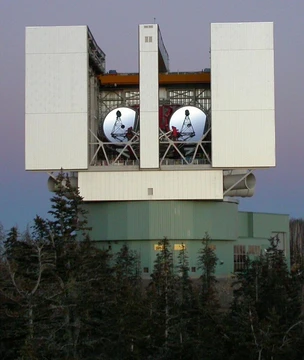
Sunspot Solar Observatory
Solar observatory closed indefinitely after mercury leak in flagship telescope.

The Sunspot Solar Observatory (SSO), also known as the Sacramento Peak Observatory, is an astronomical observatory designed for the study of the Sun. It is located in Sunspot, New Mexico, within the Lincoln National Forest on the western edge of the Sacramento Mountains. The facility was established by the U.S. Air Force in 1950 and transferred to the U.S. National Science Foundation in 1976. Its flagship instrument, the Richard B. Dunn Solar Telescope, was rendered inoperable in February 2026 after a mercury leak was discovered in its main bearing system, leading to the indefinite closure of the observatory to the public.
Quick Facts
- Native Name
- Sacramento Peak
- Research Field
- Solar Physics, Space Weather
- Staff
- 12
- City
- Sunspot
- State
- New Mexico
- Country
- USA
- Zipcode
- 88349
- Affiliations
- New Mexico State University
- Operating Agency
- AURA, NSF
Facts from the source article.
Lore & Background
The origins of Sunspot as a solar observatory date back to the increased interest in solar physics by the U.S. military during World War II. The High Altitude Observatory (HAO) was established in 1940 in Climax, Colorado, for studying the Sun, but long periods of cloudiness there prompted the need for a second site. In September 1947, the U.S. Air Force contracted HAO and Harvard University to survey for a new location. Walter Orr Roberts and Donald Menzel examined the White Sands Proving Ground area and concluded that the Sacramento Mountains were promising. A small crew including Roberts, John W. Evans, and Rudy Cook made the initial camp at the Sunspot site. By April 1948, the Committee on Geophysical Sciences formally accepted the recommendation, and a contract was written for the Air Force to complete the observatory.
The facility later became known as the Sacramento Peak Observatory and one site of the National Solar Observatory. In 2018, all scientific research and public outreach were taken over by the Sunspot Solar Observatory, with AURA remaining as operator of infrastructure. The observatory hosts four other telescopes besides the DST: the John W. Evans Solar Facility (built 1952), which until 2009 obtained daily coronal emission observations; the Hilltop Dome (1963) and Grain Bin Dome (1950), not used for research; and an Antarctic Mount telescope beside the Visitors' Center, previously deployed in Antarctica. The Visitors' Center, operated by New Mexico State University, provided guided tours and exhibits from the Dunn Solar Telescope, Apache Point Observatory, and Lincoln National Forest.
Reader's Guide
The Sunspot Solar Observatory is notable as a dedicated solar research facility established by the U.S. Air Force during the Cold War era, reflecting the military's recognition of solar activity's impact on radio communication, guided missiles, and supersonic aircraft. Its location in the Sacramento Mountains was chosen to complement the Climax, Colorado observatory by providing year-round solar coverage, with seasonal cloud cover opposite to that of Climax. The observatory's flagship Dunn Solar Telescope, originally the Vacuum Tower Telescope, was a key instrument for solar studies until a mercury leak in its main bearing system in February 2026 forced its permanent shutdown and planned demolition. The closure of the observatory to the public indefinitely marks the end of decades of solar research and public outreach at this site. The facility's history illustrates the intersection of military needs, scientific advancement, and land management, as it sits on National Forest Service lands managed under agreements between NSF, the U.S. Forest Service, and the U.S. Air Force. The observatory's legacy includes its role in solar cycle prediction and its contribution to the broader National Solar Observatory network.
Did You Know?
- The Dunn Solar Telescope was rendered inoperable in February 2026 after liquid mercury was discovered in its main bearing system.
- The observatory's site covers approximately 250 acres within the Lincoln National Forest in New Mexico.
- The John W. Evans Solar Facility, built in 1952, obtained daily observations of million-degree coronal emission until 2009.
More in Optical Telescopes 1-24
Spotted an error? Know more?
Reader corrections go straight into our review queue. Suggest an edit · How this site is sourced