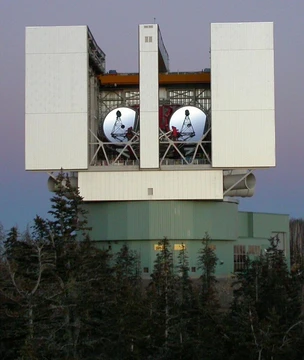
Small telescope
Small telescopes dominate amateur astronomy and key research fields.

A small telescope is defined differently by professional and amateur astronomers. For professionals, it is typically a reflecting telescope with a primary mirror less than 2 metres (80 inches) in diameter; for amateurs, it often refers to an aperture less than 6–10 inches (150–250 mm). Small telescopes are notable for dominating research in asteroid and comet discovery, variable star photometry, supernova and nova discovery, and planetary colorimetry and polarimetry.
- Professional definition
- reflecting telescope with primary mirror less than 2 metres (80 in)
- Amateur definition
- aperture less than 6–10 inches (150–250 mm)
- Smallest amateur refractor
- 2 inches (50 mm)
- Largest amateur reflector
- 36 inches (910 mm) or more
- Minimum reflector for spectroscopy
- 14 inches (360 mm)
Lore & Background
The article notes that little professional-level research is performed with refracting telescopes in the modern era. Small telescopes are usually not well-suited to spectroscopy due to limited light-gathering capability, but some useful spectroscopic work can be done with reflecting telescopes as small as 14 inches (360 mm) when equipped with sophisticated CCD imaging and spectroscopic instrumentation available to amateurs in the 21st century. Most telescopes in amateur astronomy are considered small, ranging from 2-inch (50 mm) achromatic refractors to reflectors with primary mirrors up to 36 inches (910 mm) or more. Most small telescopes are dedicated to visual observation, though many are used for astrophotography or scientific data gathering.
Reader's Guide
The article emphasizes that small telescopes are not merely hobbyist tools but are central to several active research areas. They dominate asteroid and comet discovery and observation, variable star photometry, supernova and nova discovery, and colorimetry and polarimetry of Solar System planets. This significance arises because these fields often require wide fields of view, rapid sky coverage, or sustained monitoring, which small telescopes can provide. The article also notes that while spectroscopy is generally limited, advances in amateur instrumentation have made some spectroscopic work feasible with reflectors as small as 14 inches. The wide range of amateur telescope designs—including achromatic and apochromatic refractors, Newtonian, Schmidt–Cassegrain, Maksutov-Cassegrain, Maksutov-Newtonian, and even sophisticated Ritchey–Chrétien and corrected Dall–Kirkham types—shows that small telescopes have become versatile platforms for both visual observation and scientific contribution. Their legacy is one of enabling broad participation in astronomical research, bridging the gap between amateur and professional domains.
Did You Know?
- Professional astronomers define a small telescope as a reflector with a primary mirror less than 2 metres (80 inches).
- Amateur astronomers often consider a small telescope to have an aperture less than 6–10 inches (150–250 mm).
- Small telescopes dominate research in asteroid and comet discovery, variable star photometry, and supernova discovery.
- Some spectroscopic work is possible with a reflecting telescope as small as 14 inches (360 mm) using modern CCD and spectroscopic gear.
More in Optical Telescopes 1-24
Spotted an error? Know more?
Reader corrections go straight into our review queue. Suggest an edit · How this site is sourced