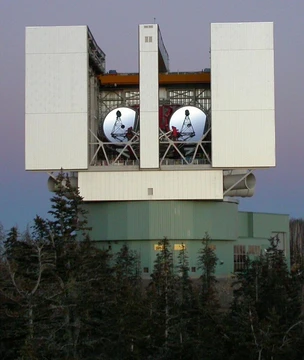
Samuel Oschin telescope
A 48-inch Schmidt camera at Palomar Observatory.

Perched at the Palomar Observatory in northern San Diego County, the Samuel Oschin telescope is a Schmidt camera with a 48-inch (1.22 m) aperture. Its optical system pairs a 49.75-inch (1.264 m) corrector plate with a 72-inch (1.8 m) mirror operating at f/2.5. This instrument is purely a camera—there is no eyepiece for direct viewing. Initially, it relied on 10-inch (25 cm) and 14-inch (36 cm) glass photographic plates, which had to be pre-curved in a special jig to match the camera’s curved focal plane.
Construction began in 1939 and finished in 1948. Originally called simply the 48-inch Schmidt, it was renamed the Samuel Oschin telescope in 1986. In the mid-1980s, the corrector plate was swapped for one made of glass with less chromatic aberration, sharpening images across a broader spectrum. Between 2000 and 2001, the telescope was converted to use a CCD imager, and the corrector plate was later replaced again with glass transparent to a wider range of wavelengths. Once hand-guided through one of two 10-inch (0.25 m) refracting telescopes mounted on its sides, the camera is now fully automated and remote-controlled. Data travels over the High Performance Wireless Research and Education Network (HPWREN), and the system is programmed and operated primarily from Pasadena, California, with no on-site operator except to open and close the dome.
The first CCD camera installed was the Near-Earth Asteroid Tracking (NEAT) camera, featuring three separate 4k×4k sensors arranged north–south with 1° gaps, covering a total field of 3.75 square degrees. From 2003 to 2007, the Quasar Equatorial Survey Team camera took over, using 112 CCDs (each 2400×600 pixels, totaling 161 megapixels) in four columns of 28—then the largest CCD mosaic in an astronomical camera. In 2009, a 12,288-by-8,192-pixel (100 megapixel) mosaic originally built for the Canada–France–Hawaii Telescope was installed, offering a 7.8-square-degree field for the Palomar Transient Factory. In 2017, the telescope became home to the Zwicky Transient Facility, a custom-designed camera with a 16×6144×6160 CCD array (606 megapixels) and a 47-square-degree field of view.
About half of the telescope’s large photographic glass plate negatives—some 19,000—had been piling up in the sub-basement of Caltech’s Robinson building since 1949.
Quick Facts
- Location
- San Diego County, California, United States
- Observatory
- Palomar Observatory
Facts from the source article.
Lore & Background
Construction on the Schmidt telescope began in 1939 and it was completed in 1948. It was named the Samuel Oschin telescope in 1986; before that it was just called the 48-inch (1.2 m) Schmidt. In the mid-1980s, the corrector plate was replaced using glass with less chromatic aberration, producing higher quality images over a broader spectrum. Between 2000 and 2001, it was converted to use a CCD imager. The corrector plate was recently replaced using glass that is transparent to a wider range of wavelengths. The telescope was originally hand-guided through one of two 10-inch-aperture (0.25 m) refracting telescopes mounted on either side. The camera is now fully automated and remote-controlled. The data collected are transmitted over the High Performance Wireless Research and Education Network (HPWREN). It is programmed and operated primarily from Pasadena, California, with no operator on site, except to open and close the observatory dome.
Reader's Guide
The Oschin Telescope was responsible for the discovery of 90377 Sedna on 2003-11-14 and Eris, the '10th Planet' on 2005-01-05 from images taken 2003-10-21. The peculiar Type Ia supernova SN 2002cx was discovered with the Oschin telescope on 2002-05-12, 21 UT. Other discoveries include 90482 Orcus (in 2004) and 50000 Quaoar (in 2002), both large trans-Neptune objects. In June 2011 it was reported the telescope discovered 6 supernovae located 8 billion light years from Earth whose composition lacks hydrogen. This is different from normal supernovae, and will contribute to the research of star formation. The telescope hosted successive CCD cameras: the Near-Earth Asteroid Tracking (NEAT) camera with three 4k×4k sensors; the Quasar Equatorial Survey Team camera (2003–2007) with 112 CCDs (161 megapixels); a 100-megapixel mosaic (2009) used for the Palomar Transient Factory; and in 2017 the Zwicky Transient Facility, custom designed with a 606-megapixel array and a 47-square-degree field of view.
Did You Know?
- The telescope originally used 10-inch and 14-inch glass photographic plates that had to be preformed in a special jig due to the curved focal plane.
- About half of the 19,000 photographic plate negatives from the telescope were organized by volunteers in 2002, who were rewarded with asteroids named after them.
- In 2017 the telescope became the host of the Zwicky Transient Facility, using a 606-megapixel CCD array with a 47-square-degree field of view.
More in Optical Telescopes 1-24
Spotted an error? Know more?
Reader corrections go straight into our review queue. Suggest an edit · How this site is sourced