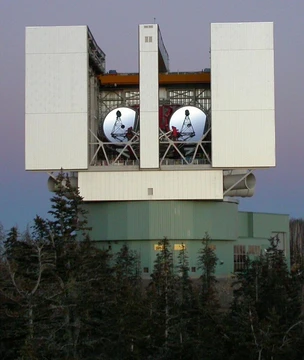
Richard B. Dunn Solar Telescope
A vertical-axis solar telescope specializing in high-resolution imaging and spectroscopy.

The Richard B. Dunn Solar Telescope, often shortened to the Dunn Solar Telescope, is a vertical-axis instrument built for high-resolution imaging and spectroscopy of the Sun. It stands at Sacramento Peak in Sunspot, New Mexico, and served as the primary telescope for the Sunspot Solar Observatory. That observatory was run by New Mexico State University alongside the National Solar Observatory, with support from the National Science Foundation, the state of New Mexico, and private partners. The telescope was finished in 1969 and received high-order adaptive optics in 2004, making it a flexible platform for both solar research and testing new instruments and technologies. It helped astrophysicists around the world study the Sun and its effects on Earth. In February 2026, the National Science Foundation announced plans to dismantle the telescope and restore the Sacramento Peak site after a liquid mercury leak was found, raising safety and environmental concerns.
The telescope’s design is unusual: the entire building functions as a single instrument, with more than half of it underground. The tower rises 136 feet (41 m) above ground, while the deepest point, the sump, lies 228 feet (69 m) below the surface. Inside the concrete tower is a vertical vacuum tube with walls 3 feet thick. Light enters through a heliostat at the top, passes through an entrance window, and is reflected by two mirrors down the vacuum tube to a 64-inch primary mirror 193 feet (59 m) underground. That mirror focuses the light and sends it back up, where it exits through six quartz windows in the floor of a ground-level optical lab. The entire optical path—from the tower top to the underground base, plus the 40-foot-diameter (12 m) observing room floor—is sealed inside the vacuum tube. Evacuating the optics prevents distortion from convection caused by the intense heat of focused sunlight. The vacuum tube itself weighs over 250 tons and is suspended from the tower top by a mercury float bearing containing 10 tons of mercury. This bearing lets the tube rotate to compensate for the Sun’s apparent motion across the sky. The bearing hangs on just three bolts, each only 76 millimeters (3.0 in) in diameter. Despite its size and weight, most of the telescope can be operated from a single control room off to the side of the main observing table.
- Location
- Sacramento Peak, Sunspot, New Mexico
- Completion year
- 1969
- Height above ground
- 136 feet (41 m)
- Depth below ground
- 228 feet (69 m)
- Primary mirror diameter
- 64 inches
- Vacuum tube weight
- more than 250 tons
- Mercury in float bearing
- 10 tons
Lore & Background
The telescope was inaugurated in 1969 as the world's premier high spatial resolution optical solar telescope. Its design was started by architect and engineer Charles W. Jones in 1963, with construction from 1966 to 1967 under the U.S. Army Corps of Engineers at a cost of about $3 million. The architectural firm was Roghlin and Baran, Associates. Richard B. Dunn, for whom the instrument was eventually dedicated, wrote an article in Sky & Telescope about its completion in 1969, describing how the design eliminated the dome and evacuated the entire telescope inside the tower to reduce local seeing problems. The tower telescope was originally dedicated on October 15, 1969, and renamed in 1998 after Richard B. Dunn.
The whole building from top to bottom is a single instrument, with more than half underground. Enclosed within the concrete tower is a vertical vacuum tube with 3-foot-thick walls. The optical path starts at a heliostat on top of the tower, with an entrance window and two mirrors reflecting sunlight down the vacuum tube to the 64-inch primary mirror 193 feet underground. The primary mirror focuses light and reflects it back up, exiting through six quartz optical windows in the floor of an optical laboratory at ground level. The interior vacuum tube is suspended from the top of the tower by a mercury float bearing containing 10 tons of mercury, allowing the entire tube to rotate to compensate for the apparent rotation of the Sun's image.
In February 2026, the U.S. National Science Foundation announced that the telescope would be dismantled and the Sacramento Peak site restored following the discovery of a liquid mercury leak in the facility and subsequent safety and environmental concerns.
Reader's Guide
The Dunn Solar Telescope helped astrophysicists worldwide better understand the Sun and how it affects Earth. Its observations allowed solar astronomers to investigate a range of solar activities, often in concert with satellites or rocket launches, and to develop new technologies for the 4-meter Daniel K. Inouye Solar Telescope. The telescope's high-order adaptive optics, installed in 2004, compensated for blurring caused by Earth's atmosphere. Its rotating optical bench could be configured to multiple observing setups, supporting instruments such as the Facility Infrared Spectropolarimeter (FIRS), the Spectro-Polarimeter for Infrared and Optical Regions (SPINOR), the Interferometric Bidimensional Spectro-polarimeter (IBIS), and the Rapid Oscillations in the Solar Atmosphere (ROSA) instrument. Scientific work at the telescope included inferring telescope polarization properties through spectral lines, adapting the telescope for Jovian Doppler spectro imaging, deriving solar coronal magnetic fields using seismology techniques applied to sunspot waves, and developing solar multi-conjugate adaptive optics and speckle interferometry. The telescope's legacy includes its role as a test platform for new instrumentation and its contributions to high-resolution solar physics until its planned dismantling in 2026 due to a mercury leak.
Did You Know?
- The lowest excavated point of the telescope is 228 feet (69 m) below ground, while the tower extends 136 feet (41 m) above ground.
- The telescope was upgraded with high-order adaptive optics in 2004.
- In February 2026, the U.S. National Science Foundation announced the telescope would be dismantled due to a liquid mercury leak and subsequent safety and environmental concerns.
More in Optical Telescopes 1-24
Spotted an error? Know more?
Reader corrections go straight into our review queue. Suggest an edit · How this site is sourced