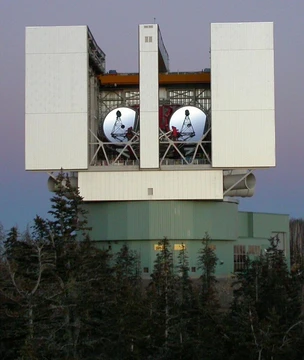
Radcliffe Telescope
74-inch reflector, largest in Southern Hemisphere upon completion in 1948.

The Radcliffe Telescope is a 74-inch (1.9-meter) reflecting telescope that observes in optical and near-infrared light. It is situated at the South African Astronomical Observatory in Sutherland, Northern Cape, South Africa. Upon its completion in 1948, it ranked as the largest telescope in the Southern Hemisphere and tied for fourth-largest in the world. Today, it is the second-largest telescope in Africa. The telescope carries a suite of instruments for photometry, spectroscopy, and polarimetry, which professional astronomers use for a broad array of research.
The telescope’s origins trace back to John Radcliffe (1650–1714), an English physician and MP who left no heirs. His will directed much of his fortune to a charitable trust, which funded public works around Oxford, such as the Radcliffe Camera and the Radcliffe Infirmary. In 1773, acting on advice from Thomas Hornsby, the trust founded the Radcliffe Observatory on Oxford’s northern edge—only the second permanent observatory in Britain after Greenwich. Initially run by Oxford’s Savilian Professor of Astronomy, the observatory later (from 1839) had a dedicated Radcliffe Observer funded directly by the trust. Productive observations continued for most of the following century.
By 1924, when Harold Knox-Shaw became Radcliffe Observer, the observatory faced several challenges. Its largest instrument was a 24-inch (61 cm) refractor, no longer competitive with large new reflectors like America’s 60-inch Hale Telescope (1908) and 100-inch Hooker Telescope (1917). Oxford’s growth had brought light pollution and poor seeing from chimney heat, while British weather often meant cloudy nights. The neighboring Radcliffe Infirmary also wanted to expand, leaving no space for a large new telescope enclosure.
Knox-Shaw began planning a new telescope and observatory. He had previously worked at Helwan Observatory in Egypt and knew the advantages of an arid site. In 1928, funding was approved for the 200-inch Hale Telescope at Palomar Observatory, California, which would far outclass any Radcliffe could build. Since the southern sky is invisible from Palomar, the Radcliffe telescope was sited in the Southern Hemisphere to observe sources the Hale could not reach.
Initially, no funds were available.
Quick Facts
- Organization
- South African Astronomical Observatory
- Location
- Sutherland, Northern Cape, South Africa
- Wavelength
- Optical/near-infrared
- Built
- 1938-1948
- First Light
- 1948
- Style
- Ritchey-Chrétien Cassegrain, Coude or Newtonian reflector
- Diameter
- 74 in
- Mounting
- Cross-axis equatorial
- Dome
- Turret
Facts from the source article.
Lore & Background
The telescope originated from the Radcliffe Trust, established by John Radcliffe (1650–1714), an English physician and MP. The trust had previously funded the Radcliffe Observatory in Oxford, but by the 1920s that site suffered from light pollution, poor seeing, and weather issues. In 1929, philanthropist Sir William Morris offered £100,000 to buy the Oxford observatory grounds, enabling a new Southern Hemisphere observatory. After site testing near Pretoria, the telescope was designed by Grubb Parsons as a copy of their 74-inch telescope for David Dunlap Observatory. Construction was delayed by World War II; the primary mirror was buried near the factory for protection. First light was achieved in 1948.
Reader's Guide
The Radcliffe Telescope was notable for being the largest telescope in the Southern Hemisphere at its completion in 1948, allowing astronomers to study southern sky objects inaccessible from large Northern Hemisphere observatories like Palomar. It was equipped with instruments for photometry, spectroscopy, and polarimetry, used for a wide range of astronomical research. Early operations suffered from a lack of instrumentation; only direct photography was possible for over a year, and spectroscopy became available in 1951. Funding issues limited staff and observing time until an agreement with the British Admiralty in 1951 bought a one-third share of observing time for astronomers from the Royal Observatory at the Cape of Good Hope. The telescope remains the second largest in Africa.
Did You Know?
- The telescope was a copy of the 74-inch telescope built for David Dunlap Observatory in Canada.
- During World War II, the primary mirror was buried near the Grubb Parsons factory in Newcastle to protect it from bombing.
- The telescope's dome is a cylindrical turret 61 feet in diameter, unlike the hemispherical dome of the Dunlap telescope.
- The site near Pretoria was chosen after testing by William Herbert Steavenson from February to June 1930.
More in Optical Telescopes 1-24
Spotted an error? Know more?
Reader corrections go straight into our review queue. Suggest an edit · How this site is sourced