Pan-STARRS
Surveying the sky for moving or variable objects continually.

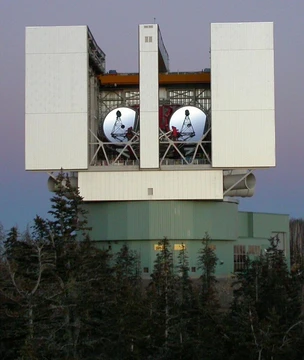
The Panoramic Survey Telescope and Rapid Response System (Pan-STARRS) is a system of astronomical cameras, telescopes, and a computing facility located at Haleakalā Observatory, Hawaii, US. It surveys the sky for moving or variable objects on a continual basis and produces accurate astrometry and photometry of already-detected objects. As of 2025, it consists of two 1.8-m Ritchey–Chrétien telescopes. Its second data release, announced in January 2019, at 1.6 petabytes, is the largest volume of astronomical data ever released.
- Location
- Haleakalā Observatory, Hawaii, US
- Telescopes
- Two 1.8-m Ritchey–Chrétien telescopes (PS1 and PS2)
- First light ps1
- June 2006 (low-resolution camera); 22 August 2007 (gigapixel camera)
- First light ps2
- 2013
- Full operations ps1
- 13 May 2010
- Data release dr2
- January 2019, 1.6 petabytes
- Primary mission
- Detect Near-Earth Objects that threaten impact events
Lore & Background
The Pan-STARRS Project is a collaboration between the University of Hawaiʻi Institute for Astronomy, MIT Lincoln Laboratory, Maui High Performance Computing Center, and Science Applications International Corporation. Telescope construction was funded by the U.S. Air Force. The first telescope (PS1) is located at the summit of Haleakalā on Maui, Hawaii, and went online on 6 December 2008 under the administration of the University of Hawaiʻi. PS1 began full-time science observations on 13 May 2010, and the PS1 Science Mission ran until March 2014. Operations were funded by the PS1 Science Consortium, which included the Max Planck Society, National Central University in Taiwan, several UK universities, Johns Hopkins and Harvard Universities, and the Las Cumbres Observatory Global Telescope Network. Consortium observations for the all-sky survey were completed in April 2014.
Having completed PS1, the project focused on building PS2, for which first light was achieved in 2013, with full science operations scheduled for 2014 and then the full array of four telescopes, sometimes called PS4. Completing the array of four telescopes is estimated at a total cost of US$100 million. As of mid-2014, PS2 was in the process of being commissioned. In the wake of substantial funding problems, no clear timeline existed for additional telescopes beyond the second. In March 2018, PS2 was credited by the Minor Planet Center for the discovery of the potentially hazardous Apollo asteroid (515767) 2015 JA2, its first minor planet discovery made at Haleakalā on 13 May 2015.
The initial telescope, PS1, has a 3° field of view, extremely large for telescopes of this size, and is equipped with what was the largest digital camera ever built, recording almost 1.4 billion pixels per image. The focal plane has 60 separately mounted close packed CCDs arranged in an 8 × 8 array. Each CCD, called an Orthogonal Transfer Array (OTA), has 4800 × 4800 pixels, separated into 64 cells. This gigapixel camera saw first light on 22 August 2007, imaging the Andromeda Galaxy. After initial technical difficulties, PS1 began full operation on 13 May 2010. The PS1 images remain slightly less sharp than initially planned, which significantly affects some scientific uses of the data.
Reader's Guide
Pan-STARRS is notable for its systematic, continual survey of the entire sky visible from Hawaii (three-quarters of the entire sky) down to apparent magnitude 24. Its primary mission is to detect Near-Earth Objects that threaten impact events, and it is currently mostly funded by a grant from the NASA Near Earth Object Observations program, spending 90% of its observing time in dedicated searches for Near Earth Objects. The survey is expected to produce a dramatically larger number of discoveries of various types of celestial objects, including asteroids, comets, variable stars, supernovae, and other objects. By detecting differences from previous observations of the same areas of the sky, Pan-STARRS discovers many new objects. The very large field of view and short exposure times enable approximately 6000 square degrees of sky to be imaged every night, allowing the entire sky to be imaged in about 40 hours. By the end of its initial three-year mission in April 2014, PS1 had imaged the sky 12 times in each of 5 filters. The second data release, Pan-STARRS DR2, announced in January 2019, is the largest volume of astronomical data ever released, at over 1.6 petabytes, residing in the Mikulski Archive for Space Telescopes (MAST). The survey also complements the infrared sky mapping by the NASA WISE orbital telescope. Military limitations initially censored pixels containing satellite information using streak detection software, but at the end of 2011, the USAF completely eliminated the masking requirement for all images.
Did You Know?
- The entire sky visible from Hawaii (about 30,000 square degrees) can be imaged in about 40 hours.
- At the end of 2011, the USAF eliminated the masking requirement that had censored satellite pixels in images.
More in Optical Telescopes 1-24
Spotted an error? Know more?
Reader corrections go straight into our review queue. Suggest an edit · How this site is sourced