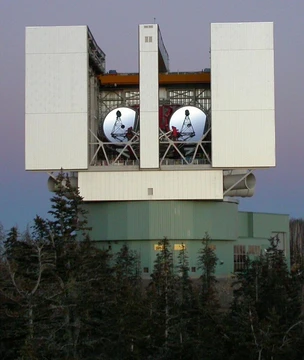
Flyeye
ESA's fly-eye telescope for detecting near-Earth objects before impact.

Flyeye, also called the Near Earth Object Survey TELescope (NEOSTEL), is a survey and early-warning system that looks for near-Earth objects at least 40 metres across, spotting them a few weeks before a potential impact. It belongs to the 'Planetary Defence Cornerstone' within the European Space Agency's Space Safety Programme. The first telescope, made by OHB, sits in Italy. If this prototype works well, three more telescopes are planned for spots near the equator around the world. Any new asteroid detections from these telescopes will be checked by ESA's Near-Earth Object Coordination Centre (NEOCC) and then sent to the IAU's Minor Planet Center.
The first telescope, Flyeye-1 (also called S16-ASI Matera Flyeye), was finished in 2024 and installed on Mount Mufara, Sicily, in 2025. An agreement with the Italian Space Agency was reached in October 2018. Its first light occurred on 20 May 2025.
The telescope uses a new "fly-eye" design, inspired by a fly's wide field of vision. It combines a single main reflector with multiple sets of optics and CCDs, giving a very wide field of view—about 45 square degrees, or 220 times the area of the full moon. This is one of the widest fields of any telescope, allowing it to scan most of the visible sky in one night. Its light-gathering power, due to the novel design, is not directly comparable to conventional telescopes, but it is equivalent to a 1-metre telescope and should reach a limiting magnitude of around 21.
The "fly eye" aspect comes from using compound optics instead of a single set. Traditional telescopes were built for one human observer looking through an eyepiece. In the 19th century, astrographs let a photographic plate or CCD record images for later viewing. Since the human eye no longer directly observes, there is no need for a single viewing point, and asteroid detection software is now fully automated, so most images never need a human to look at them. Light enters the Flyeye through the aperture, reflects off the primary mirror onto a secondary made of 16 mirrors arranged on a hexadecagonal pyramid. The split beam then goes through 16 separate aspheric lenses and onto 16 corresponding CCD image sensors. These 16 cameras together view 45 square degrees of incoming light, with a pixel scale of 1.5 arc seconds per pixel across the whole field.
Quick Facts
- Code
- S16
- Organisation
- European Space Agency
Facts from the source article.
Lore & Background
The first telescope, designated Flyeye-1 or S16-ASI Matera Flyeye, was completed in 2024 and installation on Mount Mufara, Sicily was completed in 2025, following an agreement with the Italian Space Agency in October 2018. First light occurred on 20 May 2025. The telescope uses a novel 'fly-eye' design inspired by the wide field of vision of a fly's eye, combining a single objective reflector with multiple sets of optics and CCDs to achieve a very wide field of view of about 45 square degrees, allowing it to survey the majority of the visible sky in a single night.
In terms of optics, light enters through the aperture and is reflected off the primary mirror onto a secondary consisting of 16 mirrors arranged on a hexadecagonal pyramid. The split beam then passes into 16 separate aspheric lenses and onto 16 corresponding CCD image sensors. The pixel scale is 1.5 arc seconds per pixel across the whole field of view. The observatory's detection capabilities and its requirement for a fast slewing equatorial mount mean a standard telescope dome and observatory design are insufficient; work has been done to optimize the infrastructure layout while minimizing environmental impact in the Madonie Regional Natural Park.
Reader's Guide
Flyeye represents a significant step in planetary defence, as it is designed to detect near-Earth objects of 40 metres or larger weeks before potential impact, providing an early-warning capability. Its novel fly-eye design, with 16 separate optical paths and CCDs, gives it one of the widest fields of view of any telescope, enabling rapid sky surveys. The project is part of ESA's Space Safety Programme, and all potential new asteroid detections are verified by ESA's Near-Earth Object Coordination Centre before submission to the IAU's Minor Planet Center. If the initial prototype in Sicily proves successful, three additional telescopes are planned near the equator to provide global coverage. The telescope's light-gathering power is equivalent to a conventional 1-metre telescope, with a limiting magnitude of around 21. Its design and infrastructure were adapted to meet the demands of fast slewing and environmental sensitivity in the Madonie Regional Natural Park.
Did You Know?
- Flyeye's field of view is about 220 times the area of the full moon.
- The telescope uses 16 separate CCD cameras, each fed by a mirror on a hexadecagonal pyramid.
- First light of the Flyeye telescope occurred on 20 May 2025.
- The telescope is designed to detect near-Earth objects 40 metres and above a few weeks before impact.
Frequently Asked Questions
What is Flyeye?
Flyeye, officially the Near Earth Object Survey TELescope (NEOSTEL), is ESA's dedicated early-warning telescope built to find near-Earth asteroids at least 40 metres across weeks before a potential impact. It anchors the 'Planetary Defence Cornerstone' within the agency's Space Safety Programme.
Where is the Flyeye telescope located?
The prototype unit, manufactured by OHB, is installed at Mount Mufara in Sicily, Italy. Should the system perform as expected, three further telescopes are slated for equatorial sites around the world.
What are Flyeye's main optical specs?
The instrument pairs a one-metre-equivalent primary mirror with a 45-square-degree field of view—about 220 times the area of the full Moon—and can detect objects as faint as magnitude 21 at 1.5 arc seconds per pixel.
When did Flyeye achieve first light?
The telescope captured its first images on 20 May 2025, marking the operational debut of Europe's purpose-built asteroid surveillance capability.
What happens after Flyeye spots a new asteroid?
Every fresh detection is verified by ESA's Near-Earth Object Coordination Centre, which refines the orbit and gauges any collision risk. The whole pipeline is engineered to flag threats weeks in advance, buying time for a response.
More in Optical Telescopes 1-24
Spotted an error? Know more?
Reader corrections go straight into our review queue. Suggest an edit · How this site is sourced