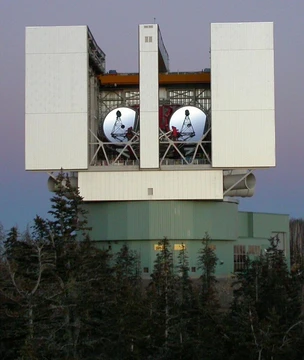
Nordic Optical Telescope
A 2.56-metre telescope in the Canary Islands, active since 1988.

The Nordic Optical Telescope (NOT) sits at the Roque de los Muchachos Observatory on La Palma in the Canary Islands. It first saw light in 1988, was formally inaugurated in September 1989, and began regular observations in 1990. Denmark, Sweden, Norway, Finland, and Iceland (which joined in 1997) fund the telescope. Astronomers from these countries have direct access, while those of other nationalities can apply through international time allocation committees.
The main mirror measures 2.56 metres (101 inches) across. Its blanks, made of Zerodur by Schott Glaswerke in Mainz, Germany, were shaped at the optical laboratory of Tuorla Observatory. Although designed as a passive telescope—its mirror thick enough to hold its shape without active feedback—the mirror sits on a pneumatic support system. This setup, along with the mirror’s flexibility, was intended to allow future installation of an active optics system, then under development for ESO’s New Technology Telescope. Such a system was added to the NOT in 1992.
The telescope operates three instruments, mounted one at a time at the Cassegrain focus. ALFOSC is a CCD camera and spectrograph, the most-used instrument, and includes a polarimetry module for polarimetry and spectropolarimetry. NOTCam is a near-infrared camera and spectrograph. MOSCA is a four-CCD mosaic camera, highly efficient at the blue end of the spectrum. Two additional instruments are permanently mounted in a folded-Cassegrain configuration; retractable folding mirrors allow quick switching from the main instrument to either of them. FIES is a cross-dispersed, high-resolution echelle spectrograph, isolated from thermal and mechanical disturbances, and is the newest addition. StanCam is a one-megapixel CCD camera, less sensitive than ALFOSC and with a smaller field of view, used as a companion for NOTCam (providing optical photometry) or for target-of-opportunity programs when neither ALFOSC nor MOSCA is mounted.
The NOT has hosted several visitor instruments. TURPOL, a UBVRI photopolarimeter, has been at the telescope since its beginning but is not part of the general instrument set. PolCor combines a lucky imager, polarimeter, and coronagraph. LuckyCam is a high-frame-rate, low-noise CCD camera for lucky imaging. SOFIN, a high-resolution CCD spectrograph first used in 1991, served for many years before being decommissioned in 2014.
- Location
- Roque de los Muchachos Observatory, La Palma, Canary Islands
- First light
- 1988
- Inauguration
- September 1989
- Regular observing start
- 1990
- Main mirror diameter
- 2.56 metres (101 in)
- Mirror material
- Zerodur
- Mirror blank manufacturer
- Schott Glaswerke, Mainz, Germany
- Optical forming location
- Tuorla Observatory
Lore & Background
The Nordic Optical Telescope was designed as a passive telescope, with a mirror sufficiently thick to keep its shape without an active feedback loop. However, the mirror was suspended on a pneumatic support system, and the designers planned that this, combined with the mirror's flexibility, would allow for the implementation of an active optics system then under development for ESO's New Technology Telescope. In 1992, such an active optics system was installed at the NOT.
The telescope operates three instruments that can be mounted only one at a time under the Cassegrain focus: ALFOSC (a CCD camera and spectrograph with a polarimetry module), NOTCam (a near infrared camera and spectrograph), and MOSCA (a 4-CCD mosaic camera). Two more instruments are permanently mounted on a folded-Cassegrain configuration, with retractable folding mirrors allowing quick switching: FIES (a cross-dispersed high-resolution echelle spectrograph) and StanCam (a 1 Megapixel CCD camera). The NOT has also hosted visitor instruments including TURPOL, PolCor, LuckyCam, and SOFIN.
Reader's Guide
The Nordic Optical Telescope is notable for its early adoption of active optics, a system installed in 1992 that was under development for ESO's New Technology Telescope. This allowed the telescope to maintain mirror shape despite its original passive design. The telescope's instrumentation suite, including versatile instruments like ALFOSC and the high-resolution FIES spectrograph, has supported a wide range of astronomical observations. The NOT has also hosted visitor instruments such as TURPOL and LuckyCam, and a new instrument, the NOT Transient Explorer (NTE), is under development for permanent mounting at the Cassegrain focus. The telescope's funding by five Nordic countries and its open access through international time allocation committees have made it a collaborative facility for astronomers of many nationalities.
Did You Know?
- The NOT's main mirror is 2.56 metres in diameter and made of Zerodur glass-ceramic.
- The telescope is funded by Denmark, Sweden, Norway, Finland, and (since 1997) Iceland.
More in Optical Telescopes 1-24
Spotted an error? Know more?
Reader corrections go straight into our review queue. Suggest an edit · How this site is sourced