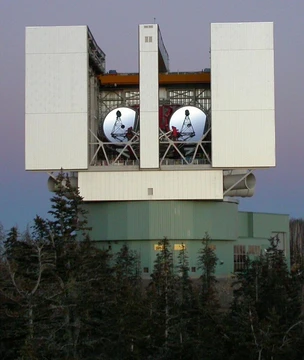
Navy Precision Optical Interferometer
World's largest-baseline optical interferometer, operated by the Naval Research Laboratory.

The Navy Precision Optical Interferometer (NPOI) is an American astronomical instrument run by the Naval Research Laboratory (NRL). It boasts the longest baselines of any such device worldwide. Until the close of 2022, a consortium including NRL, the Naval Observatory Flagstaff Station (NOFS), and Lowell Observatory jointly operated it. The NPOI mainly produces space imagery and astrometry; the latter is critical for the safe positioning and navigation of all types of U.S. Department of Defense vehicles. The facility sits at Lowell’s Anderson Mesa Station, roughly 25 kilometers (16 miles) southeast of Flagstaff, Arizona. Before November 2011, it was called the Navy Prototype Optical Interferometer. It was then temporarily renamed the Navy Optical Interferometer, and later permanently became the Kenneth J. Johnston Navy Precision Optical Interferometer (NPOI)—a name that acknowledges its operational maturity and honors its principal driver and retired founder.
The United States Naval Observatory (USNO) launched the NPOI project in 1987. Lowell Observatory joined the effort the following year, after USNO chose Anderson Mesa as the site. Construction’s first phase wrapped up in 1994, allowing the interferometer to achieve its first fringes—meaning it successfully combined light from multiple sources—that same year. The Navy began regular science operations in 1997, and the instrument has seen continuous upgrades and expansions since. Technical details of how the NPOI works as a classic interferometer are available on Scholarpedia and the NPOI website.
The NPOI is laid out as a three-arm “Y” configuration, with each arm measuring 250 meters (820 feet) long and equally spaced. Two types of stations are available. Astrometric stations, which measure celestial object positions with high accuracy, are fixed units placed 21 meters (69 feet) apart, with one on each arm and one at the center. Imaging stations can be moved to any of nine positions on each arm, and up to six can operate simultaneously during standard observations. Light from either station type first enters a feed system of long, air-evacuated pipes. These pipes lead to a switchyard of mirrors, which direct the light into six Long Delay Lines—another set of evacuated pipes that balance the differing distances to each station.
- Location
- Anderson Mesa, about 25 km southeast of Flagstaff, Arizona, USA
- Arm length
- 250 meters (820 ft) each
- Configuration
- Three-arm 'Y' configuration
- Siderostat mirror diameter
- 50 cm (20 in)
- Pipe diameter
- 12 cm (4.7 in)
- First fringes year
- 1994
- Regular science operations start
- 1997
Lore & Background
The NPOI project was initiated by the United States Naval Observatory (USNO) in 1987. Lowell Observatory joined the following year when USNO decided to build the facility at Anderson Mesa. The first phase of construction was completed in 1994, allowing the interferometer to see its first fringes that year. The Navy began regular science operations in 1997, and the instrument has been continuously upgraded and expanded since then. Until the end of 2022, it was operated by a consortium that included NRL, the Naval Observatory Flagstaff Station (NOFS), and Lowell Observatory. Until November 2011, the facility was known as the Navy Prototype Optical Interferometer; it was temporarily renamed the Navy Optical Interferometer, and now permanently the Kenneth J. Johnston Navy Precision Optical Interferometer, reflecting operational maturity and honoring its principal driver and retired founder.
The NPOI is laid out in a three-arm 'Y' configuration with each arm measuring 250 meters. It uses two types of stations: astrometric stations fixed 21 meters apart, and imaging stations that can be moved to one of nine positions on each arm. Light is directed through evacuated pipes into a switchyard of mirrors, then into Long Delay Lines, then into Fast Delay Lines, and finally to the Beam Combining Table where images are formed. Both station types include a siderostat, a Wide Angle Star Acquisition camera, and a Narrow Angle Tracking mirror. In 2009, NOFS began plans to incorporate four 1.8-meter telescopes into the array, but those plans were shelved. Instead, three PlaneWave CDK1000 (1-meter) telescopes were purchased, with initial installation of two completed in 2020.
Reader's Guide
The NPOI is a Michelson interferometer design that produces synthesized images and fringe data on the fly by taking an inverse Fourier transform of incoming data. It is one of the few major instruments globally capable of optical interferometry. The facility has produced the highest-resolution optical images of any astronomical instrument, though this may change when the CHARA array and Magdalena Ridge Observatory Interferometer begin optical-band operations. The first astronomical object imaged by NPOI was Mizar. NOFS has used NPOI for a wide range of scientific studies beyond absolute astrometry, including binary stars, Be stars, oblate stars, rapidly rotating stars, those with starspots, imaging of stellar disks (the first in history), and flare stars. In 2007–2008, NRL with NOFS used NPOI to obtain first-ever closure phase image precursors of satellites in geostationary orbit. The NPOI is capable of determining positions of celestial objects to a few milli-arcseconds, aided by a complex metrology array of lasers connecting optical elements to bedrock. The NPOI siderostat array and the CHARA Array are the world's only long-baseline optical interferometers that can simultaneously co-phase six elements.
Did You Know?
- The NPOI has the world's largest baselines of any astronomical interferometer.
- The facility was originally called the Navy Prototype Optical Interferometer until November 2011.
More in Optical Telescopes 1-24
Spotted an error? Know more?
Reader corrections go straight into our review queue. Suggest an edit · How this site is sourced