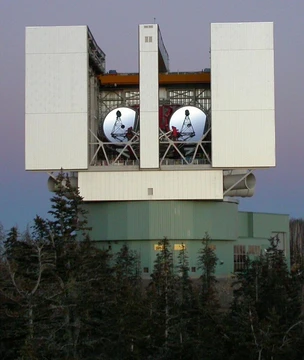
Miniature Exoplanet Radial Velocity Array
A ground-based robotic array for exoplanet discovery via photometry and spectroscopy.

The MINiature Exoplanet Radial Velocity Array (MINERVA) is a robotic observatory on the ground dedicated to finding exoplanets. It sits at the Fred Lawrence Whipple Observatory on Mt. Hopkins in Arizona, run by the U.S. The facility uses several small-aperture robotic telescopes equipped for both photometry and high-resolution Doppler spectroscopy. Jason Eastman, an American astronomer, leads the project, and PlaneWave Instruments built the telescopes.
The main science goal is to detect Earth-like planets with orbits shorter than 50 days around nearby stars, as well as super-Earths (three to fifteen times Earth’s mass) in the habitable zones of the closest Sun-like stars. A secondary goal is to search for transits, or eclipses, of known and newly found extrasolar planets. MINERVA’s design lets it work on both aims at the same time.
The array includes four PlaneWave CDK700 telescopes, each 0.7 meters across, housed in two custom enclosures designed by LCOGT engineers. There is also one MINERVA-Red telescope. The cameras are 2k × 2k back-illuminated CCDs with 15-micrometer pixels, giving a field of view over 20 arcminutes. The spectrograph is a stabilized echelle design with a resolving power of 75,000, using an iodine cell for precise radial velocity measurements. It was built by KiwiStar Optics, part of Callaghan Innovation, a New Zealand government-owned Crown entity. Full photometric science operations started in May 2015 at the Whipple Observatory, and the spectrograph was installed in December 2015.
MINERVA-Red is a separate echelle spectrograph tuned for the deep red part of the spectrum, from 800 to 900 nanometers, where M-dwarfs shine brightest. It works with a robotic 0.7-meter telescope and uses a Fabry-Perot etalon and a uranium/neon lamp for wavelength calibration.
- Location
- U.S. Fred Lawrence Whipple Observatory at Mt. Hopkins, Arizona
- Principal investigator
- Jason Eastman
- Telescopes
- Four PlaneWave CDK700, 0.7m telescopes; one MINERVA-Red telescope
- Cameras
- 2k × 2k back illuminated CCD with 15 μm pixels offering > 20’ f.o.v.
- Spectrograph
- Stabilized, R = 75,000 echelle spectrograph with iodine cell
- Status
- Full photometric science operations began in May 2015; spectrograph installed Dec 2015
Lore & Background
The primary science goal of MINERVA is to discover Earth-like planets in close-in (less than 50-day) orbits around nearby stars, and super-Earths (3-15 times the mass of Earth) in the habitable zones of the closest Sun-like stars. The secondary goal is to look for transits of known and newly discovered extrasolar planets. The unique design of the MINERVA observatory allows the pursuit of both goals simultaneously. The facility uses four PlaneWave CDK700, 0.7m telescopes within two custom telescope enclosures designed by LCOGT engineers, plus one MINERVA-Red telescope. The spectrograph is a stabilized, R = 75,000 echelle spectrograph with an iodine cell for precise radial velocimetry, designed by KiwiStar Optics. Full photometric science operations began in May 2015 at FLWO, and the spectrograph was installed in December 2015.
Reader's Guide
MINERVA is notable for its simultaneous pursuit of exoplanet discovery via both photometric transits and high-resolution Doppler spectroscopy, using a robotic array of small-aperture telescopes. Its design enables the detection of Earth-like planets in short-period orbits and super-Earths in habitable zones of Sun-like stars. The facility's spectrograph, with a resolving power of 75,000 and iodine cell calibration, provides precise radial velocity measurements. The addition of MINERVA-Red, an echelle spectrograph optimized for the deep red (800–900 nm) where M-dwarfs are brightest, extends its capabilities. The observatory's status as a ground-based robotic facility at the Fred Lawrence Whipple Observatory underscores its role in the ongoing search for extrasolar planets, contributing to the broader context of exoplanet survey projects such as HATNet, KELT, NGTS, TrES, and XO.
Did You Know?
- The telescopes were manufactured by PlaneWave Instruments.
- The spectrograph was designed by KiwiStar Optics, a business unit of Callaghan Innovation in New Zealand.
- MINERVA-Red is optimized for the wavelength range 800 nm to 900 nm.
More in Optical Telescopes 1-24
Spotted an error? Know more?
Reader corrections go straight into our review queue. Suggest an edit · How this site is sourced